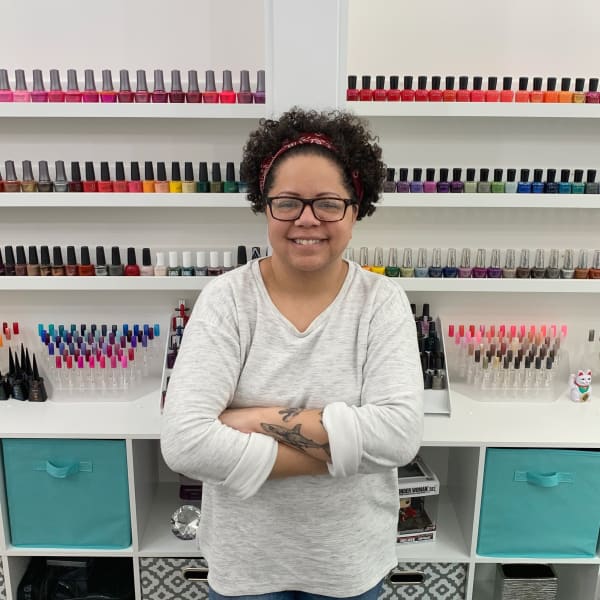
Believe it or not, some techs graduate from nail school and immediately open up their own salon. Most, however, wait to get some experience first. If you’re not ready for salon ownership, you can get to work as either an employee or a booth renter. Read on to learn the differences between these types of techs.
by Staff
June 6, 2011
4 min to read
Which Job Description is Right For You?
A Salon Owner: • Leases or owns the salon property • May hire employees, rent out booths, or work solo • May provide equipment and supplies for employees • Has discretion over salon decor, marketing, hours of operation, retail lines • May provide benefits for employees
An Employee: • Receives a salary and/or commission (plus tips) • Can be required to work certain hours, follow certain procedures, adhere to a dress code • May receive training, performance goals, and evaluations from the salon owner • Has payroll taxes withheld from her paycheck • May receive benefits like vacation and health insurance
Ad Loading...
You might prefer to be an employee if you enjoy the following: Being part of a team; Receiving training and feedback; Relying on a salon owner to help build your business, and Bearing less financial responsibility.
A Booth Renter: • Pays a fee (rent) to lease a space in a salon • Sets her own prices and collects money directly from her clients • Determines her own service offerings • Pays for her own supplies • Pays her own taxes and insurance • Does not receive any benefits
You might prefer to be a booth renter if you enjoy the following: Being your own boss and making decisions independently, Wearing many hats, Having the challenge of building a clientele.
The big question: Will I make more money as a booth renter or an employee? It may seem at first glance that you will earn more as a booth renter — after all isn’t it better to receive 100% of your service fees without someone else taking a cut? But when you calculate the overhead a booth renter faces (she has to pay rent, buy her own supplies, and buy her own insurance), you’ll find the initial numbers are deceiving. Use the worksheets on the right to estimate your true take-home pay as either an employee or a booth renter. Consult a financial advisor for more details and help with your personal situation. (Learn the difference between a booth renter and an independent contractor. Go to www.nailsmag.com/classification.)
WORKSHEET: FOR AN EMPLOYEE
Line 1.
Annual Gross Income
______________
Line 2.
Annual FICA (social security and Medicare taxes) (5.65% of line 1*)
______________
Line 3.
Estimated annual federal and state income tax (15% of line 1**)
______________
Line 4.
Annual cost for tools not provided by employer
______________
Line 5.
Total of lines 2-4
______________
Line 6.
Annual take-home pay (subtract line 5 from line 1)
______________
WORKSHEET: FOR A BOOTH RENTER
Line 1.
Annual Gross Income (gross service and retail income and tips)
______________
Line 2.
Annual space rental
______________
Line 3.
Annual tools, supplies, cost of retail product
______________
Line 4.
Annual phone
______________
Line 5.
Annual liability insurance
______________
Line 6.
Annual Marketing and advertising
______________
Line 7.
Annual misc. expenses (accountant, mileage, bank fees, etc.)
______________
Line 8.
Total of lines 2-7
______________
Line 9.
Adjusted gross income (subtract line 8 from line 1)
______________
Line 10.
Annual SECA (self-employment contributions tax) (13.3%** of line 9)
______________
Line 11.
Estimated annual federal and state tax (15% of line 9*)
______________
Line 12.
Total of lines 10-11
______________
Line 13.
Annual take-home pay (subtract line 12 from line 9)
______________
* This rate applies only to the 2011 tax year. Ordinarily the rate is 7.65% for FICA and 15.3% for SECA.
Ad Loading...
**This is just an estimate. The actual amount will vary depending on your tax bracket.
Resources:
Want more tax info? You can download the following publications from the IRS website at www.irs.gov/formspubs/index.html or call (800) 829-3676.
> Publication 1779, Independent Contractor or Employee Brochure
Powered by the brand’s Suite Relief Program, a North America initiative funds education and trade show access for students across cosmetology, barbering, esthetics, nail technology, and massage therapy.
Looking for a healthy salon job? Watch for these red flags in listings, interviews, and salon culture to avoid a toxic environment and find the right fit.
Our cosmetology schools are at risk as proposed legislation would prevent many of them from participating in student federal loan programs. The American Association of Cosmetology Schools is asking for your help today!
An affordable option for starting your beauty education, this post talks about taking those first steps to launching a successful career in the beauty industry.
Paul DiGrigoli began his four-decade long career, opening his first salon in 1986 in Massachusetts. The DiGrigoli School of Cosmetology has recently added new nails and esthetics programs.
While everyone's experience is unique, here is what it was like for me to take my state board exam, with details on the actual examination experience, from the moment I entered the building.
For those for whom I am just a hazy pre-pandemic memory, allow me to briefly introduce myself and summarize where I left off my story with this blog. And in future installments, I will cover more about practicing for the state board exam and the actual examination experience.
Getting employees to appreciate the importance of THE FUTURE with a 401K plan is the goal of Arik Efros, co-owner of the Eva Scrivo Salon. Efros outlines the importance of this perk and explains why many of the people in their NYC salon have already a nice bundle waiting for them upon retirement.
"That first set of nails I did in the salon sucked but that client still comes back to me, three years later, because of the connection we made that day."
Hear from the winners of these scholarships on how beauty helps them change lives and how it has changed their own.