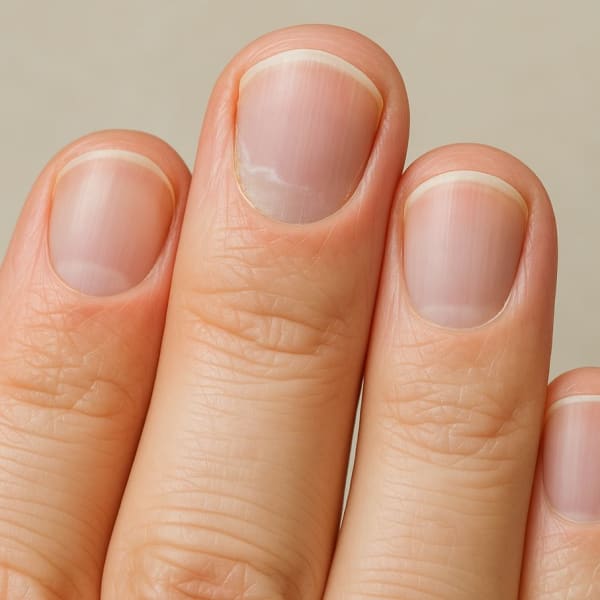
In this month’s column, Dr. Stern talks about some of the conditions that cause the appearance of stripes, bands, and ridges on the nails.
by Dr. Dana Stern
September 16, 2014
Dr. Dana Stern
5 min to read
When you think of an animal with stripes, chances are that zebras will come to mind. It turns out that zebras are not the only ones with stripes. Stripes or bands can actually appear in our nails and have a wide range of causes and clinical presentations. Here are a few interesting clinical scenarios from my practice.
Early-stage malignant melanoma
Consult #1
Ad Loading...
Patient is a 35-year-old female with a history of a black stripe at the left second fingernail that recently changed. The patient reported that the band had become wider. On examination, the stripe was not evenly pigmented and instead appeared to have color variation within. Additionally, the patient had only one out of 20 nails with pigment and had reported a recent change in the stripe. These were all reasons to biopsy this band in order to rule out the possibility of nail melanoma.
Assessment: This patient underwent a nail biopsy and was found to have an early-stage malignant melanoma. In this patient’s case, the cells in her nail were beginning to grow in an uncontrolled manner. Fortunately, nail melanoma is completely curable if caught early. This patient had an early, contained melanoma and was completely cured with surgery.
In contrast, multiple pigmented bands in the nail are common and usually non-worrisome, especially in people with darker complexions. This is because the nail, similar to the skin, has cells called melanocytes that are capable of producing pigment. These cells mostly reside in the half-moon region of the nail (the distal matrix). Therefore, people with a lot of melanocytes in their skin tend to have a higher number of these pigment-producing cells in their nails and will often have multiple benign pigmented bands in the nails. Multiple pigmented bands are usually not worrisome. In contrast, a single pigmented band like this patient’s requires close examination by a physician.
Onychorrhexis (longitudinal ridging)
Consult #2
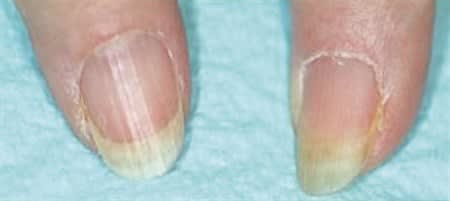
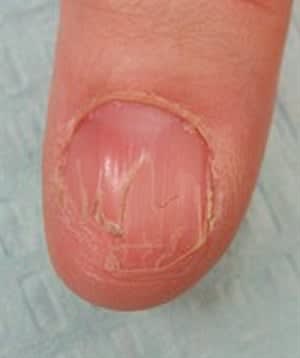
Patient is a 76-year-old female with a history of lengthwise ridges in several nails. She reports that the issue has been chronic for years.
Ad Loading...
Assessment: Onychorrhexis means longitudinal ridging in the nail. These ridges can sometimes be so deep that they appear as stripes, especially when debris lodges within the lengthwise depressions. Onychorrhexis is considered to be a feature of nail brittleness. It is associated with aging and can be challenging to treat, as there is also a genetic predisposition.
Longitudinal erythronychia (pre-biopsy)
Longitudinal erythronychia (six months post biopsy)
Consult #3
Patient is an 85-year-old male with a six-month history of a split at the right thumb nail. He denied pain at the digit but was referred by his dermatologist for a possible biopsy. On examination there was a red longitudinal band proximal to the nail plate split.
Assessment: Longitudinal erythronychia simply means a lengthwise red band or stripe in the nail. There are many causes for this finding and the most common is secondary to a benign growth. Rarely, this finding can be due to a cancer of the nail called a squamous cell carcinoma. We tend to biopsy red bands when there are splits in the nail or the patient has associated pain. In this patient’s case, there was a split and the biopsy result was thankfully benign.
Lichen planus of the nail
Consult #4
Ad Loading...
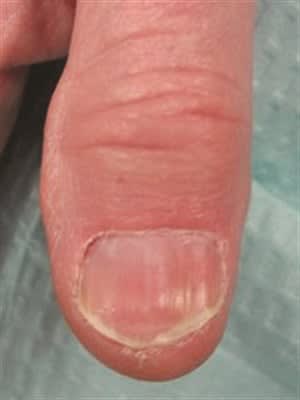
The patient is a 32-year-old male who presented with a four-year history of abnormal fingernails and toenails. He was very embarrassed about the appearance of his nails. On examination, the nails appeared to have longitudinal ridging and the nail plates were significantly thinned.
Assessment: Lichen planus is an inflammatory disorder that can involve the skin, mucous membranes, nails, and/or scalp. It can be very challenging to treat and in aggressive cases can lead to irreversible scarring of the nail. One of the most common presentations of nail lichen planus is ridging. These are longitudinal ridges, similar to onychorrhexis; however, there is usually associated nail plate thinning as well.
Mee’s Lines
Consult #5
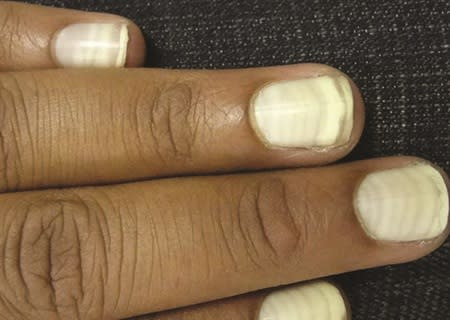
The patient is an 18-year-old male with a history of developing white stripes on the nails. He denied taking any medications or supplements and was otherwise in good health.
Assessment: Mee’s lines are a type of leukonychia (white nail). The white color follows the contour of the lunula (half moon). Arsenic poisoning is the classic cause of Mee’s lines; however, there are also many other potential medical causes including certain vitamin deficiencies and infections. A complete medical work up and extensive blood work is imperative.
Ad Loading...
Beau’s lines
Consult #6
Patient is a 14-year-old male who reported developing dents in several of his nails. He also reported having the flu three months prior to the onset of the nail changes.
Assessment: Beau’s lines are transverse indented furrows from growth arrest of the nail. These nail findings can occur weeks after a stressful event or illness that temporarily interrupts nail growth. The nail can subsequently shed off, but a new, normal, healthy nail will form.
Dr. Dana Stern
Dermatologists treat skin, hair, and nails. I am a board-certified dermatologist and I specialize in the treatment of nail disorders including nail infections, inflammatory diseases of the nail, cosmetic issues related to the nail, cancers of the nail, and sports-related nail injuries.
Most of my consults are from other dermatologists, physicians, or patients who have read about me. I also see patients referred from nail salons. I love the fact that my day is not predictable. I am constantly meeting new patients from all walks of life and I never know what interesting nail case awaits me when I enter the examination room.
Uncured gel polish and microscopic e-file dust contain active acrylates that penetrate the skin, triggering permanent contact dermatitis. Learn the chemistry behind these irritants and how to protect your clients and yourself.
The Good Patch is a leading wearable wellness patch brand, offering wellness and skincare patches that support everyday needs including energy, sleep, relaxation and more.
Orthopedic PT reveals three daily exercises plus ergonomic advice that can help salon professionals avoid the aches and injuries caused by standing, bending and repetitive overhead work.
From acrylic monomers to airborne bio-dust, the air inside a nail salon carries risks most professionals never see coming. Aerovex Systems reveals the source-capture and room-purification strategies that are setting a new standard for salon safety.
Working in beauty doesn’t have to hurt. Learn how Somatic Movement helps hairstylists, lash artists, and other beauty pros release tension, improve posture, and extend their careers.
As a spa or salon professional, your clients expect more than just beauty—they expect safety, hygiene, and peace of mind. Fungal infections like Athlete’s Foot and Nail Fungus are more common than you think, especially in environments where tools and footbaths are reused without proper sanitation. This blog covers how to stop these issues before they start, using proven infection prevention strategies for salons and spas.
A federal initiative aimed at studying chemical exposure in nail salons has ended due to staffing and budget changes. Here’s what the project set out to do—and what its conclusion means for salon professionals.
For many people, a pedicure is a relaxing beauty ritual. But what most don’t realize is that this simple service, if done without proper hygiene and sanitation, can cause serious infections and long-term health issues.
Onycholysis is the separation of the nail plate from the nail bed. While it may look painful, it typically isn’t—at least not at first. But without proper care, this common nail disorder can lead to infections, deformities, and long-term damage.
Mckenzie Kool, Psychologist, MC, RPsych provides us with guidance on what may or not be helpful in speaking with someone who has suffered a significant loss.
Clients come to you to feel their best—not leave with a viral souvenir. Warts and cold sores can spread fast in busy salons, but a few smart habits make all the difference. Let’s talk about what’s really lurking in your salon (and how to kick it to the curb).
As Earth Day approaches, The Green Beauty Community Foundation and the Green Spa Network invite beauty pros to step forward and embrace sustainability through the Green Pledge--a powerful initiative designed by and for beauty industry leaders.
Don’t cancel Valentine’s Day altogether, urges Jill Palmquist. Instead, think of it as a (frilly, flowery, Champagne-bubbly) wake-up call to fall deeply in love with your own life.
Life coach and Culture Ambassador of Sam Villa, Andrew Carruthers, outlines how to tell if your burnout is temporary - or if it's time to make a bigger career change.