A Day in the Life of a Nail Expert: Rare Nail Diseases
In this month’s column, Dr. Stern discusses some of the rare nail diseases she’s seen in her practice, including several types of tumors found under the nail.
by Dana Stern, M.D.
December 19, 2017
Dr. Dana Stern
6 min to read
Most of my consultations come from other dermatologists, physicians, or patients who have read about me. I also see patients referred from nail salons. I love the fact that my day is not predictable. I am constantly meeting new patients from all walks of life and I never know what interesting nail case awaits me when I enter the examination room. Here is a sampling of some rare nail cases that I am excited to share with you.
Consult #1: Squamous Cell Carcinoma
Ad Loading...
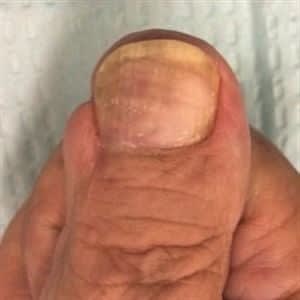
The patient is an 85-year-old man whose chief complaint is an abnormal left thumbnail. The nail had been previously treated as a chronic paronychia (an infection around the nail) for several years. The patient described a leaking of yellow, bloody fluid from under the nail. He reported no pain at the digit. The nail had been removed twice over the past several years. On examination, I noted that the nail was separated on one edge. The underlying nail bed had a beefy red appearance. Given that the underlying nail bed was obscured and that this abnormality had been persistent despite therapy, I recommended a partial nail plate removal (avulsion) to explore the possibility of an underlying tumor. A biopsy showed a well-defined tumor in the nail bed. The tumor was excised and sent to pathology and showed squamous cell carcinoma. Mohs surgery was subsequently performed to remove the tumor and the digit was grafted.
Tumors under the nail are rare in general. Of these tumors, subungual squamous cell carcinoma (SSCC) is the most frequent one. Diagnosis can be challenging because the clinical presentation of squamous cell carcinoma can vary tremendously. Unfortunately, this fact, coupled with a lack of awareness of the disease, is often responsible for an incorrect or delayed diagnosis and subsequent delayed treatment. Usually, subungual squamous cell carcinoma affects a single digit, and the thumb and the great toenail are the most frequently involved. Multiple fingers can be involved, however. The incidence is higher in middle-aged men.
Causes of squamous cell carcinoma include chronic infection, chemical or physical microtrauma, genetic disorders, radiation, tar, arsenic or exposure to minerals, sun exposure, immunosuppression, and previous human papilloma virus (HPV) infection. Genital to digital transmission has been suggested as a likely cause of subungual squamous cell carcinoma, as HPV 16 is the most frequent serotype found in genital warts. In this case, all potential causative factors of subungual squamous cell carcinoma were ruled out.
This case highlights the importance of referral to a physician with nail expertise for any recurrent nail lesions that fail to respond to conservative treatment in order to rule out the possibility of subungual squamous cell carcinoma.
Consult #2: Glomus Tumor
Ad Loading...
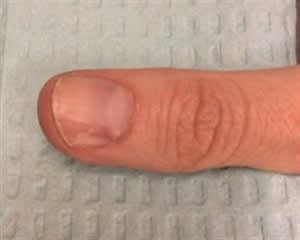
This patient had a benign glomus tumor requiring surgical removal.
This patient is a 32-year-old female who was concerned about discoloration on her left thumbnail. She had had this nail discoloration for one year. The patient described pain in the digit both at rest and with palpation (a light touch) at the nail matrix. Ultrasound imaging showed abnormal tissue in the left thumb. A nail biopsy was performed and a well-defined, encapsulated tumor was removed. Pathology results were consistent with a glomus tumor. Glomus tumors are rare soft tissue benign tumors typically present in adults (ages 20-40 years) as small, blue to red growths on the extremities, with most cases involving the nail. These tumors are typically painful, often causing sudden pain in response to temperature changes or pressure. Treatment is surgical removal.
Consult #3: Melanoma
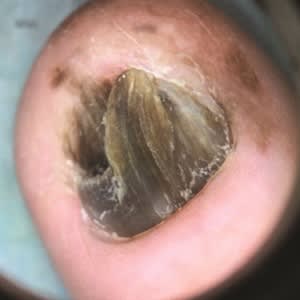
As a result of melanoma, this fingernail turned completely black and the nail plate developed surface bumps and abnormalities.
This patient is a 78-year-old female who came in with nail discoloration on the nail of the left ring finger. A biopsy done in 2014 by another physician showed malignant pigment cells along the nail epithelium [the tissue beneath the nail plate]. The physician recommended removing the tumor at that time; however, the patient did not follow up for the procedure. When I saw her two years later, an examination showed that the fingernail was completely black and the nail plate was dystrophic (the nail had surface bumps and abnormalities). There was brown pigment visible on the skin surrounding the nail and at the tip of the finger.
We discussed the high probability of nail melanoma and a biopsy of the nail was performed that day showing malignant melanoma. Melanoma is a type of cancer that most people tend to associate with the skin. This type of cancer can be extremely dangerous as it can metastasize and spread to other parts of the body. Many don’t realize that melanoma can be found in the nails as well. If caught early, nail melanoma is curable. Unfortunately, melanoma in the nail tends to be diagnosed late.
Melanoma occurs when the pigment-producing cells in the nail (melanocytes) begin to grow in an uncontrolled fashion. Although melanoma in the nail typically appears as a single brown or black pigmented band, pigmented bands are fairly common and usually normal, especially in people with darker complexions. The other causes of single brown-pigmented bands in the nail are often either benign moles or simply the pigment cells “waking up” and producing pigment, much like when a new freckle appears in the skin. Any trauma to the cuticle area — repeated cuticle pushing, cutting, picking, or biting — can also result in stimulation of these pigment-producing cells because the cuticle lies directly over the area where the melanocytes reside.
Ad Loading...
Because early melanomas are very difficult to distinguish from benign pigmented bands, it is imperative to see a dermatologist for a thorough exam and consultation if one appears. People can do self-checks, as well.
Here are some helpful tips and signs to look for:
> Single pigmented band that is brown or black in color on a single nail.
> The band is dark in color.
> There is brown pigment on the surrounding skin (around the nail).
Ad Loading...
> The thumb, index finger, and great toenail are the most common digits to have melanoma.
> Make sure the nails are polish free at yearly skin check appointment with a dermatologist.
Consult #4: Leukonychia
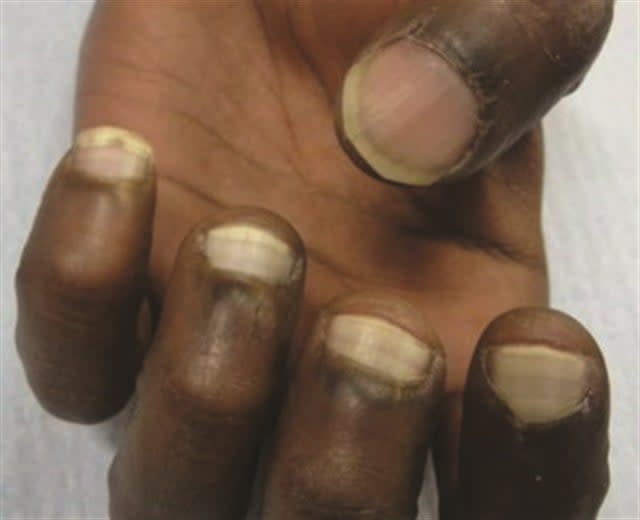
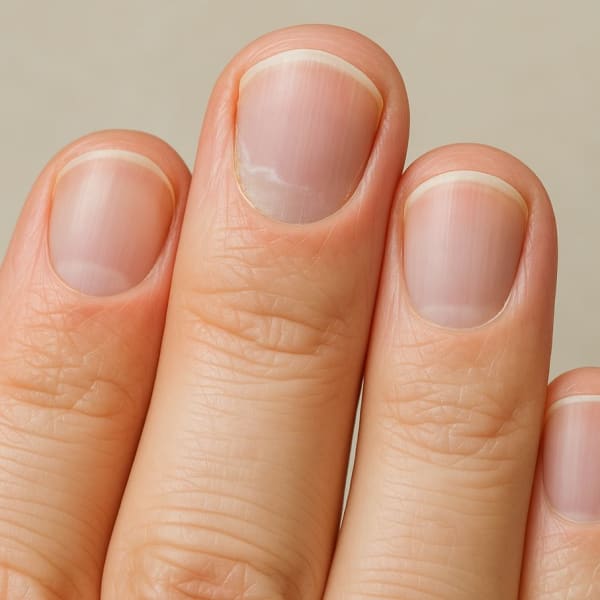
Leukonychia has many possible causes, but one was not determined in this case.
A 34-year-old man from Djibouti presented with a 14-year history of relapsing transverse (side-to-side) white bands on the fingernails, but not on the toenails. An examination revealed several transverse white bands on seven of his fingernails that did not fade upon compression. He had no family history of white nails. All laboratory tests including arsenic levels and nail fungus were negative. When leukonychia (whiteness in the nail) is acquired (meaning the patient is not born with it), possible causes include kidney disease, arsenic poisoning, thallium poisoning, carbon monoxide poisoning, trauma, chemotherapy, heart disease, severe infection, Hodgkin’s lymphoma, leprosy, and malaria. Arsenic-induced Mees’ lines was a preliminary diagnosis for this patient because he had had exposure to a well water drinking supply. (The U.S. EPA reports that ground water supplies have higher levels of arsenic than surface sources and recommends regular testing of well water arsenic levels.) However, the patient had no other symptoms of arsenic intoxication and laboratory levels were all normal. An obvious cause for the leukonychia was not found and it was deemed to be idiopathic (unknown).
Read previous “day in the life” articles by Dr. Stern at www.nailsmag.com/danastern.
Dermatologists treat skin, hair, and nails. I am a board-certified dermatologist and I specialize in the treatment of nail disorders including nail infections, inflammatory diseases of the nail, cosmetic issues related to the nail, cancers of the nail, and sports-related nail injuries.
Uncured gel polish and microscopic e-file dust contain active acrylates that penetrate the skin, triggering permanent contact dermatitis. Learn the chemistry behind these irritants and how to protect your clients and yourself.
The Good Patch is a leading wearable wellness patch brand, offering wellness and skincare patches that support everyday needs including energy, sleep, relaxation and more.
Orthopedic PT reveals three daily exercises plus ergonomic advice that can help salon professionals avoid the aches and injuries caused by standing, bending and repetitive overhead work.
From acrylic monomers to airborne bio-dust, the air inside a nail salon carries risks most professionals never see coming. Aerovex Systems reveals the source-capture and room-purification strategies that are setting a new standard for salon safety.
Working in beauty doesn’t have to hurt. Learn how Somatic Movement helps hairstylists, lash artists, and other beauty pros release tension, improve posture, and extend their careers.
As a spa or salon professional, your clients expect more than just beauty—they expect safety, hygiene, and peace of mind. Fungal infections like Athlete’s Foot and Nail Fungus are more common than you think, especially in environments where tools and footbaths are reused without proper sanitation. This blog covers how to stop these issues before they start, using proven infection prevention strategies for salons and spas.
A federal initiative aimed at studying chemical exposure in nail salons has ended due to staffing and budget changes. Here’s what the project set out to do—and what its conclusion means for salon professionals.
For many people, a pedicure is a relaxing beauty ritual. But what most don’t realize is that this simple service, if done without proper hygiene and sanitation, can cause serious infections and long-term health issues.
Onycholysis is the separation of the nail plate from the nail bed. While it may look painful, it typically isn’t—at least not at first. But without proper care, this common nail disorder can lead to infections, deformities, and long-term damage.
Mckenzie Kool, Psychologist, MC, RPsych provides us with guidance on what may or not be helpful in speaking with someone who has suffered a significant loss.
Clients come to you to feel their best—not leave with a viral souvenir. Warts and cold sores can spread fast in busy salons, but a few smart habits make all the difference. Let’s talk about what’s really lurking in your salon (and how to kick it to the curb).
As Earth Day approaches, The Green Beauty Community Foundation and the Green Spa Network invite beauty pros to step forward and embrace sustainability through the Green Pledge--a powerful initiative designed by and for beauty industry leaders.
Don’t cancel Valentine’s Day altogether, urges Jill Palmquist. Instead, think of it as a (frilly, flowery, Champagne-bubbly) wake-up call to fall deeply in love with your own life.
Life coach and Culture Ambassador of Sam Villa, Andrew Carruthers, outlines how to tell if your burnout is temporary - or if it's time to make a bigger career change.