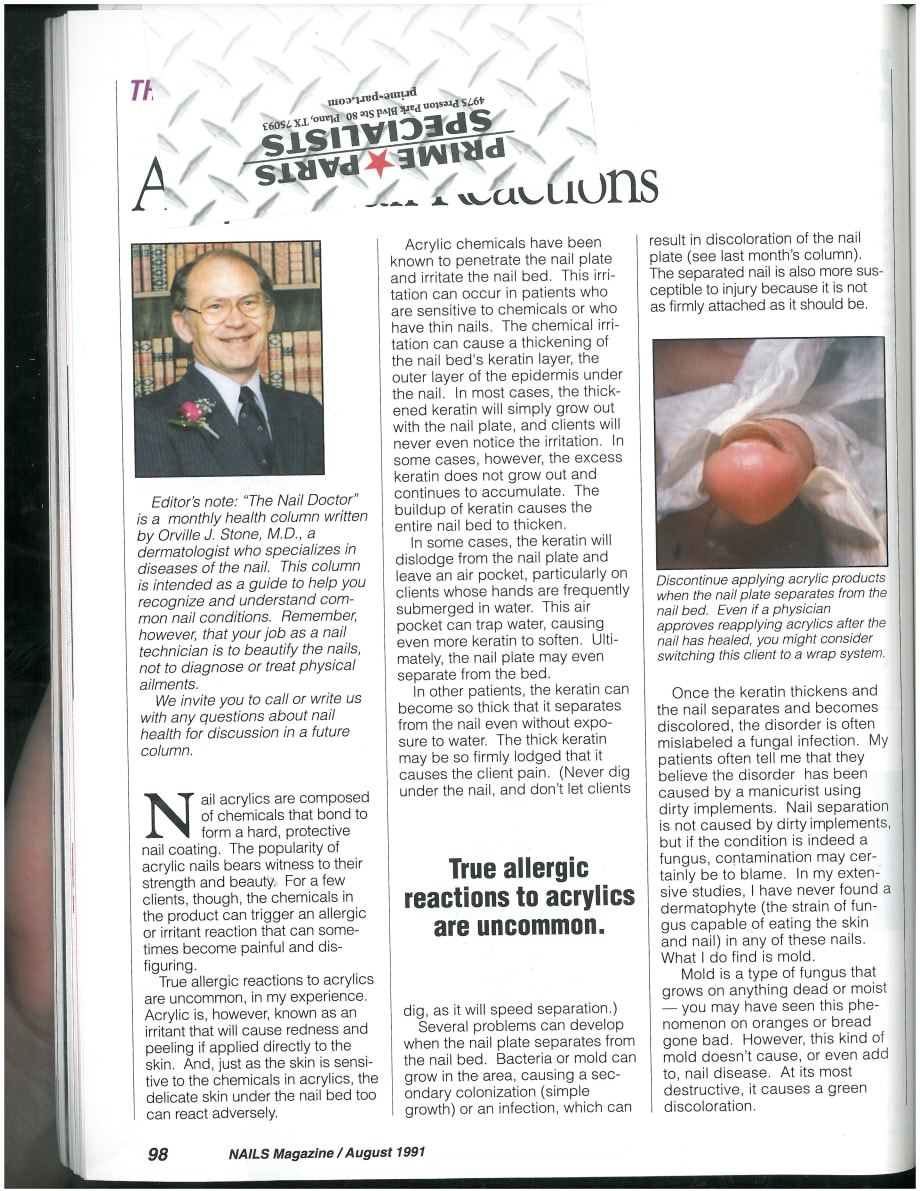
“The Nail Doctor” is a monthly health column written by Orville J. Stone, M.D., a dermatologist who specializes in diseases of the nail. This column is intended as a guide to help you recognize and understand common nail conditions. Remember, however, that your job as a nail technician is to beautify the nails, not to diagnose or treat physical ailments.
by Staff
August 1, 1991
5 min to read
Nail acrylics are composed of chemicals that bond to form a hard, protective nail coating. The popularity of acrylic nail bears witness to their strength and beauty. For a few clients, though, the chemicals in the product can trigger an allergic or irritant reaction that can sometimes become painful and disfiguring.
True allergic reactions to acrylics are uncommon, in my experience. Acrylic is, however, known as an irritant that will cause redness and peeling if applied directly to the skin. And, just as the skin is sensitive to the chemicals in acrylics, the delicate skin under the nail bed too can react adversely.
Ad Loading...
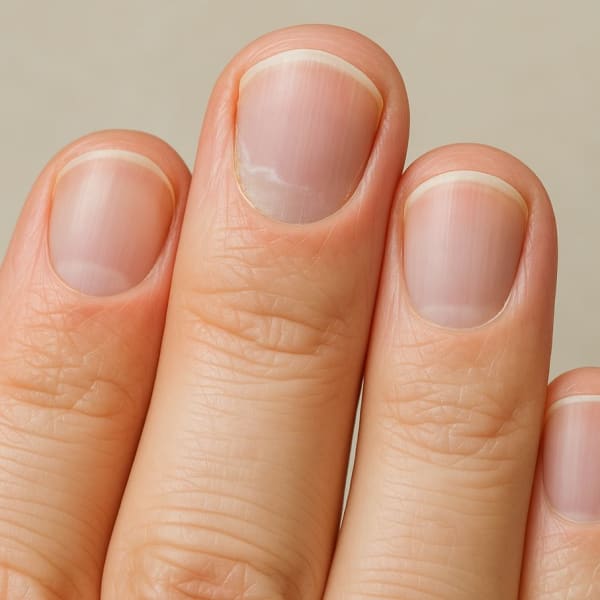
Acrylic chemicals have been known to penetrate the nail plate and irritate the nail bed. This irritation can occur in patients who are sensitive to chemicals or have thin nails. The chemical irritation can cause a thickening of the nail bed’s keratin layer, the outer layer of the epidermis under the nail. In most cases, the thickened keratin will simply grow out with the nail plate, and clients will never even notice the irritation. In some cases, however, the excess keratin does not grow out and continues to accumulate. The build up of keratin causes the entire nail bed to thicken.
In some cases, the keratin will dislodge from the nail plate and leave an air pocket, particularly on clients whose hands are frequently submerged in water. This air pocket can trap water, causing even more keratin to soften. Ultimately, the nail plate may even separate from the bed.
In other patients, the keratin can become so thick that it separates from the nail even without exposure to water. The thick keratin may be so firmly lodged that it causes the client pain. (Never dig under the nail, and don’t let clients dig, as it will speed separation.)
Several problems can develop when the nail plate separates from the nail bed. Bacteria or mold can grow in the area, causing a secondary colonization (simple growth) or an infection, which can result in discoloration of the nail plate (see last month’s column). The separated nail is also more susceptible to injury because it is not as firmly attached as it should be.
Once the keratin thickens and nail separates and becomes discolored, the disorder is often mislabelled a fungal infection. My patients often tell me that they believe the disorder has been caused by a manicurist using dirty implements. Nail separation is not caused by dirty implements, but if the condition is indeed a fungus, contamination may certainly be to blame. In my extensive studies, I have never found a dermatophyte (the strain of fungus capable of eating the skin and nail) in any of these nails. What I do find is mold.
Ad Loading...
Mold is a type of fungus that grows on anything dead or moist---you may have seen this phenomenon on oranges or bread gone bad. However, this kind of mold doesn’t cause, or even add to, nail disease. At its most destructive, it causes a green discoloration.
Still, patients, cosmetologists, and even some doctors cling to thje idea that this green invader ia a fungal infection. A general physician’s knowledge of nails is limited and he may accept the diagnosis of fungus and treat it. But the great majority of dermatologists, to whom you should refer this client, will recognize that this is not a fungal problem.
There are medications to treat the keratin buildup and its complications, but the patient’s participation in her own treatment is essential. I usually tell a patient with keratin buildup not to dig under the nail as that will only make the air pocket bigger. She should also avoid prolonged wetness and bandages on her hands.
In the salon, care for the client with significant nail separation should begin with removing the offending product from the affected nails until a doctor approves reapplication. You can suggest the client apply an over-the-counter cortisone spray ---hold close to the underside of the nail and spray into the separation---until she can see her doctor. There is no need for antifungal medications. You should keep the client’s nails trimmed to minimize trauma. Cover the defective nail polish (no acrylics) until it heals.
There are cases when I will allow a patient with keratin buildup to continue having acrylic applied, even on the affected nail, unless there are more serious nail problems, such as bacterial infection or excessive separation .
Ad Loading...
In those cases, my treatment is an application of a potent cortisone spray under the nail via a plastic tube. This treatment has an anti-inflammatory effect.
Obviously, the medication I use is a prescription treatment. The type of cortisone available over the counter is much weaker and will not have the same effect.
Occasionally, if I feel bacteria are present, I use an alcohol-based antibiotic, such as Cleocin T solution (used in acne therapy). It dries the infected site and wards off secondary infections. Polysporin spray is an over-the-counter antibacterial treatment that has a similar effect.
The fastest, most clear-cut treatment when the nail separates from the bed is to cut away all the separated nail plate. However, because women are so conscious of the unsightliness of a partially missing nail, I rarely suggest this unless there is a significant medical complication. Once the patient is made to understand the potential seriousness of her condition, she will usually be patient with medication therapy.
I hate to sound like a traitor to my profession, but the average cosmetologist who uses an over-the-counter cortisone spray and Polysporin spray will achieve superior results to the physicians who fall for the fungus myth and treat the reaction as a fungal infection. However, if inflammation or infection set in, refer the client to a doctor immediately. Only a doctor can accurately recognize and prescribe the right treatment for bacterial infections.
Ad Loading...
Infections should be referred to a physician, especially since the public is so sensitive about fungal infections that they believe have been caused by bad nail services.
Have the client ask the doctor what services you can perform, and observe the client closely in the future for other reactions. If she can no longer wear acrylics, explore other service options.
Uncured gel polish and microscopic e-file dust contain active acrylates that penetrate the skin, triggering permanent contact dermatitis. Learn the chemistry behind these irritants and how to protect your clients and yourself.
The Good Patch is a leading wearable wellness patch brand, offering wellness and skincare patches that support everyday needs including energy, sleep, relaxation and more.
Orthopedic PT reveals three daily exercises plus ergonomic advice that can help salon professionals avoid the aches and injuries caused by standing, bending and repetitive overhead work.
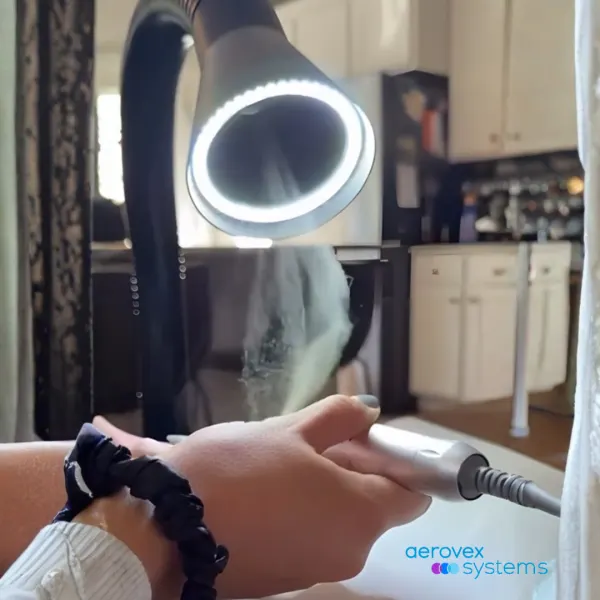
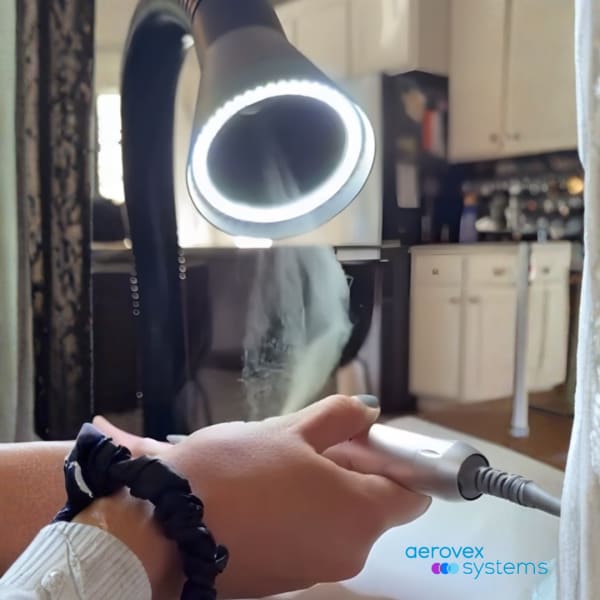
From acrylic monomers to airborne bio-dust, the air inside a nail salon carries risks most professionals never see coming. Aerovex Systems reveals the source-capture and room-purification strategies that are setting a new standard for salon safety.
Working in beauty doesn’t have to hurt. Learn how Somatic Movement helps hairstylists, lash artists, and other beauty pros release tension, improve posture, and extend their careers.
As a spa or salon professional, your clients expect more than just beauty—they expect safety, hygiene, and peace of mind. Fungal infections like Athlete’s Foot and Nail Fungus are more common than you think, especially in environments where tools and footbaths are reused without proper sanitation. This blog covers how to stop these issues before they start, using proven infection prevention strategies for salons and spas.
A federal initiative aimed at studying chemical exposure in nail salons has ended due to staffing and budget changes. Here’s what the project set out to do—and what its conclusion means for salon professionals.
For many people, a pedicure is a relaxing beauty ritual. But what most don’t realize is that this simple service, if done without proper hygiene and sanitation, can cause serious infections and long-term health issues.
Onycholysis is the separation of the nail plate from the nail bed. While it may look painful, it typically isn’t—at least not at first. But without proper care, this common nail disorder can lead to infections, deformities, and long-term damage.
Mckenzie Kool, Psychologist, MC, RPsych provides us with guidance on what may or not be helpful in speaking with someone who has suffered a significant loss.
Clients come to you to feel their best—not leave with a viral souvenir. Warts and cold sores can spread fast in busy salons, but a few smart habits make all the difference. Let’s talk about what’s really lurking in your salon (and how to kick it to the curb).
As Earth Day approaches, The Green Beauty Community Foundation and the Green Spa Network invite beauty pros to step forward and embrace sustainability through the Green Pledge--a powerful initiative designed by and for beauty industry leaders.
Don’t cancel Valentine’s Day altogether, urges Jill Palmquist. Instead, think of it as a (frilly, flowery, Champagne-bubbly) wake-up call to fall deeply in love with your own life.
Life coach and Culture Ambassador of Sam Villa, Andrew Carruthers, outlines how to tell if your burnout is temporary - or if it's time to make a bigger career change.