The only way wearing acrylics could have contributed to the damage is by rough manicuring.
by Staff
February 16, 1993
Dr. Stone
5 min to read
Dr. Stone
Q: I wore acrylics for about four years before removing them a year and a half ago. It took four months for my nails to grow out and return to normal. All but one nail is now strong and healthy.
The bad nail ( on my ring finger) is split vertically and there is a ridge where it splits. The nail grows slower on one side of the split than the other---it never grows straight and I have to keep filing one side down. The nail is also still very weak. My nails were healthy and strong before I started using acrylics. Could my nails have been damaged by the acrylics or by the filing? Is this permanent or is there something I can do to bring it back to normal?
Ad Loading...
A: The split is caused by injury to the matrix. The acrylics are not applied to the important growth area of the matrix, so it is not the acrylic itself that caused the problem. The only way wearing acrylics could have contributed to the damage is by rough manicuring (for example, heavy filing or vigorous manipulation of the cuticle, etc.). Some women are overly rough on their nails because the acrylic overlay rough on their nails because the acrylic overlay makes them ideal tools.
In general, wearing acrylics doesn’t injure the matrix. Since the damage is to the nail matrix, the split cannot be corrected. The thinness and weakness are probably due to damage to the matrix as well.
You are doing a good job of observing and describing nail plate dynamics. One can only guess at the cause of one side growing faster than the other, but I suspect a decreased blood supply to the matrix that is caused by many minor injuries to the nail bed over time.
Much can be learned by observing the direction the ridge is growing in. The nail usually curves toward the slow growing side. I sometimes inject a cortisone-type suspension into the base of the split nail to reduce scaring and help the nail return to normal. Or, sometimes I’ll use a cortisone injection to slow the fast growth side of a nail. This won’t correct the damage, but it might help even the rate of growth.
Q: Can you recommend any books on nail diseases and disorders that are written in language easily understood by nail technicians?
Ad Loading...
A: While there are a few medical texts that discuss nail diseases and disorders, they are written for physicians and use complex medical terms and descriptions. I don’t know of any books that would be useful for nail technicians. However, if you saved every issue of The Nail Doctor column you would probably have almost everything you need to know about nail health.
Q: I have been wearing acrylic nails for two years and now both thumbnails and one index finger have separated from the nail bed. I went to my dermatologist and he prescribed Betamethosone and gave me the impression they would grow out. The medication was for an infection, but I don’t think that’s what I have. What do you recommend? All my other nails are fine.
A: Betamethosone is topical cortisone medication that suppresses inflammation and irritation. It has no effect on infections. You most likely have an irritant reaction to chemicals that have penetrated the nail plate. Unfortunately, the Betamethosone cannot get to the area just proximal to the separation, where it would be most effective. Keep your hands out of water, avoid bandaging, and consider removing the acrylic and covering the nail with polish until it re-grows. Do not dig at the area.
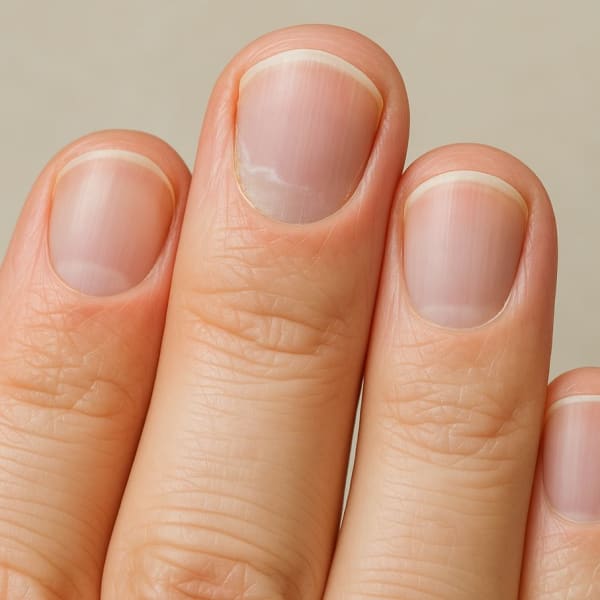
Q: This is a photo of a client’s nails. What is this deformity and what is it caused by?
A: This is a classic example of a habit tic deformity of the nails. It is caused by repeated stroking of or picking at the thumbnail, usually with the index finger. This is a tension-relieving habit that often the person is not even aware of.
Ad Loading...
Usually, the person starts at the base of the thumbnail and strokes toward the tip of the finger. Note the thickening of the central cuticle in this picture. Sometimes the thickened area of the cuticle itches, initiating the stroking response.
The same deformity can also be produced just by picking at the posterior cuticle. The repeated trauma over the nail stimulates the blood supply and causes an irregular growth rate, which makes the nail grow out wavy.
This is a common nail change. In this case, it is not yet permanent and the nail will grow out normally if the stroking is stopped. This is one case where applying acrylics may help speed healing by decreasing the friction that disrupts the blood supply and causes the nail to grow out wavy.
Q: I recently soaked off my acrylic nails to apply a new set. I noticed two of my nails had separated from the nail bed. The separation has now spread to five other fingers. There is no green stain or crumbling. I have been treating it as a fungus with medication and have seen no improvement. Is onycholysis always a fungus? Is it contagious? Can I cover it with tips and acrylics?
A: There are two types of onycholysis. In one type, the nail separates from the nail bed for no apparent reason. This form of onycholysis is separate from acrylic reactions. The other type of onycholysis is much more common and is secondary to some other event, like chemical irritation or injury to the nail bed. Neither form of onycholysis is caused by fungus (see “Debunking the Fungus Myth,” April 1992). The phenomenon that occurs under acrylics is not contagious.
Ad Loading...
The patient who has a separation is sensitive to further irritation. She is more prone to other nail changes, depending on the thickness of the natural nail and factors such as further trauma and exposure to wetness.
One nail can separate first, and even if you remove the acrylics other nails may separate because the chemical irritation already has occurred.
Do not bandage a nail that is separated because that creates the ideal environment for a secondary
Uncured gel polish and microscopic e-file dust contain active acrylates that penetrate the skin, triggering permanent contact dermatitis. Learn the chemistry behind these irritants and how to protect your clients and yourself.
The Good Patch is a leading wearable wellness patch brand, offering wellness and skincare patches that support everyday needs including energy, sleep, relaxation and more.
Orthopedic PT reveals three daily exercises plus ergonomic advice that can help salon professionals avoid the aches and injuries caused by standing, bending and repetitive overhead work.
From acrylic monomers to airborne bio-dust, the air inside a nail salon carries risks most professionals never see coming. Aerovex Systems reveals the source-capture and room-purification strategies that are setting a new standard for salon safety.
Working in beauty doesn’t have to hurt. Learn how Somatic Movement helps hairstylists, lash artists, and other beauty pros release tension, improve posture, and extend their careers.
As a spa or salon professional, your clients expect more than just beauty—they expect safety, hygiene, and peace of mind. Fungal infections like Athlete’s Foot and Nail Fungus are more common than you think, especially in environments where tools and footbaths are reused without proper sanitation. This blog covers how to stop these issues before they start, using proven infection prevention strategies for salons and spas.
A federal initiative aimed at studying chemical exposure in nail salons has ended due to staffing and budget changes. Here’s what the project set out to do—and what its conclusion means for salon professionals.
For many people, a pedicure is a relaxing beauty ritual. But what most don’t realize is that this simple service, if done without proper hygiene and sanitation, can cause serious infections and long-term health issues.
Onycholysis is the separation of the nail plate from the nail bed. While it may look painful, it typically isn’t—at least not at first. But without proper care, this common nail disorder can lead to infections, deformities, and long-term damage.
Mckenzie Kool, Psychologist, MC, RPsych provides us with guidance on what may or not be helpful in speaking with someone who has suffered a significant loss.
Clients come to you to feel their best—not leave with a viral souvenir. Warts and cold sores can spread fast in busy salons, but a few smart habits make all the difference. Let’s talk about what’s really lurking in your salon (and how to kick it to the curb).
As Earth Day approaches, The Green Beauty Community Foundation and the Green Spa Network invite beauty pros to step forward and embrace sustainability through the Green Pledge--a powerful initiative designed by and for beauty industry leaders.
Don’t cancel Valentine’s Day altogether, urges Jill Palmquist. Instead, think of it as a (frilly, flowery, Champagne-bubbly) wake-up call to fall deeply in love with your own life.
Life coach and Culture Ambassador of Sam Villa, Andrew Carruthers, outlines how to tell if your burnout is temporary - or if it's time to make a bigger career change.