As nail techs, we’re often asked about the dangers of the smells in the salon — but it’s not the smells that should cause us concern. Learn the facts on air purification, and then take steps to protect yourself and your clients.
“If you smelled a gas leak in your house, you wouldn’t want an air purifier to get rid of the smell, you would want to get rid of the gas,” says Doug Schoon, chief scientific advisor for CND. In the same way, techs can go crazy trying to get the smell of nail products out of the air, but that’s not the right way of looking at the problem. You need to ventilate the vapors and the dust, and in doing so, you’ll take care of the smell. Even though the dangers of the salon are well under OSHA’s guidelines, “there is still a need for proper ventilation,” says Schoon.
But what is proper ventilation? Neutralized, purified, oxidized — we hear lots of words used to describe what needs to be done to “clean” the salon’s odiferous air. At the same time, we hear about the dangers of breathing dust for 10 hours a day. Don’t listen to fear-mongers. “It’s easy to work in a salon safely,” says Schoon. Think of protecting yourself and your clients as a three-tier approach. Working from the broadest area in, techs should be concerned first about the building, next about their salon space, and finally about their breathing zone.
Your Building
Ad Loading...
A building’s ventilation system, whether in a strip mall or a stand-alone structure, is called the HVAC system. It stands for Heating, Ventilating, and Air Conditioning. This is your first line of attack. The HVAC system brings fresh air to the salon and pushes it from one room to another. This system needs to be professionally maintained by a specialist. The specialist will change the filters, and properly balance and clean the system every year. An HVAC system removes mold, mildew, dust, etc., providing relatively fresh air to a building.
Your Salon
“If you walk into your salon in the morning and it smells, you have a problem,” says Schoon. The vapors emitted by nail products should be out of the air within 10 minutes, so there should be no smell of nail products in your salon when you arrive in the morning. This probably shocks a number of us, because for years, we’ve smelled acrylic the minute we open the doors. You have probably even thought if this was bad for me, they would regulate a system to take the smell away. Somehow there’s a part of us that thinks someone else is going to take care of us. “The reality is, we need to be progressive about our own health,” says Jeff Cardarella, president of Modern Solutions in Madison, Wis. “We might think we’re protected by regulations, but the regulations are outdated and meaningless.” His first recommendation: tear up the carpet. “Carpeting in a salon is not a good idea.” says Cardarella. “It’s an odor and a dust trap, and it doesn’t belong in a salon.”
Next, invest in an air purification system. Techs may have heard that the best ventilation systems vent to the outside. Schoon agrees — get the vapors and dust out of the salon. However, venting to the outside may not be possible. Even if it’s possible, it may not be practical. Ventilating to the outside could blow all your warm or cold air outside, says Cardarella. But if we don’t vent to the outside, how do we clean the air in the salon?
You need a professional system that can handle what you’re putting into the air. Don’t buy one designed for the home or office, advises Schoon. An appropriate ventilation system will contain a material that absorbs the vapors created by nail products. This is important. Some products claim to neutralize the smell, and since the smell is gone, we think we’ve taken care of the problem. “This doesn’t get rid of the chemicals in the air,” says Schoon. The system won’t simply neutralize the smell; it will remove the vapors from the air. Generally speaking, a whole-salon air purification system circulates salon air through the unit and material inside the system acts as a sponge, absorbing chemical vapors. The absorbant filters in these types of salon systems will need to be changed regularly, every three to four months, as they get saturated with salon chemicals. Each unit on the market will have different specs, so techs should ask questions about how effective the unit will be for a salon of their size with their number of techs (or stylists, etc.). Multiple units may be needed in larger salons. Units are mobile and should be positioned in the center of the salon, never in a corner. “Purifying the salon air is important,” says Cardarella, “but we also want to prevent the vapors from even getting into the air.”
Your Breathing Zone
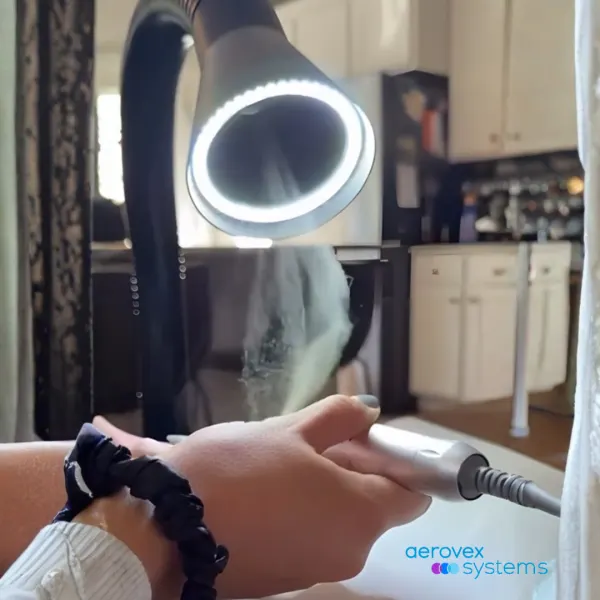
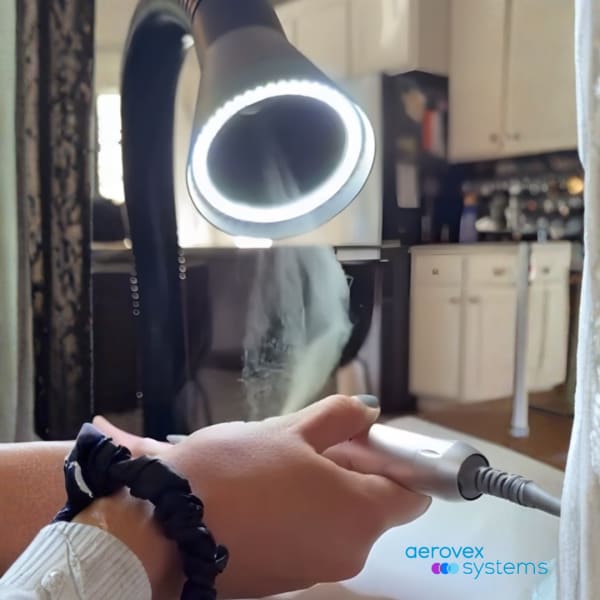
The easiest and most efficient way to prevent vapors and dust from getting into the salon is to supply each nail desk with a source-capture system. A source-capture system protects the “breathing zone” of the tech — the two-foot radius in front of the mouth. “Every breath we take comes from the breathing zone,” says Schoon. “We want to keep that area clean.” And if that area is clean — if the vapors and dust are captured immediately — then they don’t make it past the desk and into the salon. If anything does get past the source-capture system, it would be absorbed by the whole-salon unit.
Ad Loading...
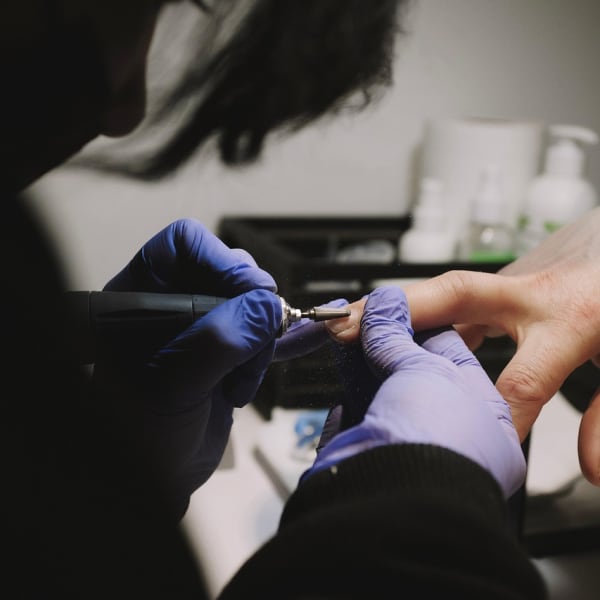
A number of source-capture systems are available on the market, but they all do essentially the same thing: They immediately capture (suck) the dust and vapors that are created when techs prep, apply, and file enhancements, and then they absorb and contain the vapors, dust, and debris. As with the larger, whole-salon ventilator, the absorbent material needs to be changed regularly as it becomes saturated with salon chemicals.
While source-capture systems are all meant to accomplish the same thing, the quality of them dramatically differs. “These are not magic boxes,” says Schoon. He recommends techs choose a unit with a four-inch bed of absorbent material that the air has to pass through. “It needs to be a hefty, thick bed,” says Schoon. “Tables with a bed of material that you can see through are useless.”
Together, “source-capture and purification systems minimize what becomes part of the air,” says Cardarella. Techs will benefit in two ways. First, they will breathe clean air — which makes for happier lungs and reduces headaches, fatigue, and dry, irritated eyes. Second, they will never have to be concerned about the smell of the salon.
Where to Shop: These companies provide ventilation and air purification systems.
Uncured gel polish and microscopic e-file dust contain active acrylates that penetrate the skin, triggering permanent contact dermatitis. Learn the chemistry behind these irritants and how to protect your clients and yourself.
The Good Patch is a leading wearable wellness patch brand, offering wellness and skincare patches that support everyday needs including energy, sleep, relaxation and more.
Orthopedic PT reveals three daily exercises plus ergonomic advice that can help salon professionals avoid the aches and injuries caused by standing, bending and repetitive overhead work.
From acrylic monomers to airborne bio-dust, the air inside a nail salon carries risks most professionals never see coming. Aerovex Systems reveals the source-capture and room-purification strategies that are setting a new standard for salon safety.
Working in beauty doesn’t have to hurt. Learn how Somatic Movement helps hairstylists, lash artists, and other beauty pros release tension, improve posture, and extend their careers.
As a spa or salon professional, your clients expect more than just beauty—they expect safety, hygiene, and peace of mind. Fungal infections like Athlete’s Foot and Nail Fungus are more common than you think, especially in environments where tools and footbaths are reused without proper sanitation. This blog covers how to stop these issues before they start, using proven infection prevention strategies for salons and spas.
A federal initiative aimed at studying chemical exposure in nail salons has ended due to staffing and budget changes. Here’s what the project set out to do—and what its conclusion means for salon professionals.
For many people, a pedicure is a relaxing beauty ritual. But what most don’t realize is that this simple service, if done without proper hygiene and sanitation, can cause serious infections and long-term health issues.
Onycholysis is the separation of the nail plate from the nail bed. While it may look painful, it typically isn’t—at least not at first. But without proper care, this common nail disorder can lead to infections, deformities, and long-term damage.
Mckenzie Kool, Psychologist, MC, RPsych provides us with guidance on what may or not be helpful in speaking with someone who has suffered a significant loss.
Clients come to you to feel their best—not leave with a viral souvenir. Warts and cold sores can spread fast in busy salons, but a few smart habits make all the difference. Let’s talk about what’s really lurking in your salon (and how to kick it to the curb).
As Earth Day approaches, The Green Beauty Community Foundation and the Green Spa Network invite beauty pros to step forward and embrace sustainability through the Green Pledge--a powerful initiative designed by and for beauty industry leaders.
Don’t cancel Valentine’s Day altogether, urges Jill Palmquist. Instead, think of it as a (frilly, flowery, Champagne-bubbly) wake-up call to fall deeply in love with your own life.
Life coach and Culture Ambassador of Sam Villa, Andrew Carruthers, outlines how to tell if your burnout is temporary - or if it's time to make a bigger career change.