Files. Do you reuse them or throw them away after every client? Do you keep each Ghent’s files in a labeled paper bag or do you rely on them to bring m their own files for every appointment? Every nail technician has her own system, depending on how much attention she pays to salon sanitation and the money and time she feels she can afford to spend. Sanitizable files are probably the most expensive on the market, but they offer something that no other file can: a surface that can be made relatively contaminant-free to use on more than one client.
Super Files
For years, files were made with paper or cloth abrasives that were attached to a wooden core and were not designed to withstand exposure to water. In the late 1980s, companies started producing files made from plastic and water-resistant adhesives that could stand up to repeated washing and soakings Geoff Geils, president of Flowery Beauty Products, Inc. (Greenwich, Conn.), remembers one quiet Saturday in about 1992 when he had a Mylar-backed abrasive and a jar of disinfectant. “I dipped the file in the disinfectant and noticed that it didn’t retain any moisture,” he says “I thought it could be marketed as a comb or a brush.” Instead he came out with Purifiles, washable, sanitizable files that last for up to 10 services. Mylar, a type of plastic film, is the material of choice for many brands of sanitizable files; it’s sturdy and nonporous. “It’s tough, so when you immerse it, the file remains intact while the acrylic debris m the file becomes soft and falls away from the frit,” says Stuart Schwartz, sales manager for Worldwide Cosmetics (N. Hollywood, Calif.). Worldwide makes four different kinds of sanitizable files in a variety of grit combinations, color cores, and block-shaped files.
A combination of disposable and non-disposable materials was used when Backscratchers Salon Systems (Sacramento, Calif.) came out with Septifiles last year. “Basically you have a sturdy plastic handle that is sanitizable,” explains Sue Hubbard, director of marketing. “Only the less-expensive grits are being removed and disposed of after each use “By keeping the handle (which is the most expensive part of a file) dean, the grits are new every time, yet the overall cost of the file is still reasonable. The life of your sanitizable file depends largely on how you use it, says Larry Feldman, vice president of sales and marketing for Relays/Tropical Shine (Huntington Beach, Calif.). “Some nail technicians go through a file in one day, while others can make one last a week or even a month,” he says. “It depends on the type of application you’re doing and how hard you are on the file.” For the most part, he continues, Mylar files are sturdy and built to last through many uses if they are well-made in the first place.
The cost of a sanitizable file runs anywhere from 80¢-$1.30. A typical non-sanitizable file costs anywhere from 30¢-40¢ each. If a nail technician uses her $1.30 sanitizable file five times, each use will cost her 26¢, slightly less than the price of a disposable file. Of course, the savings can easily be higher or lower, depending on the price and longevity of the files she chooses.
Wash Carefully
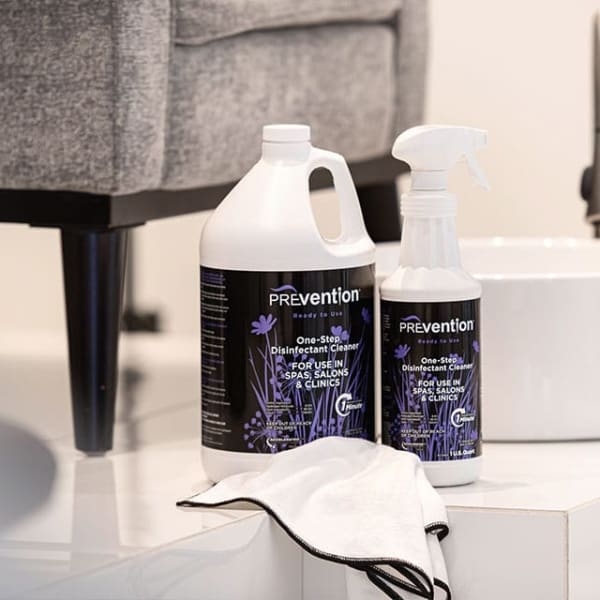
Sanitizing files works essentially like sanitizing any non-disposable implement: You wash the file first with soap and water, then use a scrub brush with firm plastic bristles to extract as much debris as possible. Then, immerse the file in a disinfectant solution for the amount of time recommended by the disinfectant manufacturer (usually anywhere from 10-20 minutes), remove, rinse, and allow to dry on a paper or cloth towel. Store clean files in a dry, clean, covered container or in a clean drawer.
Sanitizing files is a quick procedure, says Ben King, president of King Research Inc. (Brooklyn, N. Y.). “Ten minutes is all it takes; some nail technicians simply leave a set of files soaking, since they usually have more than one set of files,” he says. His disinfection solution, called Barbicide, has been used to disinfect combs and hair scissors for 50 years. It is a hospital-grade, EPA-registered multiple quat solution which is an acceptable sanitation product in many states. King Research also offers Barbicide Plus, which is a phenolic solution (an acidic compound that is used as a disinfectant when diluted). Most phenolic solutions are tuberculocidal, but they are harsher on implements (especially plastic) than necessary, and many industry experts feel this level of disinfection is not necessary in the salon environment.
Many state boards require that any implement that is not sanitizable must be disposed of after one use. This is where it gets confusing. “Are files sanitizable? Yes,” states Gerri Cevetillo, group manager of Ultronics (Mahwah, N. J.). “Can they be completely disinfected? No. Disinfected means you’re killing viruses as well as bacteria. Viruses are many times smaller than bacteria; since the surface of a file is porous, you cannot guarantee you’re killing viruses unless it is a metal file.” In addition, any time a nail technician accidentally cuts a client and draws blood, the file should be thrown away immediately, sanitizable or not. “Viruses are transmitted through blood and body fluids rather than dead skin,” Cevetillo explains. Ultronics makes a dual-phase quat disinfectant that kills 62 organisms and will not damage sanitizable files.
State boards such as California, Iowa, New York, and New Jersey have specifically prohibited emery boards from being reused on another client regardless of whether they are sanitizable (Oregon does allow files and other disposable items to be used again on the same client provided they are kept in a clean, sealed container). New York, however, is currently reviewing a proposal to allow sanitizable files (see sidebar “Filing for Change in New York” on page 58;. According to Geils, Oregon has decided to allow sanitizable files; Arizona, California, Maryland, and a few other states may follow suit. “The Oregon Board said Purifiles can be used as long as the brand name ‘Purifile’ was imprinted permanently on the handle so that state inspectors could identify them immediately,” Geils explains. Many of the states implemented rules on emery boards well before sanitizable files ever existed, so nail technicians and manufacturers alike are pushing for change. To do so, they are trying to work with the state boards to show them that other options are available.
“We’ve talked to some California State Board inspectors, and they want to see disinfection systems on every nail station,” says Christina Jahn, marketing director for Star Nail Products (Valencia, Calif.). “Whether that’s practical or not is another question.” Star Nail carries both a dual quat disinfection solution for implements and files, as well as its Client Guard Implement Pak. (Client Guard is a package of individual clients’ basic tools, such as a cuticle pusher, files, and scrub brush, that can be used again and again on the same client.) “This method has really caught on now that state boards are cracking down on sanitation enforcement and so many news stories have come out on dirty salons,” Jahn continues.
Keeping files for individual clients at least will assure that there is no cross-contamination between clients. However, the kits must be kept dry and clean, and any sanitizable implement should still be sanitized. Also, says Cevetillo, clients should not be allowed to take their kits home with them because the implements might be contaminated from others in the household using them. Some industry experts fee the possibility for contamination ii client kits is too great to make them an acceptable sanitation method.
Sanitation in the salon is a never ending task, and it is rarely foolproof. But the effort must be made not only to be in compliance with your stat board rules, but also to be doing everything within your power to keep you salon a clean, organized place that clients feel comfortable returning to you again and again.
Filing for Change in New York
If there is anything she prides herself on, Marina Sullivan would say sanitation. So when the owner of The Polished Touch in Binghampton, N.Y.; was told by an inspector she must get rid of her sanitizable files, Sullivan was shocked. “I had trained all my girls and was really strict with the rules,” Sullivan says “When I asked the inspector why sanitizable files weren’t allowed in New York, he said no one had ever questioned the rule before.”
So Sullivan started asking questions. She called Geoff Geils of Flowery Beauty Products and asked him if he had ever tried to get the law changed in New York. Geils had tried once, without success, but said it was time to try again. He and Jay Dinga, an Assemblyman in Sullivan’s district, presented information to the board in Albany on sanitizable files; Geils mentioned that other states have decided to accept them as a method of sanitation. Meanwhile, Sullivan gathered signatures on a petition from clients and nail technicians. The board sent the proposal to the New York Department of Health for review. At press time no one knew whether or not the health department would approve the amendment.
If the amendment does not pass, Sullivan will continue to fight for it by attending board meetings and petitioning for change.”It’s the best system I can think of for my clients,” she says. “I’m the professional; I should be the one taking the necessary steps of keeping everything sanitary.”