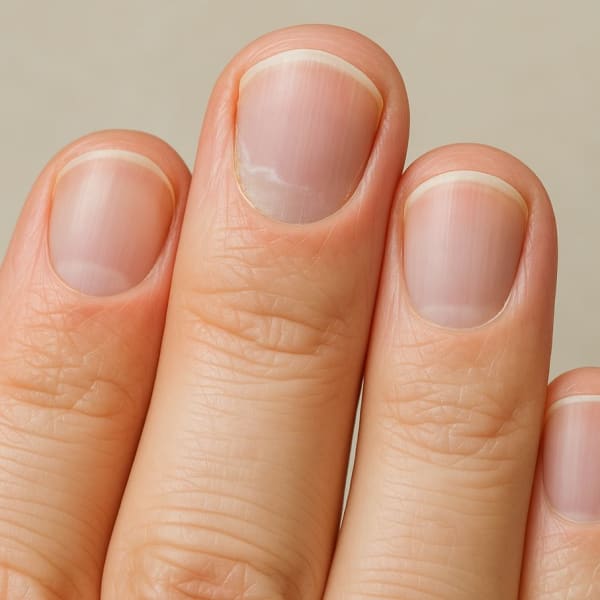
Unless you’re Courtney Love and you’re making a social statement, discolored nails are quite unattractive. Yellow nails – whether natural or extension – don’t have to happen.
You can eliminate grungy – looking nails from your salon by preventing the problem. Natural nails in an otherwise healthy client shouldn’t be discolored, although the free edge naturally has a slight yellowish tint, explains Richard K. Scherer, M.D., in his book Nails: Therapy, Diagnosis, Surgery. The portion of the nail plate over the nail bed is transparent (that’s why you can see the nail bed through it).
There are some nail conditions such as yellow-nail syndrome, many fungal and bacterial infections and some prescription medications that can cause the nails to become discolored. The solution in this article probably won’t whiten these nails, because the discoloration originates in the matrix or in the nail bed – two places these techniques won’t reach. In other words, the stains are on the inside of the nail, and these solutions are for stains that come from the outside.
Substances such as tobacco, dyes, dark nail polish, or polish on the nail a long time can stain the nail plate. “Unhealthy, dry nail plates tend to pick up color because they’re more porous,” says Harriet Rose, CEO of Forsythe Cosmetic Group (Lawrence, N.Y.). When a staining agent has worked its way into the nail, lightly buffing the nail might remove it, says Rose, but she doesn’t recommend heavy buffing. “Filing off too much of the nail plate might weaken it and make it susceptible to more damage,” she says.
Scott Hanrahan, senior chemist at Forsythe, adds that nail technicians need to be careful even when using a high-quality base coat. “A lot more staining actually occurs when polish is removed than when it is applied. Each time the technician dips the cotton ball back into the remover, it becomes more pigmented by dissolved nail polish. As she continues to remove the polish, the highly pigmented liquid is then rubbed into the nail plate, where it is easily absorbed,” he explains.
The best way to deal with stained nail plates is to prevent them from becoming stained in the first place. “Always use a good base coat,” Rose recommends. Hanrahan says than an opaque base coat made with tale, silica, titanium oxide, or zinc oxide provides a barrier on the nail plate, dealing it off from any thing that might stain it.
There are some products on the market designed to remove stains. Gena Labs has a product called Nail Brite.
Hanrahan says that a 10% solution of household bleach and water will help. Be sure to use extra moisturizer and good cuticle oil afterwards, because bleach is harsh on skin. (Remember, this is a last resort solution because of bleach’s harshness). Bleach will dry out nails even more, causing them to be even more, causing them to be even more prone to staining. If you have a couple weeks’ notice before your client wants her nails pearly white, switch her to light-colored polishes to keep from staining the nails further, says Rose.
Great White Nails
The only thing uglier than yellow nails is yellow nail extensions. But just like with natural nails, prevention is in the preparation.
Beware of the mistakes that can ruin a beautiful set of nails. Most of the acrylic lines with advanced technology are formulated with UV inhibitors in them, says Angie Tullis, sales manager for The Nail Authority at Peel’s Friendly Beauty Supply (Hutchinson, Kan.). “When you go with a quality acrylic line, you’ll also find that you’ll have less yellowing. Systems without UV stabilizers are prone to discoloration, as are batches of product that have frozen while being shipped,” Tullis explains. She also maintains that primer on older acrylic (that is still on the nail when performing a fill service) and odd monomer remaining on the brush when applying acrylic can contaminate your product and discolor the nails.
Careful handling of your tool and product will help prevent product contamination that can cause yellowed extensions. When you clean your brush, lay it on its side or store it with the bristles down. Tullis says that many nail technicians stand their brush on its end with the bristles up. “Unless the brush is completely clean, dirty monomer can drip back into the bristle,” she says, Debra Shoaff, owner of the Nail and Hair Gallery in Wampum, Pa., says that if primer gets on the old acrylic during a fill, a yellow line of demarcation can develop. “Be careful when you prime during a fill and apply it only to the nail plate,” she says.
It’s extremely important to cover the powder and liquid during your service so filings and dust don’t fall into them and contaminate the product. Tullis recommends that you empty your clap pen dish and clean it out by simply wiping it with a paper towel after every service and clean the dish with acetone. I’ve seen some nail technicians’ dirty clap pen dishes, and they have little islands of hardened acrylic in the bottom. That will definitely contaminate your acrylic and yellow your client’s nails,” she says.
Just like natural nail clients, artificial nail clients need good base coats before polish. An extra precaution for your permanent French manicure clients is to use a UV top coat. This is a good idea for clients who tan as well.
Don’t file out a discolored nail if the product was contaminated, Tullis says, “Usually, yellowed acrylic is also brittle. If you just grind it down and apply a fresh overlay of good product, you are going to have a week nail that you can’t guarantee, so soak off the nails and start over,” she says.
Making nails whiter is a commitment you need to make by changing your techniques a little and helping your clients keep their natural nails healthy so there are no cracks or dry spots for dark polishes to stain. Then when your clients come back for fills or manicures, their nails will be as white and bright as the day you first did their nails.