The majority of the problems seen by a podiatrist are directly related to improper mechanical function of the bones, joints, and muscles of the foot during walking and standing.
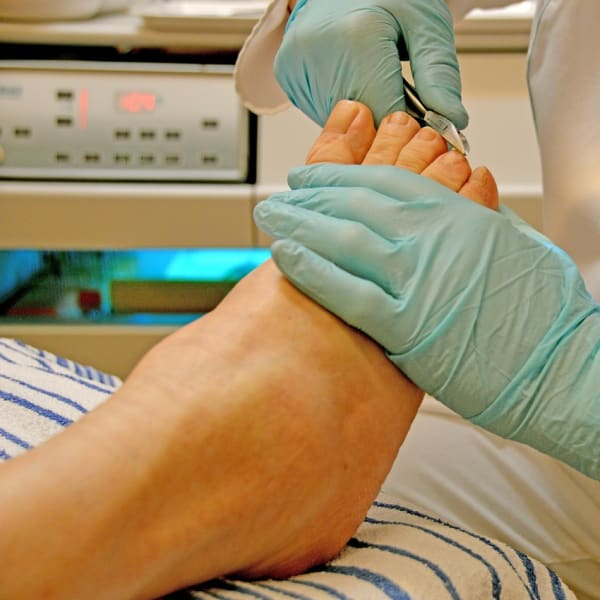
I am a firm believer that some patient visits to the podiatrist can be avoided by more visits to the pedicurist. Routine foot maintenance is more cost-effective when handled by the nail professional. I refer many patients to the pedicurist, which allows me to spend my time on the medical needs of my patients. This column will be written to help nail technicians provide improved foot care service by better understanding the feet from a podiatrist's point of view.
The human foot is a dynamic organ It must support us, as well as help to move us from one point to another. It is composed of 26 bones and 56 ligaments that hold the bones together. The pressure on the bottom of the foot during walking is tremendous — more than 25,000 pounds per square inch! If the bones and joints are not in proper alignment when we are walking, that type of pressure can cause a little discomfort to become major pain. The majority of the problems seen by a podiatrist are directly related to improper mechanical function of the bones, joints, and muscles of the foot during walking and standing. Let's explore the three most common foot problems the nail professional will see while giving a pedicure — corns, calluses, and warts — and when these conditions should be referred to a podiatrist.
A corn is a callus on a toe, and a callus is the buildup of dead skin on any other part of the foot. Corns and calluses are deposits of dead skin that form on the skin's surface in response to pressure or friction. This is the way the body protects itself from injury. If the corns and calluses didn't develop, the sensitive skin would blister or break down totally into an open sore or ulcer. A callus can continue to build up, and what at first was a protection soon becomes an irritation. There is usually one area of the corn or callus that is deeper than the surrounding areas. This is not a root! It is the area that has endured the most pressure. It therefore builds the most callus. And since it is under pres sure from the shoe or body weight, the callus is pressed back deep into the skin.
CALLUSES
Callus buildup on the heel of the foot is a mechanical problem. It is caused by friction and pressure on the skin around the heel area. It seems to build up more on those who wear open-heeled shoes or sandals. It can be an unsightly but not necessarily painful condition.
In most cases, heel calluses can be reduced easily with a foot file or abrasive stone. These can be controlled if the client uses a moisturizer or hydrating cream regularly on her heels to keep them soft and pliable between pedicures. In some instances a client will develop large amounts of callus tissue around the heel; the tissue can crack and become painful. A foot file will not do the job on this! The cracking can extend into the underlying good skin, which compounds the problem and makes the condition more painful and more prone to infection. A referral to a podiatrist should be considered when a client has badly cracked or painful heel callus buildup. The podiatrist will reduce the callus to the good tissue level and treat the open wounds. Once healed, the patient can be referred back to the salon for routine pedicures. For severe cases of heel calluses, I often recommend to my patients a product composed of a petroleum base with aloe vera, essential oils, vitamin E, and natural fragrances. Other products with similar properties can be adequate for your clients' dry, cracked heels. Plain moisturizers do not work as well on severe cases of heel calluses.
Calluses on the bottom of the foot are also caused by pressure or friction. Pressure calluses are usually located under one of the metatarsal heads (the bone the toe attaches to) and are round, well demarcated areas of callus that have a deep central core. They are quite painful to walk on when there is a large amount of callus present. Friction calluses are thinner and cover a larger area, and their edges are not well demarcated. Burning is the usual symptom of a friction callus.
Calluses on the plantar surface (bottom) of the foot can be safely reduced with the foot file or abrasive stone. When you can't give your client adequate comfort with your normal professional service, a referral is a smart move. The podiatrist is trained to trim the "core" (deep portion) out of the pressure callus, which will give immediate relief from pain. Depending on the cause of the pressure, the podiatrist will then recommend either a surgical or accommodative treatment to relieve the problem permanently. Friction calluses and pressure calluses can also be treated by having the patient use orthotics. An orthotic is a custom-made device made to a cast of the patient's foot. It must be prescribed by a doctor and it differs from an arch support in that it allows for the normal motion of the foot to take place during walking, but stops the abnormal motion that causes the callus.
SOFT CORNS
Have you ever looked between the fourth and fifth toes and seen a white, spongy-looking area of skin buildup? You were probably looking at what is called a soft corn, or heloma molle. This condition can also occur between other toes, but it is most common between the fourth and fifth. The client will usually tell you it is painful. The soft corn is caused by pressure of the toe bones (called phalanges) against one another, with the skin being caught between. The skin does form a callus, but because of the perspiration between the toes the callus becomes soft and spongy and turns white. This condition can easily become infected because there are large amounts of bacteria between the toes.
Because of their propensity for infection, soft corns should be referred to the podiatrist for care. Depending on the depth and location of these corns, there are some rather simple surgical procedures that can cure this problem. Your clients will be pleased that you were able to recognize the condition and refer them to someone who could relieve their discomfort on a permanent basis.
HARD CORNS
A corn on the top or side of the toe is usually yellow in colour. These are called hard corns or heloma dura. If the com has been present for many years, it may have little blood vessels (capillaries) extending up into the callus that look like small black dots. The toe is usually contracted (hammered) or will have a bony bump (spur) on it over which the corn forms due to pressure of the shoe. Sometimes on a contracted toe you will see a corn on the end of the toe. This is caused from pressure on the tip of the toe when the person is walking.
Hard corns can be safely reduced with the foot file if one is careful not to break the viable skin around the corn. If what you are able to remove doesn't relieve your client’s discomfort, then a podiatric referral is proper. If the corn is caused from a hammer toe, the podiatrist can surgically straighten the toe so that it will not rub on the shoe. If the corn is on the end of the toe, a simple tenotomy (cutting) of the tendon that is tight and causing the toe to contract can be performed. This will, in most cases, correct the condition with minimal discomfort and disability. This procedure is also referred to in the literature as a phalangeal set.
WARTS
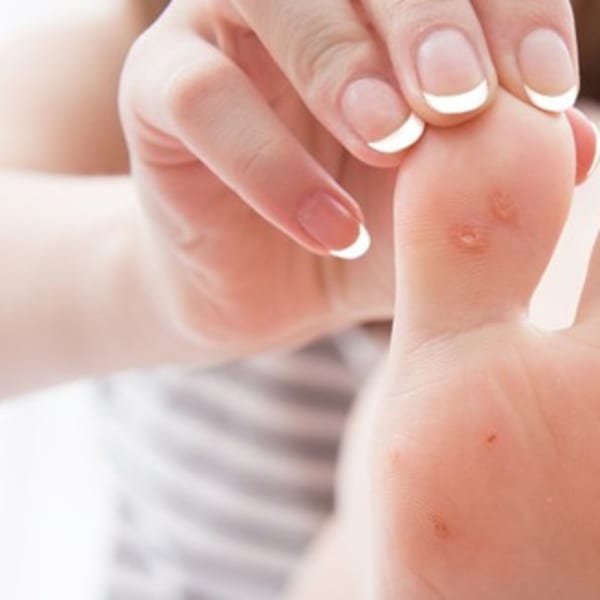
Warts are hard to differentiate from calluses when they are on the bottom surface of the foot. Warts, also known as papilloma or verruca, are a true skin tumor caused by the papilloma virus.
Warts generally look like a small cauliflower on the surface of the skin. A wart on the bottom of the foot is the same as a wart anywhere on the body. It looks different because the pressure during walking causes a great deal of callus to form over the top of it. Sometimes small black dots can be seen in the lesion. These are the end of the capillaries, of which the wart has many (a callus can also have capillaries). When a wart is first starting to form, many people will see these capillaries and think they have stepped on something and try unsuccessfully to remove them with a needle. There are a number of over-the-counter medications for warts that sometimes work Usually, however, it takes stronger medication to cure a plantar wart.
If you are filing what you believe to be a callus and it starts to bleed, you may be working on a wart. It is best to discontinue your treatment and apply a disinfectant and a bandage. A referral to the podiatrist for medical treatment of the wart will be greatly appreciated by your client.
THINK SMART
When giving your clients a pedicure, be sure to look closely at the areas where there is callus formation. If you think about how the foot is functioning during walking and when wearing shoes, it will be easier for you to determine why the corn or callus is there in the first place (that is, whether it's caused by friction or pressure). You may then be able to counsel your client in a more knowledgeable manner about what may be causing her condition. In some states it is legal for the nail professional to trim the callus with a knife-like pedicure instrument. With proper training and a lot of practice, this can be a safe procedure, but it is my recommendation that the pedicurist use only the professional foot files and abrasive stones to reduce the callus tissue. If you are unable to give your client sufficient relief with gentle filing, a referral to the podiatrist should be considered. The podiatrist will be able to treat the condition by medical or surgical measures and in many cases can relieve them on a permanent basis.
In this age of cost-consciousness about medical care, the relationship between the podiatrist and nail professional is an important alliance. As insurance companies and government-sponsored health care services become more and more cost-conscious, these payers will only be paying for services which are medically necessary. The nail professional therefore must be trained to recognize potential medical conditions in their clients.
We have only touched the surface of this discussion; it is now up to you. You need to develop a referral relationship with a podiatrist in your area. If you do not know one personally, you can ask your clients for recommendations, contact the local Podiatric Medical Society, or ask your personal physician who he or she refers patients to for foot care. Call, introduce yourself, and ask to talk to the podiatrist either in the office or at a lunch. Discuss your desire to learn more about the foot and its care. Develop a professional relationship. Working together with mutual respect will only result in healthier, happier patients and clients.
I look forward to your questions about foot health and any suggestions you have for future columns. I am here to assist you, the nail professional, in providing your clients with quality services.