We don’t know anyone who enjoys a visit from the state inspector, but we’ve learned it’s often not as bad as we imagined. These techs tell their survival stories.
“I really didn’t survive,” says Lourdes Castillo, owner of Lourdes Nail Studio in Sarasota, Fla. “When I worked in Houston, people called around and warned each other. Here, I didn’t get any warning, and he just showed up.”
The problem was that on that day, one of her dogs was at the vet, and she didn’t want to leave the other one home alone. She knew her dog would be fine in the salon. It would sit on the pedicure chair all day, as content as could be. So, Castillo brought her dog to work. When the inspector walked in, Castillo kicked the chair of her client and said, “It’s your dog.”
Ad Loading...
The inspector went through each checkpoint: license, proper signage, pedicure logs. He finally turned to Castillo.
“He asked whose dog was sitting in the pedicure chair,” says Castillo. “At the same time I said ‘hers’ and pointed at my client, one of my staff answered ‘Lourdes’.’ I got a $50 ticket right there.”
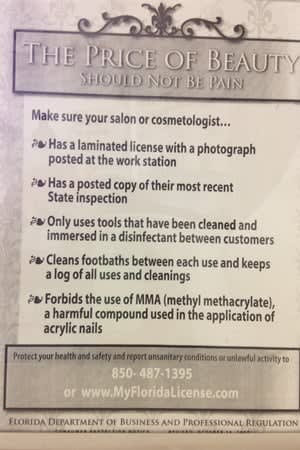
This poster in Castillo’s nail studio lets clients know what to look for in salons.
It wasn’t the first time Castillo had been fined. Working as an independent contractor in Texas, she was fined $500 for an expired license. Actually, both she and the salon where she worked were fined $500. “But the salon wouldn’t pay the fine,” explains Castillo. “So that cost me $1,000.” When she moved to Florida, she was working in a salon with a current license — from the State of Texas. “That day, the inspector walked in, saw I had a license from Texas and not Florida, and made me stop working right then,” says Castillo. “That cost me another $1,000.”
Today, Castillo makes sure all her paperwork is in order and the dogs stay out of the salon. “The last time the inspector came in, he told me I was doing too much work, and he gave me a form that was much simpler than the one I had.”
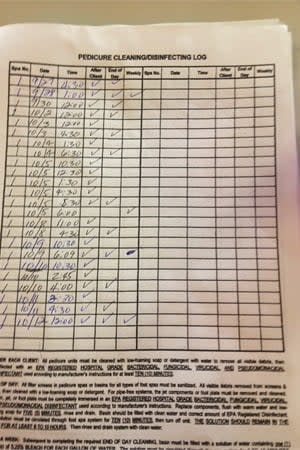
Castillo is required to display her license, the most recent inspection, plus a list of safety cautions that clients should look for in any salon. She must also keep a log of each time she performs a pedicure and check the box that says the pedicure chair has been cleaned. The state requires her to wash the pedicure bowl, plus disinfect for 10 minutes. “I let the disinfectant soak while I walk my client to the front desk to pay. I make her next appointment, and then right there at the register, add that cleaning to the log.” Castillo says the last time the inspector came in, he told her in many salons he visits he finds charts that are filled out weeks in advance of the current date.
Ad Loading...
Castillo fills out the pedicure cleaning log after each client.
Despite following the letter of the law now, Castillo still cringes when she sees the inspector. “They are rude. They interrupt. They don’t care about a client. I have to stop what I’m doing to walk them around and show them what they need to see,” she says. Clients don’t like it either, she notes. It makes them uncomfortable to see an inspector walk in, and it changes the relaxing part of their appointment. “Even though I know I have everything in order,” says Castillo. “I still think his visit ruins the day.”
Laura Merzetti, owner of Scratch My Back Nail Studio in Ajax, Ontario, Canada, thinks differently. “Home-based businesses like mine aren’t licensed or regulated in Ontario, so many of them fly under the radar and go without an inspection,” she says. “I see the inspection as a way to set myself apart, so I welcome them.”
One reason for the difference in perspective, however, is how the inspection is handled. “It’s always a scheduled visit, because I have a home-based business,” says Merzetti. “They usually call me about a month or so before the anniversary of the last inspection and we set up a mutually agreeable time.” (Salons in commercial buildings do get surprise visits, as in the United States.)
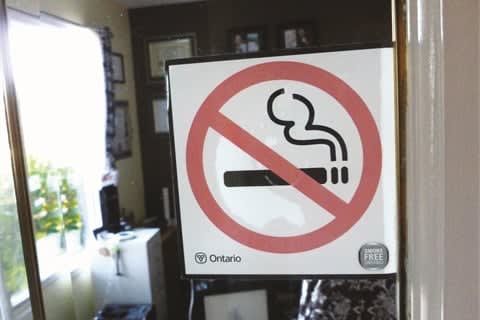
“No-smoking signage on the door to my salon is required by law as this is a workplace,” says Merzetti.
While Merzetti sounds like she’s got it easy compared to her nail sisters here in the States, the stakes are much higher for violations. Nail professionals in the province of Ontario are governed by one set of rules, but in addition to that, each municipality within Ontario has a public health department that issues their own set of guidelines. In addition to that, a public health inspector can issue orders to a particular nail tech. “This places the operator and salon under a lot of scrutiny,” says Merzetti. An inspector could keep returning to the same salon until the tech complies with the orders. “If she fails to comply, she could be charged with ‘Failure to Comply with an Order of a Public Health Inspector,’” Merzetti explains. “At that point, she would go before a judge. If the judge finds her guilty, she could face a fine of $5,000 per day for every day she was non-compliant.” Further, she could be placed on probation for two years, which results in a criminal record.
Despite layers of regulation, Merzetti has never been cited. “In fact, the first time the inspector arrived it was for a preliminary hearing to show me what was required,” says Merzetti. “She planned to leave documentation with me and come back in a week for the actual inspection, but I was comfortable with her doing the inspection right then, so she did. It turns out I was 100% compliant.”
Ad Loading...
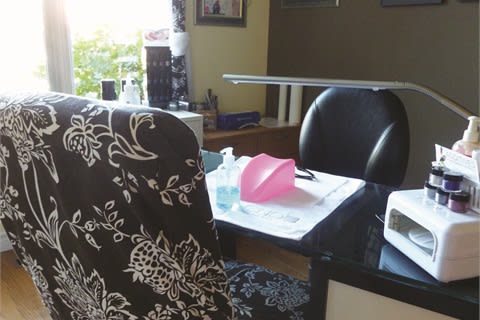
At her desk, Merzetti has hand sanitizer for clients (clients wash hands first, then use hand sanitizer before every service), a sanitizable hand rest, a clean towel, and a disposable table towel.
That’s not to say the requirements are easy to meet. Merzetti explains what might be involved in a visit from the inspector: “The inspectors check my desk area; sometimes they even go through my drawers. They check my bathroom for paper towels and liquid hand soap for hand-washing. They look at the area where I keep my disinfectant tray and check to make sure my disinfectants have a valid expiration date on the container and my generic containers are labeled. They want to see my calendar to see the dates when I changed the disinfectant and to confirm I have plenty of single-use items, such as toe separators, nail files, buffer blocks, and table towels. They test me by asking questions such as how I would handle accidental exposure to blood. They check to make sure my no-smoking sign is posted. I use a Footsie Bath foot bath and a vinyl-backed pedicure chair for my pedicures, so I have to show them my stock of disposable liners so they know I’m not reusing them. Finally, they ask what I use to clean the table and chair surfaces.” They’re thorough, but nothing they ask is a surprise.
Regardless of how the inspector shows up — as a surprise or during a scheduled appointment — the visit doesn’t need to cause anxiety. Though the drop-in may be inconvenient, because it takes your time and your attention away from the client, the visit can go smoothly if a system is in place long before the inspector arrives.
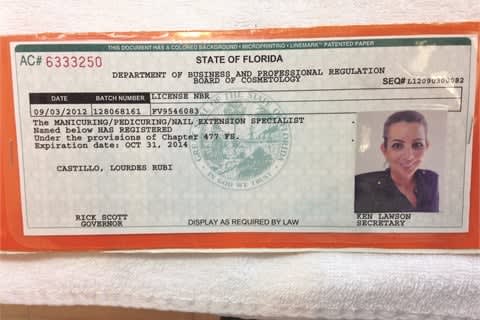
A valid license must be displayed. This is Castillo’s.
Set up an area of the salon where all the required documents can be displayed in an attractive way. Have a binder of past inspections, old and current licenses, and completed sheets of pedicure logs. Label all your products and containers. Organize your supplies. All the preparation will ease your anxiety and make a visit from the inspector a seamless interaction instead of a dramatic saga of survival.
> Pedicure Cleaning Log (in English and Vietnamese)
> State-by-State Guide to Disinfection Regulations
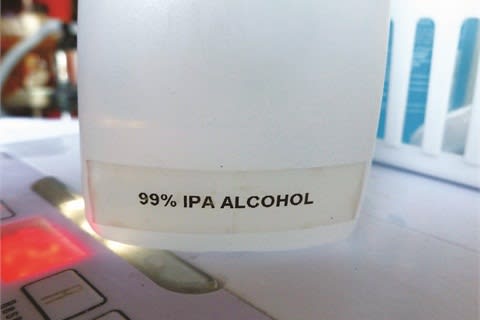
Generic containers must be labeled.
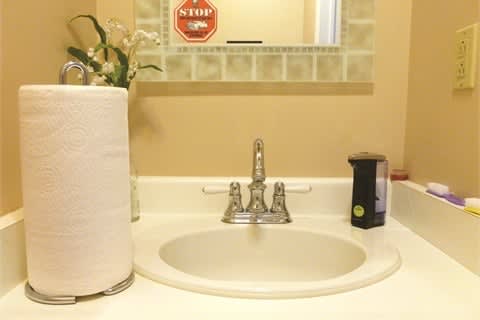
Laura Merzetti’s powder room serves as her clients’ hand-washing station. Note the paper towels, liquid soap dispenser, manicure brushes, and a Durham Region hand-washing sticker on the mirror.
Uncured gel polish and microscopic e-file dust contain active acrylates that penetrate the skin, triggering permanent contact dermatitis. Learn the chemistry behind these irritants and how to protect your clients and yourself.
The Good Patch is a leading wearable wellness patch brand, offering wellness and skincare patches that support everyday needs including energy, sleep, relaxation and more.
Orthopedic PT reveals three daily exercises plus ergonomic advice that can help salon professionals avoid the aches and injuries caused by standing, bending and repetitive overhead work.
From acrylic monomers to airborne bio-dust, the air inside a nail salon carries risks most professionals never see coming. Aerovex Systems reveals the source-capture and room-purification strategies that are setting a new standard for salon safety.
Working in beauty doesn’t have to hurt. Learn how Somatic Movement helps hairstylists, lash artists, and other beauty pros release tension, improve posture, and extend their careers.
As a spa or salon professional, your clients expect more than just beauty—they expect safety, hygiene, and peace of mind. Fungal infections like Athlete’s Foot and Nail Fungus are more common than you think, especially in environments where tools and footbaths are reused without proper sanitation. This blog covers how to stop these issues before they start, using proven infection prevention strategies for salons and spas.
A federal initiative aimed at studying chemical exposure in nail salons has ended due to staffing and budget changes. Here’s what the project set out to do—and what its conclusion means for salon professionals.
For many people, a pedicure is a relaxing beauty ritual. But what most don’t realize is that this simple service, if done without proper hygiene and sanitation, can cause serious infections and long-term health issues.
Onycholysis is the separation of the nail plate from the nail bed. While it may look painful, it typically isn’t—at least not at first. But without proper care, this common nail disorder can lead to infections, deformities, and long-term damage.
Mckenzie Kool, Psychologist, MC, RPsych provides us with guidance on what may or not be helpful in speaking with someone who has suffered a significant loss.
Clients come to you to feel their best—not leave with a viral souvenir. Warts and cold sores can spread fast in busy salons, but a few smart habits make all the difference. Let’s talk about what’s really lurking in your salon (and how to kick it to the curb).
As Earth Day approaches, The Green Beauty Community Foundation and the Green Spa Network invite beauty pros to step forward and embrace sustainability through the Green Pledge--a powerful initiative designed by and for beauty industry leaders.
Don’t cancel Valentine’s Day altogether, urges Jill Palmquist. Instead, think of it as a (frilly, flowery, Champagne-bubbly) wake-up call to fall deeply in love with your own life.
Life coach and Culture Ambassador of Sam Villa, Andrew Carruthers, outlines how to tell if your burnout is temporary - or if it's time to make a bigger career change.