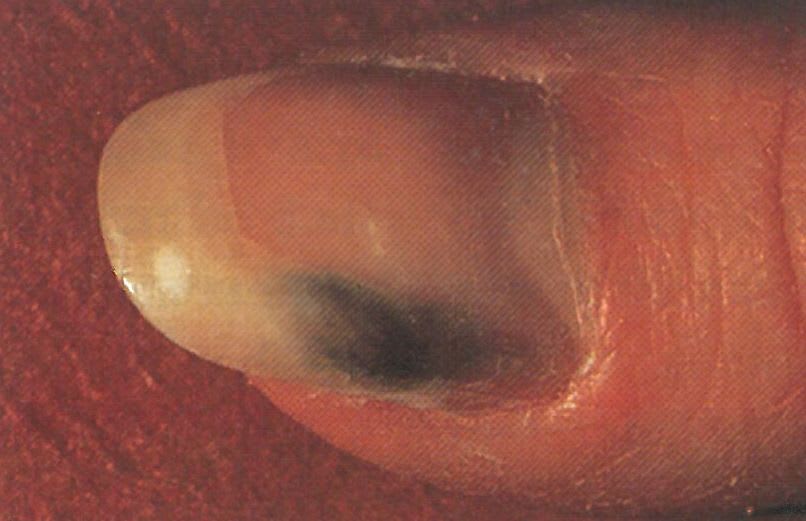
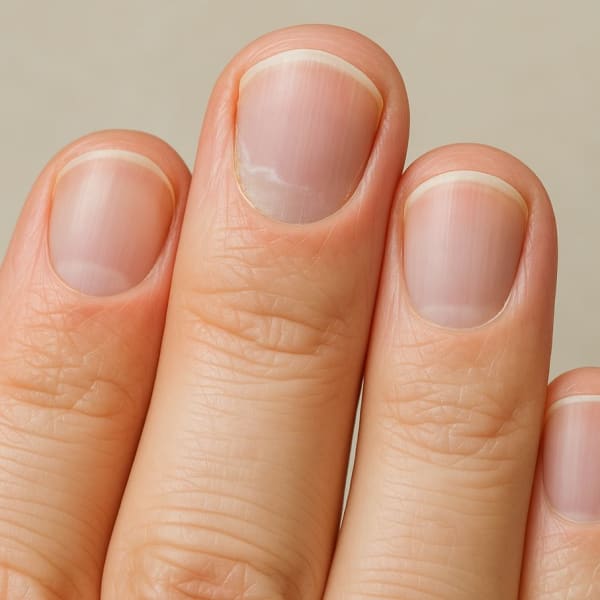
One of my clients has what looks like tiny splinters between her nail bed and nail plate. They are very small, dark, straight lines that appear throughout the nail. Should she see a doctor?
by Staff
January 1, 1997
The nail is stained green by a pseudomonas bacterial infection. it will take several months for the stains to grow out.
7 min to read
Q: One of my clients has what looks like tiny splinters between her nail bed and nail plate. They are very small, dark, straight lines that appear throughout the nail. She is a recovering nail biter, and her nails are very ridged. She has been working hard over the last few months to let her nails grow and comes in every week for a manicure. Is there anything that can be done during the manicures I give her to improve her condition, or should she see a doctor?
The nail is stained green by a pseudomonas bacterial infection. it will take several months for the stains to grow out.
Dr. Rich: The appearance of “splinters” under the nail plate is called splinter hemorrhages. They occur when a tiny drop of blood is released into the longitudinal grooves of the nail bed, usually in the distal part of the nail. Splinter hemorrhages usually grow out with the nail over time. The most common cause of splinter hemorrhages is trauma to the nail, such as nail biting or being slammed in a door. Take special care during the manicure to avoid causing pain or further damage to the affected nails.
Ad Loading...
Q: My client has skin growing under the free edge of her nail. If I’m not careful, I file or cut this skin and it bleeds. How do I push down or remove this tough skin?
Dr. MacDougall: There are a few possible reasons for tissue to form under the free edge of the nail. Some problems are congenital, which means that the problem appears at or shortly after birth, and some problems are acquired later in life. Some involve just one or a few nails, and some may involve all the nails. Congenital problems are quite rare. This is fortunate, because they can be more severe and, since they probably are due to a genetic disorder, are generally not very treatable. One example is pachyonychia congenita, an inherited disorder in which the nail plate develops an exaggerated curvature at the sidewalk. The nails are excessively thick and the underlying skin is attached to them. The nails are almost impossible to cut, and the thick skin that remains attached underneath the nail plate can be quite sensitive. Liberal use of urea-containing moisturizers may provide some relief of the symptoms.
This pateient was born wtih pachyonychia congenita.
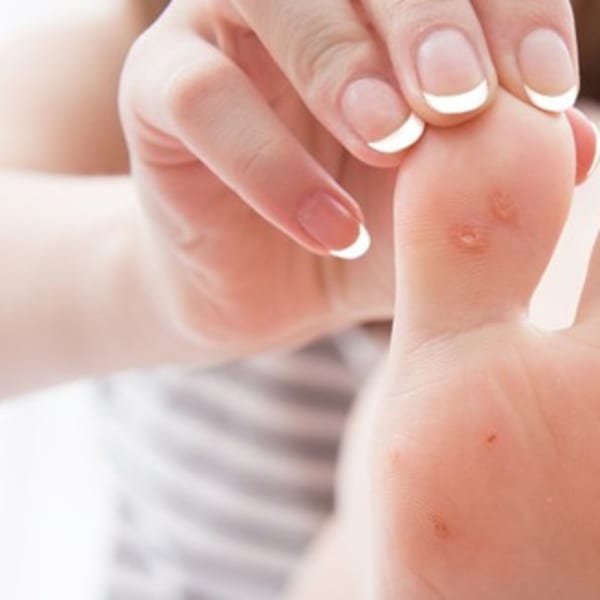
Acquired conditions are far more common. For example, so-called periungual warts, caused by the same human papilloma virus that causes childhood warts, can cause thickening just under the nail plate. Pushing or trimming this tissue can actually worsen or spread the infection. Over-the-counter wart remedies that contain salicylic or lactic acid may sometimes help, but they require long treatment times and are not very effective if the wart is deep under the nail. A dermatologist can sometimes remove these warts using topical medications, or they can be removed with liquid nitrogen or laser surgery. Unfortunately, the virus may reappear later, even after the skin looks completely normal, and some warts won’t respond to any treatment.
Another possible cause could be a phenomenon known as a pterygium, which is basically a reversal of the normal inward folding of the skin under the free edge of the nail plate. This can be caused by trauma and by certain skin conditions such as lichen planus. Topical 1% hydrocortisone cream, available over the counter, can temporarily reduce the thickness of a pterygium but should not be used if the area is infected. A dermatologist can sometimes remove this excess tissue using acid peels or surgery.
Q: Aside from referring the client to a doctor for what appears to be a bacterial infection (green discoloration), what should I advise my client to do? What is the best treatment for a bacterial infection of the nail, and to get rid of the green color? Approximately how long should it take? Is it harmful to cover an infected nail with artificial products?
Ad Loading...
Dr. MacDougall: Greenish discoloration under the nail plate is usually caused by either bacterial or mold infections. Pseudomonas bacteria, which thrive in places like faucet heads, soap dispensers, and other wet areas, usually cause some tenderness around the edge of the nail (paronychia) and may have a slight fruity odor. Pseudomonas infections can sometimes be cleared up with a .25% acetic acid soak used for five minutes twice daily. Your client can purchase it inexpensively from any pharmacy, or she can make it at home by mixing two tablespoons of white vinegar with a pint of water. Some infections won’t respond and may require a doctor to prescribe oral antibiotics, particularly if a skin infection is present.
It is not a good idea to cover these infected nails with artificial products generally, although I advise patients that if they are already on a treatment regimen for one of these infections, they may wear polish for special occasions. However, they must remove the polish promptly to avoid worsening or spreading the infection.
Q: I have used acrylic products on my clients and myself for approximately five months. A couple of weeks ago, I had an allergic reaction that caused dermatitis, according to my dermatologist. The reaction occurred on all 10 fingers, and it is characterized by many little yellow and red spots under the skin, which became very hard and itched tremendously. The skin then peeled off my fingers. I have totally recovered now, but your opinion is very important to me. Is this really dermatitis? Why did I get this and how? Is it related to the acrylic nail products? Is there any solution?
Dr. MacDougall: Translated from Latin, dermatitis literally means “inflammation of the dermis (skin),” and is more of a description of a problem than a diagnosis. Some forms of dermatitis can be inherited, and others are acquired.
Basically, any type of dermatitis is caused by an overreaction of the immune system in the skin. Your immune system is composed of white blood cells, and they have many different functions. Some of these cells kill invading germs, such as viruses and bacteria. Some of these cells are on the lookout for abnormal or cancerous cells within your body. Some of these cells produce antibodies, which are proteins that recognize various substances as being foreign. Some of these cells produce substances that tell other immune cells how to act.
Ad Loading...
When a dermatitis appears on the skin, it means that something has triggered your immune system to become more active. When this happens, white blood cells in the bloodstream move out into the skin and collectively migrate into the top layers of tissue. As they move, they make various substances that irritate nerve endings; this can damage the tissues. The yellow and red spots you saw were large collections of these white blood cells in small pockets called vesicles, and the itching was caused by the various substances they manufactured. The peeling that happened later was due to leftover damage as the white blood cells passed by.
In your case, the dermatitis could either be caused by an inherited type of hand eczema called dishydrosis, or by an acquired type of dermatitis called contact dermatitis. Irritants such as detergents, soaps, and solvents, or allergens can trigger contact dermatitis. If you have a true allergic contact dermatitis, your immune system has become sensitized to a particular substance in your environment (in this case, it might be the acrylic), and you will always be allergic to it even if you never had problems with it before.
You should ask your doctor to perform “patch testing” on you. This is a simple test that can be done in the dermatologist’s office to help identify specific substances to which you might have become allergic. He can then help you find ways to avoid these substances and perhaps continue your work.
Doug Schoon: You may have recovered from the skin reaction, but allergies to ingredients in products last a lifetime. If you continue to expose your skin to enhancement products, the symptoms will probably worsen. Allergic reactions to nail enhancements are caused by long-term overexposure to the liquid monomer. Usually, problems begin after four to six months of repeated skin contact. Luckily, the solution is simple. Nail technicians should never let any enhancement products touch soft tissue.
Once the products harden, they are unlikely to cause these problems unless the nail technician uses too wet of a bead consistency. Too wet of a bead consistency can cause red, puffy cuticles and itchy nail beds. Both are signs of impending allergic reactions. Also, fresh dust filings created after using too wet of a consistency can settle on skin and cause a reaction. Clients usually develop this condition when nail technicians use swabs soaked in product to clean up the skin. To prevent these problems, treat your products like professional tools. Avoid all skin contact with liquid monomers, gels, or resins. When using acrylic liquids, use a medium-wet consistency.
Uncured gel polish and microscopic e-file dust contain active acrylates that penetrate the skin, triggering permanent contact dermatitis. Learn the chemistry behind these irritants and how to protect your clients and yourself.
The Good Patch is a leading wearable wellness patch brand, offering wellness and skincare patches that support everyday needs including energy, sleep, relaxation and more.
Orthopedic PT reveals three daily exercises plus ergonomic advice that can help salon professionals avoid the aches and injuries caused by standing, bending and repetitive overhead work.
From acrylic monomers to airborne bio-dust, the air inside a nail salon carries risks most professionals never see coming. Aerovex Systems reveals the source-capture and room-purification strategies that are setting a new standard for salon safety.
Working in beauty doesn’t have to hurt. Learn how Somatic Movement helps hairstylists, lash artists, and other beauty pros release tension, improve posture, and extend their careers.
As a spa or salon professional, your clients expect more than just beauty—they expect safety, hygiene, and peace of mind. Fungal infections like Athlete’s Foot and Nail Fungus are more common than you think, especially in environments where tools and footbaths are reused without proper sanitation. This blog covers how to stop these issues before they start, using proven infection prevention strategies for salons and spas.
A federal initiative aimed at studying chemical exposure in nail salons has ended due to staffing and budget changes. Here’s what the project set out to do—and what its conclusion means for salon professionals.
For many people, a pedicure is a relaxing beauty ritual. But what most don’t realize is that this simple service, if done without proper hygiene and sanitation, can cause serious infections and long-term health issues.
Onycholysis is the separation of the nail plate from the nail bed. While it may look painful, it typically isn’t—at least not at first. But without proper care, this common nail disorder can lead to infections, deformities, and long-term damage.
Mckenzie Kool, Psychologist, MC, RPsych provides us with guidance on what may or not be helpful in speaking with someone who has suffered a significant loss.
Clients come to you to feel their best—not leave with a viral souvenir. Warts and cold sores can spread fast in busy salons, but a few smart habits make all the difference. Let’s talk about what’s really lurking in your salon (and how to kick it to the curb).
As Earth Day approaches, The Green Beauty Community Foundation and the Green Spa Network invite beauty pros to step forward and embrace sustainability through the Green Pledge--a powerful initiative designed by and for beauty industry leaders.
Don’t cancel Valentine’s Day altogether, urges Jill Palmquist. Instead, think of it as a (frilly, flowery, Champagne-bubbly) wake-up call to fall deeply in love with your own life.
Life coach and Culture Ambassador of Sam Villa, Andrew Carruthers, outlines how to tell if your burnout is temporary - or if it's time to make a bigger career change.