Wouldn’t it be nice if clients could get all their information about nails from you — they wouldn’t have to read in their favorite magazines that they need to have their acrylic nails removed periodically “so their nails can breathe.” They wouldn’t have to be warned against wearing those lovely but “dangerous” extensions because nails can “sweat and cause a fungus.” If clients would only come to you with their concerns about nails you could set them straight that nails are just a layer of dead keratin and they don’t breathe, eat, drink, or any other nonsense function. First and foremost, nails provide a rigid backing to protect the delicate fingertip, which we use to grasp items and distinguish textures. The nails themselves allow us to pick up small items and scratch itchy skin.
While educating clients about nail care and home maintenance, you should also educate them about the nails’ function and structure. Clients will feel more comfortable with you and your services when they understand how the nail grows. At the same time, you can dispel some common nail myths that make clients fearful of wearing artificial nails.
FROM THE MATRIX UP
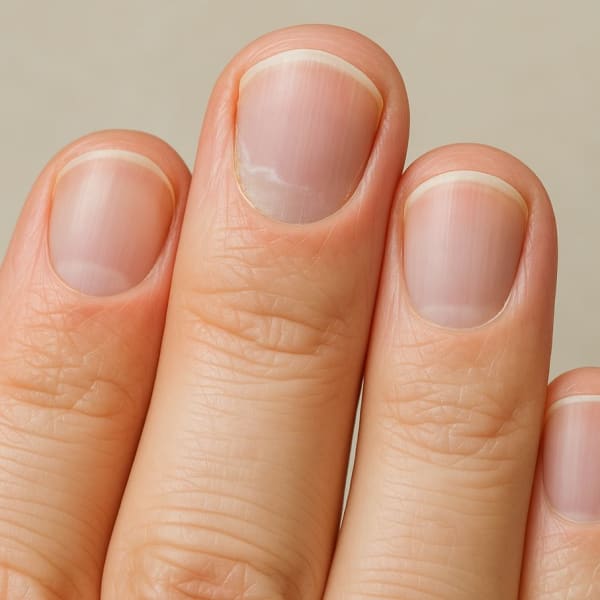
Nail growth begins in the matrix, which is the nail’s “heart.” The matrix is a bed where special skin cells form the nail plate. Damage to the matrix can cause permanent deformity, and can even cause the nail to stop growing completely.
Nails are firmly implanted beneath the skin by the nail root. The root is implanted in a groove under the proximal nail fold just above the matrix.
The nail root and matrix are protected by the proximal nail fold, which is the fold of skin at the base of the nail. Above the proximal nail fold, the white half moon at the base of the nail is the lunula, which is an extension of the matrix. Because the nail plate is still hardening as it grows over the lunula, it is soft and easily damaged. The nail plate itself is composed of dead keratin. In the nail matrix, keratinocites (a type of skin cell) are compacted and flattened as they push forward toward the nail plate. These flat, compacted cells form the hard nail plate.
The nail bed is the pink bed of skin that extends past the lunula. The nail bed is richly supplied with blood capillaries that oxygenate the nail bed and give it its healthy pink tone. Physicians can quickly check the hands’ circulation by squeezing your nail bed.
The cuticle adheres the proximal nail fold to the nail plate at the base of the nail (called the eponychium) and the nail plate to the nail bed at the nail’s free edge (called the hyponychium). The cuticle seals die nail bed and matrix from air and water. Without this protection, these two areas would create a warm, moist pocket for germs to grow.
HOW FAST DO NAILS GROW?
Nails grow 1/8 to ¼ inch per month, depending on a person’s age and health, and it takes three to six months for a nail to completely grow out from the matrix to the free edge. Nails grow faster during youth, in warm weather, during pregnancy, and when they are recovering from an injury. Additionally, nails on the right hand (or left, if you’re left-handed) grow faster. Nails on the middle fingers grow the fastest.
NAILS DON’T BREATHE
The nail plate is made of dead keratin, and contrary to popular opinion, does not require oxygen. The nail bed, cuticle, and matrix do, however, require oxygen because they are composed of live skin cells, but they are supplied by the numerous capillaries that feed the fingertip and nail bed with oxygen-rich blood.
Nails don’t sweat. Sweating is the body’s air conditioning system, cooling the body from the inside out. The nail bed, however, does not have sweat glands, so it can’t perspire. While the nails do contain a lot of moisture, about 18%, the moisture does not build up under artificial nails. The moisture that causes problems under artificial nails occurs when product lifts and moisture gets underneath. This is so common because people have their hands in water frequently.
Nails don’t eat, and they don’t need vitamins or minerals. Because nails are made from dead protein, they cannot be strengthened by vitamin or mineral supplements. While severe vitamin and mineral deficiencies can affect the nails, Americans are rarely affected by genuine vitamin deficiency. On the other hand, a protein deficiency will affect nail health, but most Americans consume three times more protein than the body needs.
Nails don’t need to rest from artificial extensions. The top layers of the nail are thinned by application of artificial product, but this does not affect new growth. However, as the nails continue to be covered they will become thinner and weaker. The condition is not permanent, and nails will grow back as healthy as they were before.
A nail’s strength and thickness is determined, in part, by the nail bed’s response to its environment. When the nails are covered by artificial product, the natural nail is not exposed to sensations of water, air, or temperature. In response, the nail becomes thinner and weaker. When artificial product is removed, the nail bed once again can monitor the environment and the nail will grow in thicker and stronger to protect the nail bed and fingertip. It will take three to six months for a stronger and thicker nail to completely grow out.
By understanding what nails are made of, how they grow, and how they adapt to artificial extensions, clients will be much more enthusiastic about artificial nails. At the same time, you will help dispel some common nail myths that keep potential clients away from nail salons.