New Guidelines Aim to Protect Your Respiratory Health
When it comes to healthy salon air, the new magic number is three. The Nail Manufacturers Council recently updated its guidelines to recommend a three-zone protection approach for nail salons.
“Too many nail techs think they just have to ‘buy this’ and all their ventilation problems are solved, but it’s not that easy,” says Doug Schoon, safety co-chair for the PBA’s Nail Manufacturers Council (NMC). “Achieving proper ventilation and good air quality requires more than many imagine or recommend.” To ensure good salon air quality, the NMC has expanded its brochure “Guidelines for Controlling and Minimizing Inhalation Exposure to Nail Products” to provide a more comprehensive three-zone approach to ventilation.
“Proper ventilation is needed to help ensure the quality of your breathing air and to protect your health. A comprehensive three-zone protection approach will allow you to easily control vapors and dust. This is also the best way to eliminate strong or offensive odors and can even improve the way you feel,” says Jeff Cardarella, president of Aerovex Systems, a longtime proponent of three-zone protection. “Technicians and stylists should first be concerned about their breathing zone, which is an invisible two-foot sphere in front of your and your client’s mouth. Second, consider your work station as its own zone. And finally, think about the general building air as the third zone.”
Ad Loading...
The NMC recommends using a combination of: 1) a properly maintained HVAC system; 2) a professional HEPA room air cleaner; and 3) a source capture system.
HVAC Systems. The general room ventilation and air-conditioning systems in a salon are classified as “Heating, Ventilation and Air-Conditioning” (HVAC) systems. HVAC systems are built-in to the salon and are designed to exchange air inside the salon with fresh air from the outside. Typical salon HVAC filters remove some dusts, pollens, etc., but cannot remove vapors or the smallest dust particles. Special HVAC filters designed with replaceable activated carbon panels and electrostatic dust-filtering material are recommended to remove residual salon vapor and dust not captured by a source capture system or by a room air purifier. The adsorbent panels eventually become saturated, making them ineffective, and, therefore, must be replaced on a regular basis (e.g., four times per year). Whether the salon is being heated, air conditioned, or neither, the HVAC fan should be in the “on” position if the building is occupied.
Professional HEPA Room Air Cleaners. Use of a stand-alone salon HEPA room air cleaner designed specifically to remove salon vapors and dusts is also recommended to help further clean the salon’s air and to help keep it recirculating throughout the salon. It is best to use a professional quality air cleaner and avoid air cleaners designed for home use. Air cleaning devices that utilize HEPA filters are designed to remove most dusts from the air in the immediate vicinity of the air cleaning device, but will have much less effect on the breathing zone of nail technicians. Even so, they can be effective for removing fine dusts from the salon air. Newer types of filters referred to as electrically enhanced filters or polarized filters can be considered electronic versions of HEPA filters and are commonly called eHEPA filters. These claim to have the effectiveness of HEPA type filters, but allow substantially more air flow to pass through the air cleaning device. Both HEPA and eHEPA filters are designed to remove particles as small as 100th the diameter of a human hair and when used properly and according to manufacturer’s directions can provide dust removal benefits to salons. Some activated charcoal air cleaner devices utilize a dust pre-filter that is machine washable or replaceable. These devices are also considered effective ways to lower airborne dust concentrations. Note: Never rely solely on stand-alone air filtration in the salon.
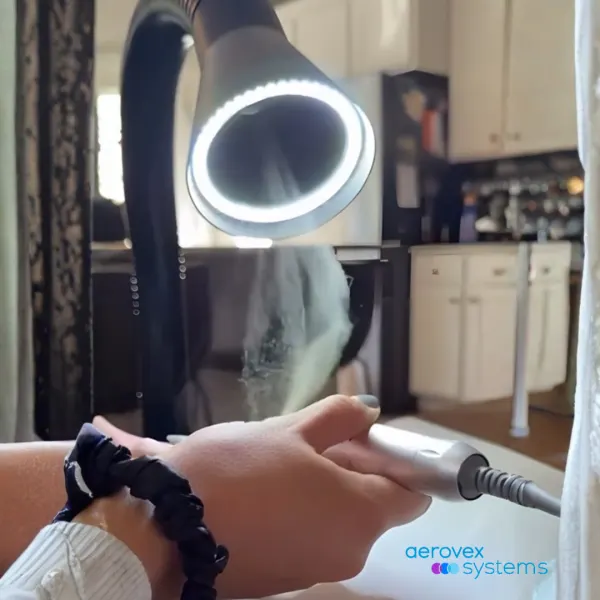
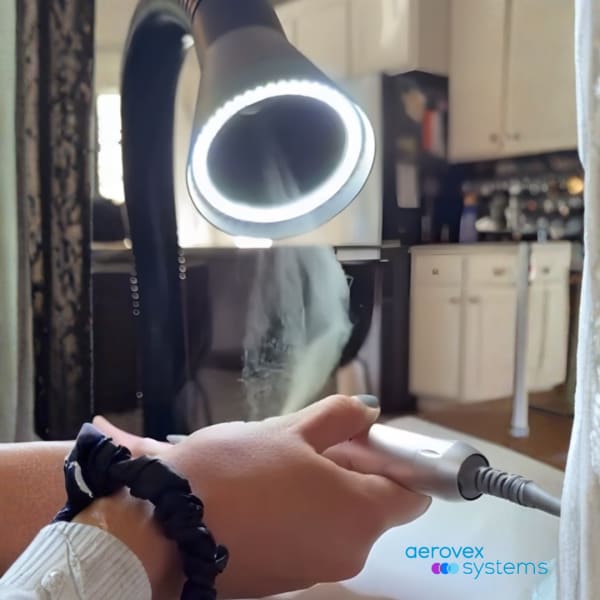
Source Capture Systems. Source capture systems are designed to capture nail vapors and dust particles at their source of release and then extract them from the breathing zone, protecting the health of those working in the salon. At a minimum, these systems should draw 50 cfm of airflow when measured within six inches of the area where the dusts and vapors are released. A three-stage filtration system is recommended and should include an activated carbon filter with a minimum of two pounds of activated carbon. Avoid systems with little or no activated carbon. Additionally, some systems are equipped with eHEPA filters which have enhanced dust collecting and vapor adsorption capability. When properly designed and correctly used, source capture systems protect the breathing zone of both the nail technician and client. These systems are the most effective way to control and prevent inhalation of salon dusts, vapors, and other airborne contaminants.
Source capture systems that return filtered air into the salon are not as effective as those designed to vent to the outdoors and are more costly to maintain, so when possible, source capture systems should be ventilated to the outside. However, when this is impractical, systems that clean the air and return it to the salon can be very useful if properly maintained.
Ad Loading...
Odor Not a Factor
Some salon professionals mistakenly believe that ventilation systems are solely for controlling strong odors, when in fact, odors are not the reason for ventilating. Just because a substance smells strange or unpleasant does not mean it is risky to breathe. The odor of a substance does not indicate whether it is safe or harmful. Dirty socks provide a good example. They don’t smell good, but they aren’t harmful to breathe. Don’t ventilate to control odors; ventilate to control vapors and dusts. (Source: NMC)
Avoid Ozone
Air cleaners that produce tiny amounts of ozone (parts-per-billion) may neutralize some odors, but they do not remove vapors or dusts. Ozone is a hazardous air contaminant, even at very low concentrations. The Environmental Protection Agency (EPA) has warned all consumers against using air cleaners that release ozone due to the health risks they create. These devices sometimes cause watery eyes, runny nose, coughing, chest tightness, metallic tastes in the mouth, shortness of breath, and blurred vision. These are not effective for controlling dusts or vapors in salons. Healthy people, as well as those with respiratory difficulty, can experience breathing problems when exposed to even relatively low levels of ozone, e.g. 40 parts-per-billion. (Source: NMC)
Don’t Share With Others
Ad Loading...
To avoid spreading chemical vapors to neighboring businesses, nail and hair salons should not share the same ventilation system with another business and should be under negative air pressure in relation to adjacent spaces. To maintain negative pressure, the salon should exhaust slightly more air than is supplied so that any leakage of vapors will not enter adjacent businesses. (Source: Aerovex Systems)
> You can read the complete NMC brochure at www.nailsmag.com/handouts. It includes information on product overexposure, dust masks, and other safety tips.
Uncured gel polish and microscopic e-file dust contain active acrylates that penetrate the skin, triggering permanent contact dermatitis. Learn the chemistry behind these irritants and how to protect your clients and yourself.
The Good Patch is a leading wearable wellness patch brand, offering wellness and skincare patches that support everyday needs including energy, sleep, relaxation and more.
Orthopedic PT reveals three daily exercises plus ergonomic advice that can help salon professionals avoid the aches and injuries caused by standing, bending and repetitive overhead work.
From acrylic monomers to airborne bio-dust, the air inside a nail salon carries risks most professionals never see coming. Aerovex Systems reveals the source-capture and room-purification strategies that are setting a new standard for salon safety.
Working in beauty doesn’t have to hurt. Learn how Somatic Movement helps hairstylists, lash artists, and other beauty pros release tension, improve posture, and extend their careers.
As a spa or salon professional, your clients expect more than just beauty—they expect safety, hygiene, and peace of mind. Fungal infections like Athlete’s Foot and Nail Fungus are more common than you think, especially in environments where tools and footbaths are reused without proper sanitation. This blog covers how to stop these issues before they start, using proven infection prevention strategies for salons and spas.
A federal initiative aimed at studying chemical exposure in nail salons has ended due to staffing and budget changes. Here’s what the project set out to do—and what its conclusion means for salon professionals.
For many people, a pedicure is a relaxing beauty ritual. But what most don’t realize is that this simple service, if done without proper hygiene and sanitation, can cause serious infections and long-term health issues.
Onycholysis is the separation of the nail plate from the nail bed. While it may look painful, it typically isn’t—at least not at first. But without proper care, this common nail disorder can lead to infections, deformities, and long-term damage.
Mckenzie Kool, Psychologist, MC, RPsych provides us with guidance on what may or not be helpful in speaking with someone who has suffered a significant loss.
Clients come to you to feel their best—not leave with a viral souvenir. Warts and cold sores can spread fast in busy salons, but a few smart habits make all the difference. Let’s talk about what’s really lurking in your salon (and how to kick it to the curb).
As Earth Day approaches, The Green Beauty Community Foundation and the Green Spa Network invite beauty pros to step forward and embrace sustainability through the Green Pledge--a powerful initiative designed by and for beauty industry leaders.
Don’t cancel Valentine’s Day altogether, urges Jill Palmquist. Instead, think of it as a (frilly, flowery, Champagne-bubbly) wake-up call to fall deeply in love with your own life.
Life coach and Culture Ambassador of Sam Villa, Andrew Carruthers, outlines how to tell if your burnout is temporary - or if it's time to make a bigger career change.