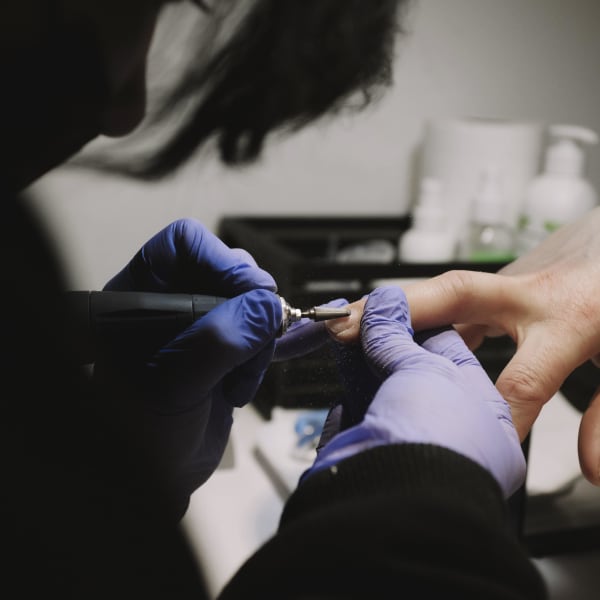
Artificial nail products are composed of various chemicals. The main ingredient for most artificial nail products is ethyl methacrylate (KMA). In 1974 the U.S. Food and Drug Administration (FDA) banned a similar chemical, methyl methacrylate (MMA), for use in nail products because of its harmful effects during application. Despite the FDA ban, MMA is still found in trace amounts in some products.
Is Anyone Getting Sick From Applying Artificial Nails?
There has been little research done to date on the health effects of EMA, but mounting evidence shows that EMA may be just as harmful as MMA. Both chemicals are potent skin sensitizers, which can cause allergic reactions if the dose is large enough. Both also can irritate the eyes, nose, and other mucous membranes. In 1990, the Colorado Department of Health reported five cases of physician-diagnosed occupational asthma among cosmetologists who applied artificial fingernails. These cases of asthma were caused specifically by the job, hence the name, "occupational" asthma.
Why Should I Worry Since My Exposures Are Below Regulations?
Although there are currently no federal regulations for EMA, you want to make your workplace as safe as possible by reducing potentially harmful chemicals in your salon through ventilation and work practices. Some people may experience health problems even when the chemical exposures are very low. Odor is a good indicator that EMA is present in the air you breathe. You can smell it at very low levels, starting at about 0.05 to 0.08 parts per million (ppm). To visualize one part per million, picture a million golf balls in a railroad car. If just one of those balls is painted red, that golf ball represents one ppm. The level of EMA needed for detection is much less than one ppm.
How Effective Are Traditional Hazard Controls in Salons?
There are many different methods used by salons and schools to reduce the odors and hazardous chemical exposures from artificial nail application. Unfortunately, many of them are not very effective. Some of these methods and their associated problems are outlined below:
1. Manicure tables with charcoal filters: These tables may not have a large enough fan to pull the air downward, filters may not be sealed properly, or there may be other problems. If the air is pulled from above the work- table, it pulls the sensitizing chemicals past the technician's face. An exhaust system that pulls air from the table's side is often not close enough to capture the chemical vapors.
2. Practice of spreading towels on manicure tables to collect generated dust: While cloth towels may collect some of the visible dust generated, they cannot capture vapors, breathabledusts, or all of the larger particles.
3. General room air-purifying systems located in a central area: Most of these general purifying systems are wall or ceiling mounted or freestanding units, having charcoal or low-efficiency filters. These general purifiers may eventually clean the air for the rest of the salon, but will not reduce the nail technician's immediate exposures because of her close work with the chemicals.
4. Room fans moving air into a general heating, ventilation, and air-conditioning (HVAC) system: The air that is captured by the general HVAC system is not clean and will be redistributed to all areas served by that particular HVAC system.
Why Are Charcoal Filters Often Ineffective?
In nail salons, the "life" of the charcoal filter is dependent upon how many sets of nails are done and for how long, and the number of technicians at the salon.
In many salons that use air-cleaning devices with charcoal filters, the filters aren't changed often enough. Many salon owners think that the charcoal can be vacuumed or rinsed to remove the chemicals. However, the chemicals cannot be vacuumed or rinsed off. The charcoal must be replaced or professionally rejuvenated. The life of the charcoal filter is controlled by a number of factors: the number of technicians manicuring nails daily, the sets of nails done, and the length of time the filter has been in place. Also, humidity decreases the efficiency of the charcoal. In other words, when the charcoal becomes saturated, it can no longer clean the air.
Why Did NIOSH Evaluate Chemical Exposures in the Nail Salon?
In response to salon owners' requests, the National Institute for Occupational Safety and Health (NIOSH) studied the chemical exposures that affect nail salon technicians. We decided to compare the exposures from two types of manicure tables during the application of artificial nails: I) a commercially available, vented manicure table employing suction to vacuum away contaminated air; and 2) the usual unvented manicure table that has no suction. A school of cosmetology in Cincinnati, Ohio, was selected for testing the two tables. The amount of the chemical EMA that the technicians were breathing was measured over six days.
How Was the NIOSH Study Done?
To begin the testing, we purchased a widely available vented manicure table to see how well it worked. Contaminated air was pulled down into the table near the client's hands and through a charcoal filter; the "cleaned" air was then returned from under the table.
We did not believe the purchased table did an adequate job for the following reasons: 1) There were leaks around the charcoal filter which meant not all the air was being "cleaned." 2) There was no indicator to warn the operator when the filter needed replacing, nor was there a backup filter. 3) The vacuum was uneven across the table. 4) There was not enough vacuum.
How Did NIOSH Modify the Original Design of the Purchased Table?
We made some relatively simple design changes that improved the table's ventilation capacity. They included increasing the air flow by installing a larger fan, enlarging the area between the table surface and the fan to maximize air movement across the tabletop, and exhausting the contaminated air outside of the building instead of filtering it through charcoal. Also, we placed the vacuum surface closer to the client's hands to increase capture efficiency.
What Were the Results When Using the Ventilated Table?
All sampling results showed that the NIOSH-modified, vented manicure table was better at lowering exposures to EMA than was the unvented table. When samples were taken in the technician's breathing zone, the exposures for the vented table were reduced by more than tenfold. Technicians using the unvented table had an average EMA exposure of 10.6 ppm; those using the vented table had an average exposure of 0.8 ppm. The technicians and clients preferred using the vented table because it also helped to reduce the odor of the nail application products.
What Additional Actions Can I Take to Lower My Exposures?
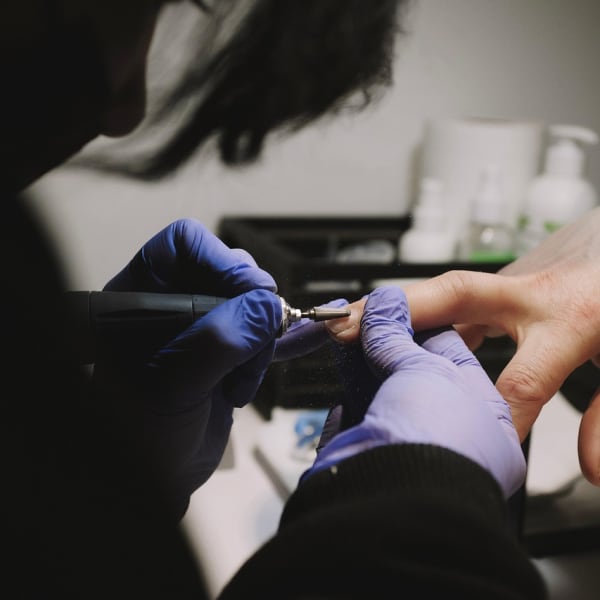
There are many simple changes you can make to lower your exposures. The technician should use a ventilated table (like the modified one tested by NIOSH) if it is available, or the salon should consider purchasing and modifying one if none is available. Since some of the chemicals used can soak into skin (dermal absorption), technicians should limit skin contact by wearing gloves. Gloves should be chosen to protect against the specific chemicals used in nail application; a glove manufacturing representative should be consulted to assist in the proper glove choice.
Technicians need to check that their artificial nail materials do not contain methyl methacrylate. The manufacturer of the material can supply them with a Material Safety Data Sheet (MSDS), which will list the ingredients of the product. Methyl methacrylate has been banned by the FDA for use in nail products but is still found in small amounts in some products.
Safety glasses should be worn so that acrylic won't enter the eyes. Technicians should wash their hands and other exposed areas with mild soap and water several times throughout the day to remove potentially irritating dust; long-sleeved garments should be worn to help avoid this dust. Eating or drinking should not be permitted in the work areas because unintentional contact with methacrylates can cause dermatitis. Also, there are many other chemicals located in a salon that if ingested can cause health problems.
Smoking should not be permitted in the salon because many chemicals in a salon, including nail products, are flammable. Elimination of smoking within the facility will also eliminate the hazards of exposure to secondhand smoke. Many facilities set aside a room as a smoking and eating area, but rarely is this room on a separate ventilation system. Consequently, secondhand smoke is distributed throughout the facility.
Small-mouthed containers should be used to reduce the nail solution as an exposure source. However, many technicians use a wide-mouthed glass container to hold the artificial nail liquid during application. These should be replaced by containers having an opening just large enough to admit an application brush. Also, no more than the required amount of nail solution should be poured into the container. Since more than needed is usually poured, technicians have to dispose of the excess. By pouring in a smaller amount, less is wasted and possible exposures are reduced when the residue is dumped. Such containers and limited amounts of nail solution will result in less evaporation, thereby reducing potential chemical exposures and product waste. Solution-soaked gauze should be disposed of in a sealed bag. When cleaning up between clients, many technicians use a small cloth or gauze to soak up any remaining artificial nail liquid. The cloth/gauze is then thrown away. Every time the trash can is opened, this cloth becomes a source of chemical exposure. Therefore, the gauze should be placed in a sealed bag, such as a plastic sandwich bag, before it's thrown in the trash can.
Trash bag liners should be changed daily. At the studied school, the plastic trash bags lining the waste receptacles were not changed daily. When the can was opened, a strong chemical odor was emitted. Salon managers or owners should make sure all sources of chemical evaporation, such as trash bags, are removed daily.
Summary: Through a combination of work practices, appropriate selection of artificial nail materials, and a ventilated manicure table, it is easy to reduce hazardous exposures in the salon. However, proper maintenance of the ventilation system, good housekeeping, and trained technicians, who know the correct use of equipment, are all necessary for the greatest exposure reduction. If you would like a copy of the NIOSH study or additional information for building a ventilated manicure table, please call NIOSH at (800) 35-NIOSH.