Before we can prevent CTS, we need to understand its actual cause-anatomically speaking, that is. How do we bend our wrist and move our hand?
by Marc Levine
November 16, 1994
4 min to read
With so many people earning their living at computer keyboards, it’s no wonder there’s been so much discussion lately about carpal tunnel syndrome (CTS). But it’s not just wordsmiths who are at risk for developing this painful affliction of the hand and wrist. Any repetitive hand or wrist motion can lead to CTS, and nail technicians, who sculpt, file, and buff nails all day, need to be especially scrupulous about correct posture and hand positions to avoid developing this debilitating, career-threatening injury.
But before we can prevent CTS, we need to understand its actual cause-anatomically speaking, that is. How do we bend our wrist and move our hand?
Ad Loading...
Let’s say you’re about to file someone’s nails. First, a nerve impulse travels from your brain down your spinal cord at high speed, then races through your arm to the median nerve. This is the large nerve that connects directly with most of the muscles that bend your wrist and close your fist. These muscles then contract, pulling on a tendon (which is the part of the muscle that attaches to the bone). When the tendon is pulled, the hand bends at the wrist joint and the fingers bend inward. Nerve impulses returning to the brain tell it that your wrist is bent and how much, how hard you’re gripping with your hand, and what the object you’re gripping feels like.
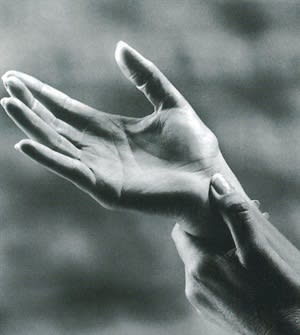
Now you know what body parts moving your hand involves-the nerves, muscles, tendons, and bones. Now hold out your hand and open it with the palm up. At the base of your hand are eight carpal bones that, along with the ends of the two forearm bones, form the wrist. The carpal bones are held together by though, fibrous tissues called ligaments. These ligaments run perpendicular to your fingers and are positioned over the median nerve and hand muscle tendons. In other words, the median nerve and the tendons sit inside a “sandwich,” with bone on the bottom and ligaments on top. This sandwich is called the carpal tunnel.
Perhaps you can visualize now why repetitive wrist bending or finger flexing can overtax the tendons that operate within the narrow space of the tunnel. Just bending the wrist normally compresses the tunnel contents. With overuse, the sheath around these tendons can become inflamed, or the tendons themselves can swell. This swelling takes up more of the valuable space in the carpal tunnel, thus putting pressure on the median nerve. Pressure on this nerve can result in pain, of course, but also in muscle weakness, since there is a decrease in the impulses that can get through that nerve to the muscle in the numbness, tingling, and other abnormal sensations, referred to as parasthesias.
If you start to feel numbness, tingling, and other abnormal sensations in your hand, they could be the first warning signs that you are developing CTS.
To prevent the ailment from worsening (and hopefully before it gets this far), you must learn to use good posture and hand and body mechanics while working. Remember, posture and body, since everything is connected. Modify your work habits and work area before they modify you.
Ad Loading...
If you work sitting, you should be in a comfortable position with your back straight (not hunched). If necessary, the chair should have armrests. Make sure that when using your hands they are in the most comfortable position in relation to the position of your body. Observe how you perform a fill: are you bending your wrists while applying product or filing? Try to find a position that keeps your wrists straight as you do these tasks. If you have no choice but to perform the same or similar tasks in succession, take frequent breaks to massage and flex your hands.
After work each day, take a little time to massage and ice your hands. First, rub some lotion into your hands, putting extra pressure on the sorest area. This will increase the circulation-and the inflammation. Then, fill a sealable plastic bag with crushed ice and hold it on your wrists for 15-20 minutes. If you’re on the run, massage your hand and wrist with an ice cube until they are numb.
Another form of treatment is to use a wrist splint. Wrist splints are a way of keeping the wrist and hand in a neutral (non-bending) position to avoid compression in the tunnel. The splint offers temporary relief and is a useful tool for people who overuse their hands. There’s surgery, of course, if all else fails to alleviate the pain. But there is no reason for CTS to get to that point. With a few adjustments in work habits and a little time each day spent taking care of your own hands, you’ll see the light at the end of the carpal tunnel, I guarantee it.
By Marc Levine, a registered physical therapist and president of Ther Ex Inc., a physical therapy company that provides home health care in Los Angeles.
Uncured gel polish and microscopic e-file dust contain active acrylates that penetrate the skin, triggering permanent contact dermatitis. Learn the chemistry behind these irritants and how to protect your clients and yourself.
The Good Patch is a leading wearable wellness patch brand, offering wellness and skincare patches that support everyday needs including energy, sleep, relaxation and more.
Orthopedic PT reveals three daily exercises plus ergonomic advice that can help salon professionals avoid the aches and injuries caused by standing, bending and repetitive overhead work.
From acrylic monomers to airborne bio-dust, the air inside a nail salon carries risks most professionals never see coming. Aerovex Systems reveals the source-capture and room-purification strategies that are setting a new standard for salon safety.
Working in beauty doesn’t have to hurt. Learn how Somatic Movement helps hairstylists, lash artists, and other beauty pros release tension, improve posture, and extend their careers.
As a spa or salon professional, your clients expect more than just beauty—they expect safety, hygiene, and peace of mind. Fungal infections like Athlete’s Foot and Nail Fungus are more common than you think, especially in environments where tools and footbaths are reused without proper sanitation. This blog covers how to stop these issues before they start, using proven infection prevention strategies for salons and spas.
A federal initiative aimed at studying chemical exposure in nail salons has ended due to staffing and budget changes. Here’s what the project set out to do—and what its conclusion means for salon professionals.
For many people, a pedicure is a relaxing beauty ritual. But what most don’t realize is that this simple service, if done without proper hygiene and sanitation, can cause serious infections and long-term health issues.
Onycholysis is the separation of the nail plate from the nail bed. While it may look painful, it typically isn’t—at least not at first. But without proper care, this common nail disorder can lead to infections, deformities, and long-term damage.
Mckenzie Kool, Psychologist, MC, RPsych provides us with guidance on what may or not be helpful in speaking with someone who has suffered a significant loss.
Clients come to you to feel their best—not leave with a viral souvenir. Warts and cold sores can spread fast in busy salons, but a few smart habits make all the difference. Let’s talk about what’s really lurking in your salon (and how to kick it to the curb).
As Earth Day approaches, The Green Beauty Community Foundation and the Green Spa Network invite beauty pros to step forward and embrace sustainability through the Green Pledge--a powerful initiative designed by and for beauty industry leaders.
Don’t cancel Valentine’s Day altogether, urges Jill Palmquist. Instead, think of it as a (frilly, flowery, Champagne-bubbly) wake-up call to fall deeply in love with your own life.
Life coach and Culture Ambassador of Sam Villa, Andrew Carruthers, outlines how to tell if your burnout is temporary - or if it's time to make a bigger career change.