Don’t let repetitive-motion injuries keep you from doing your job.
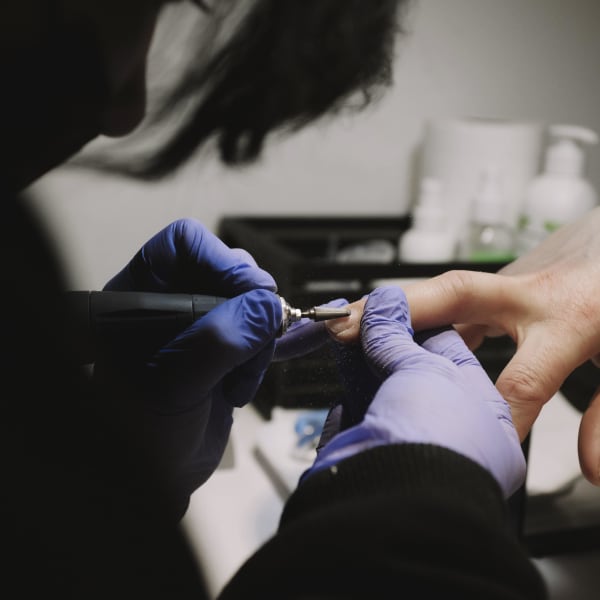
A recent study by the Labor Department reveals that repetitive-motion injuries among American workers have increased 700% in the last decade. To nail technicians, who spend many hours a day doing such repetitive-motion tasks as filling, the duty is frightening news.
One of the common repetitive-motion injuries that afflict nail technician is carpal tunnel syndrome.
At onset, carpal tunnel syndrome can strike softly. What may begin as subtle discomfort in the hands, often a tingling or sleepy sensation, can, if ignored, accelerate into excruciating pain that can render its victim wide-eyed at night and virtually crippled. Grip strength, coordination, and dexterity of the hands and arms diminish. In advanced stages the impaired nerves and tendons can cause the fingers to contract in such a way that they resemble claws.
If that’s not uncomfortable enough, sufferers of this syndrome can experience chronic fatigue from the need to get up frequently at night to restore circulation to the arms and hands. Allowing gravity to pull the arms down or shaking and rubbing them tend to alleviate the discomfort-temporarily-by increasing the free flow of blood to the extremities.
The increase in pain is usually so gradual, in fact, and the habit of giving oneself temporary relief so automatic, that one hardly notices the continuing and increasing pain and tend to develop a pattern of protection through frequent resting or bracing. Such “armoring” simply locks in accumulated metabolic waste (toxins) and protects the individual from suffering by limiting muscle functioning , according to Dr. Elnora Schmadel, a clinical psychologist and biofeedback specialist in Santa Ana, California. As the individual begins to experience greater pain, there is an automatic tendency to limit movement further, and muscle function is further damaged while the range of motion becomes increasingly smaller.
HEALING WITH ELECTRICITY
Healing currents have created a buzz lately as an alternative to surgery in the treatment of carpal tunnel syndrome and other repetitive-strain injuries.
One of Dr. Schmadel’s patients, a manicurist of six years, attests to the positive results from the electrical treatments. Plagued by lower back pain and tendonitis much of her life, one sufferer says she has seen “tremendous improvement” in the level of pain she has to endure.
She first learned of the treatments offered by Dr. Schmadel through a client. “An electrical non-invasive probe sends electrical impulses through very tender areas and breaks up congestion-and I can feel the difference immediately,” she signs.
PHYSICAL THERAPY
Judy Pasternak, a reporter at the Los Angeles Times, had her first bout with “computeritis” in 1986. At first doctors thought she had pinched a nerve in her neck from cradling the phone while she conducted interviews. She eventually had to take a non-reporting job for nine months because of the pain in her neck, shoulders, and forearms.
Once she was back on track, she traumatized the muscles one day while typing on deadline and suffered a painful relapse. It was frightening and a long way back, says Pasternak.
“I had to start at the beginning again,” says the reporter, “but I handled it at little smarter this time. I’m more aware and I have a better setup,” she adds, referring to her workstation. “Now I want to learn to correct not just the symptoms, but the causes, and to get myself in the best possible shape.”
Getting into shape for Pasternak means 45 minutes a day of physical therapy, gripping, and other exercises that she can do while watching television.
THE SURGICAL SOLUTION
Traditional medicine dictates surgery when the carpal tunnel becomes compromised and blood flow to the nerve is poor. While the surgery is fairly simple, usually a one-hour outpatient operation performed under a local anesthetic getting back to normal activity can take time. Hands are immobilized for four weeks in a splint before they can be used, and even then forceful exertion is forbidden.
During the surgery, a longitudinal incision is made in the palm of the hand, and the entrapped nerve is freed of obstructive matter. The period of recovery varies, and effectiveness rate of the surgery is as high as 95%. This depends largely upon the length of time a patient has experienced symptoms. A patient who has been in chronic pain for some time runs a greater risk of sustaining some permanent nerve damage. The body tries to build a defense and as a result, some of the nerve tissues can be permanently scarred.
According to a spokesperson at one Los Angeles neurosurgeon’s office, the patient who acts promptly and seeks medical advice runs a far greater chance of full recovery from repetitive-strain injuries such as carpal tunnel syndrome than one who dismisses the symptoms as something temporary and fails to seek out information and treatment.
THERAPY FIRST
“With carpal tunnel syndrome, the nerves are being stressed” explains Dr. Elinor Gibbs of the Clinic for Neuromuscular Disorders in Los Angeles. “With therapy and electrostimulation, we make a change in sensory feedback to the muscle. By increasing circulation in the hand to function far better,” she adds.
In treating the syndrome, Dr. Gibbs stresses sensory awareness with her patients-or more specifically, decreasing their stress and learning appropriate ways to use and move the hand.
Investigating alternatives to surgery, therapy can still be helpful. “Therapy first, then evaluation,” insists Gibbs. “Having therapy first enables far greater return after surgery. It is best to have therapy to increase relaxation, range of motion, circulation, fine motor control, strength, and endurance.”
CAN YOU MAKE A FIST?
“Most people don’t realize the habit patterns of how they use the hand,” says Dr. Gibbs. Ironically, one contributor to hand problems is long nails. When the fingernails are so long that an individual is unable to bend her fingers to make a fist, the normal range of motion of the hand has been altered. “The hand should be able to make a fist, fully flexed at all joints, and also be able to extend wide.
While at work, the posture of the body can suffer, so one should review the workstation and any peculiarities one may exhibit while performing one’s work routine.
“The neck should be straight, with the head centered above the spine, which should have its normal curve supported. The feet should rest on the floor in a relaxed fashion,” according to Linda Morse, chief of the occupational medicine division at Valley Health Center in San Jose, California.
One nail technician under treatment for carpal tunnel syndrome complained to her doctor of continually having to lean over to pull her clients’ hands forward. Checking to insure that the manicure table is positioned to allow maximum comfort for the client as well as the manicurist is a good idea-an inch or two can make a world of difference. It should not be necessary to support the weight of the clients’ arms or legs for any extended period of time.
Good posture quickly deteriorates if the table and chair height are incorrect for the worker. If there is a lamp lighting the manicure table, it should be positioned in such a way that the operator is not craning or holding her head to one side to see beneath it. The upper back and neck can be affected by repetitive-strain injuries as well as the arms and hands, since the nerve network originates in the spine.
OCCUPATIONAL NEUROSIS?
Repetitive-strain injuries have been shown to affect young to middle-aged and predominantly female employees engaged in low-paying, monotonous, low-prestige occupations, and for this reason is linked by some medical experts to job dissatisfaction more than to actual physical reasons. D. C. R. Ireland, in a medical review in The Journal of Hand Surgery, reports, “Repetitive strain injuries (RSIs)… are a multi-factorial, occupational, socioeconomic problem with a major psychological basis rather than a physical condition resulting from injury.”
A Los Angeles Times survey indicates otherwise. When close to 200 workers began to report symptoms of cumulative trauma disorders, and measures were being taken to correct working conditions from an ergonomic standpoint, a blind survey was conducted. Workers were asked to respond anonymously to a questionnaire if they were experiencing any problems at home or in the workplace. Absolutely no correlation was found between job dissatisfaction and repetitive-strain injuries.
PAIN IS REAL
Whether the symptoms have a physical or an emotional origin, the pain is real. “It often affects women working line jobs with minor physical demands and very repetitive action,” Dr. schmadel observes. “In terms of mind-body interaction, there is no question that there is always emotional response to physical distress. [Yet] it’s pretty difficult to explain as [solely ] psychological phenomenon. The clawing effect is one of the things that happens-which is entirely a matter of nerve entrapment.
“Irrespective of what causes carpal tunnel. It doesn’t it’s painful, it’s painful. It doesn’t matter what causes it, you just want it to stop,” says Dr. Schmadel.
CONSIDERATIONS
Anyone experiencing the symptoms of cumulative trauma disorder or carpal tunnel syndrome should speak to a physician or a neurologist immediately. If there is a positive diagnosis, there are several available treatment options. Whether it’s electrical therapy, physical therapy, or surgery, the sooner steps are taken to help alleviate the stress on the upper body, hands, improvement can be experienced.
In some cases, a combination of treatments may be a wise choice. Both electrotherapists and physical therapists advocate working jointly with a physician.
For those fortunately unaffected by injury, it might still bode well to heed Benjamin Franklin’s advice “An ounce of prevention is worth a pound of cure.” Take a good luck at your posture while you’re working, and (just as your mother told you) keep your chin up, your shoulders back, and your feet on the ground. On the whole, that’s not bad advice for anyone.