Are airborne chemical vapors giving you a headache? Implement your own salon “Clean Air Act” by investing in a local ventilation system.
Do you know if the air quality in your salon is healthful? Test your clean air IQ with our true/false quiz:
A good heating, ventilation, and air conditioning (HVAC) system will keep indoor air healthful for workers.
Low-odor and odor-free products are healthier than traditional products for salon air quality.
A free-standing air cleaner that cleans 250 cubic feet of air per minute (cfm) will clean 2,500 cubic feet of air in just 10 minutes (10 ´ 250 = 2,500).
Local exhaust ventilation is the most effective means to remove air contaminants from the salon.
You’ve probably already guessed that you were being set up, but do you know which, if any, of the four statements are true? The answer is number 4: local exhaust ventilation not only the most effective means to remove air contaminants from the salon, but it is the only means to remove them before they enter your breathing zone, where you could inhale them. To ensure good ventilation, indoor air specialists and industrial hygienists recommend that salon supplement their HVAC systems with local exhaust ventilation.
Ventilation Basics
Any industry that uses chemicals must make good ventilation a primary concern. According to the Environmental Protection Agency (EPA), general ventilation is a combination of processes that brings fresh air in and removes contaminated air. In most homes and offices, HVAC systems do the trick (and are required in all commercial buildings), but alone they aren’t adequate for the salon.
General ventilation systems control pollen and dust and keep the air from getting stale, explains Doug Schoon, chemist and executive director of Chemical Awareness Training Services in Newport Beach, Calif. “Paints, carpets, and furniture give off trace amounts of vapors. General ventilation systems are designed to take care of these trace vapors and to keep carbon dioxide from building up. They are not designed for industrial use, says Schoon.
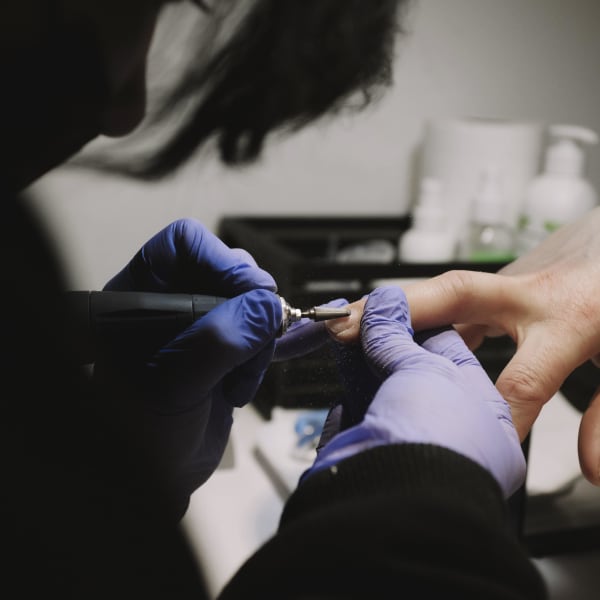
While you may not consider the salon environment where you use nail products “industrial,” it is when it comes to your ventilation needs. A 1994 study by the National Institute of Occupational Safety and Health (NIOSH) titled “Control of Ethyl Methacrylate Exposures During the Application of Artificial Fingernails” found that nail technicians’ exposure to ethyl methacrylate (the monomer, or liquid component of acrylic systems) are well below the Occupational Safety and Health Administration’s (OSHA) permissible exposue levels for industrial workers. At the same time, the report states, “It appears that some technicians are adversely affected by the chemical exposures associated with artificial nail application … many nail technicians have frequent headaches, burning nose and eyes, and irritation from dust on the neck and face.” Fortunately, these symptoms can be eliminated by removing their cause – chemical vapors and dust in the air.
Even if the chemical vapors don’t bother nail technicians, they might bother customers or surrounding businesses. Just recently NAILS heard from Dream Nails in South Africa. Its franchise in Claremont, Cape Town, has been fielding complaints from neighboring shop owners about the odor of its products. Franchise owner Christeen Calothi has had repeated visits from the labor department, which regulates exposure to chemicals in the workplace. Now, a client has complained to the health department about the odor of the products. As a result, the health inspector is investigating clients’ and technicians’ exposures to chemicals used in the salon.
Closer to home, John Martyny, a certified industrial hygienist with the Tri-County Health Department in Denver, says his department receives at least one complaint a month about the odor of nail products from businesses located near nail salons.
Spot-Cleaning Works Best
To ensure salon air is healthy for everyone, salons need an adjunct ventilation system in addition to an HVAC system. Adjunct ventilation systems encompass air cleaners, filters, and spot ventilation (which includes local exhaust ventilation). The most effective adjunct system is spot ventilation, which removes pollutants at their source and prevents contamination of air in your breathing space.
“Spot ventilation is akin to a fan over your stove or a bathroom fan. It handles the air contaminants your general ventilation system can’t,” says John Zierer, staff liaison for the American Society of Heating, Refrigeration, and Air Conditioning Engineers (ASHRAE) in Atlanta, Ga.
With spot ventilation, you can choose an adjunct system that removes contaminated air at the source of contamination, filters the air, then returns it to the salon, or a local exhaust system that removes the contaminated air and exhausts it out of the salon. The most effective means is local exhaust ventilation, says Martyny. Amy Beasley Spencer, the chemical engineer who conducted the ethyl methacrylate study for NIOSH and wrote the report, says ethyl methacrylate levels measured in technicians’ breathing zones were 10 times higher when the local exhaust ventilation was turned off than when it was on.
Local exhaust is recommended over other adjunct systems because once the air is vented out of the salon, you don’t have to worn’ about it anymore. With systems that filter the air, there are too many variables that can cause the system to function poorly. For example, NIOSH purchased for its study a vented manicure table that was supposed to remove contaminants at the source, filter the air, and return it to the salon environment. However, the table’s ventilation system did not work, says Spencer. Its problems were many: Leaks were detected around the charcoal filter in the table (allowing air to escape before it reached the filter); there was no warning indicator for when the filter needed replacing; airflow across the down-draft opening was uneven; and the down-draft airflow was inadequate for removing contaminated air.
Even tables without these design flaws have another fundamental flaw: Many charcoal and carbon filters just aren’t up to the job. “There needs to be a one-to two-inch-thick bed of packed charcoal for the filter to remove vapors from the air,” says Bud Offerman, president of Indoor Environmental Engineering in San Francisco, Calif. “You can’t do it with a rinky-dink filter that’s carbon-impregnated.”
What’s true for vented tables is true for freestanding air cleaners and purifiers. An additional drawback of freestanding units, says Spencer, is that they’re usually too far from where the contaminants enter the air. “You’re trying to remove the contaminant before it gets in anybody’s breathing zone,” she says.
Martyny explains the difference between systems that exhaust the air and systems that clean the air: “Say you use White Out at your desk. If you use the White Out over a grate in your desk that pulls the air through the grating and out of the building, the vapors never pass through your breathing zone. Instead, the vapors get caught by the collection system and 100% of that air is taken outside. That’s how local exhaust works,” he explains.[PAGEBREAK]
“To use an air cleaner to remove the vapors, you’d need to clean all the air in that room. Most air cleaners purify 250 cubic feet per minute. Let’s say your room has 2,500 cubic feet. Theoretically, the air cleaner would clean all the air in 10 minutes. But that isn’t what really happens because the air cleaner can’t tell clean air from dirty air. So in the first minute it cleans 250 cubic feet of air. Part of the 250 cubic feet it cleans in the next minute, however, is some of what was just cleaned. Every minute, more and more of the air cleaned is air that was already cleaned. Instead of taking 10 minutes to clean the air, it takes hundreds of minutes. And that’s assuming you’re not generating more contaminants,” he explains.
Another problem with air cleaners, says Martyny, is that the contaminants travel through your breathing zone on the way to the air cleaner, meaning you will inhale them in spite of having an air cleaner.
Exhausting Considerations
Another plus for local exhaust systems is that you can design and install one yourself a little help from an industrial hygienist or heating and air conditioning technician.
Most workstations can be retrofitted with a local exhaust system, or you can custom-build your own. As for the cost, it’s not as high as you might think. “A one-station salon owner who has a local vendor design the system and who puts it in herself could probably do it for about $1,500. For each additional station you’re probably looking at $800-$900,” Schoon says.
All you need, says Spencer, are an intake grate, flexible ducting, a damper (if you want to have more than one station hooked up), and a fan (a variable speed motor will allow you to adjust the airflow). “The biggest problem you’ll encounter is figuring out how large of a fan you’ll need,” adds Spencer. If the fan is too small, the down-draft will be too weak to remove contaminated air. Too large of a fan will be too noisy and may cause your liquid to evaporate too quickly as you apply product.
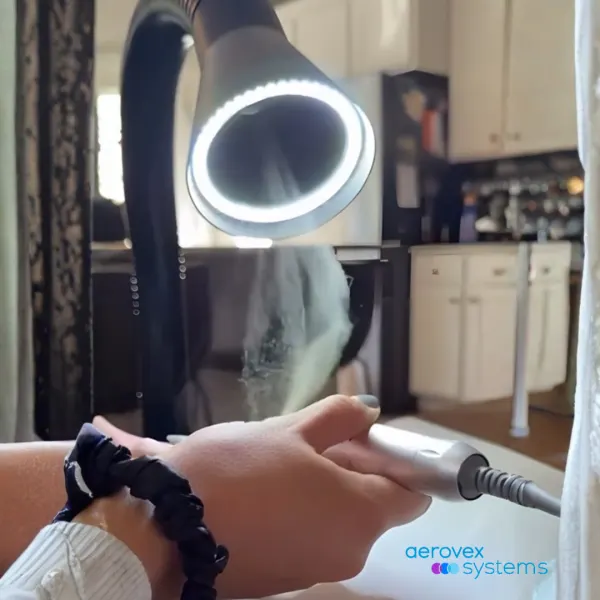
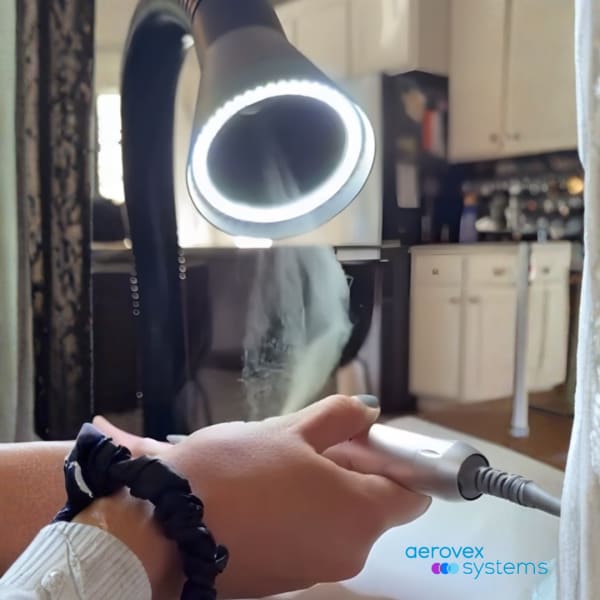
You have several options on where to put the intake duct. The intake can be stationary and located in the tabletop, or it can be movable, like the flexible arms Maggie Boyd installed in her manicure tables (see photos on page 82) at Avanté Salon in Barrington, Ill. Schoon recommends a repositionable intake like Boyd’s. “When you’re filing you need the intake by your hands. When you’re not filing it needs to be near your dappen dish,” he says. On the other hand, Spencer recommends a stationary intake located in the tabletop such as those on vented tables.
“The down-draft technique is a good control option for this process, since placement of a duct for local exhaust ventilation somewhere else would not be as effective. The nail technician uses both sides of the manicure table for tool and product storage, so ventilation by means of a hood on the side of the manicure table would not be a good option. A ventilation duct from above would interfere with client and nail technician interaction. Also, this type of system could potentially pull contaminants into the personal breathing zones of the nail technician and the client,” Spencer says.
According to Schoon, placing the intake near the hand while applying product will create drafts that will cause the liquid to evaporate too quickly. However, in NIOSH’s study Spencer solved this problem by using a multi-speed fan. “A higher airflow volume could be used to collect dust during filing and to help dry the color coat,” she explains. “A lower airflow volume could be used for nail application during the curing of the polymer while the technician is forming the nail,” she says.
As for the outtake, it has to vent to the outside, obviously. When ever possible, the best place to put the outtake is on the roof, says Schoon. “Be careful where you blow the outtake,” he says. “It should be at least 10 feet away from any ventilation intake or your fumes will be pulled right into someone else’s business, or maybe even back into your own.”
If you can’t go up, see if you can go through a window (the least esthetically pleasing solution) or through a wall. Check your local building codes before you do anything, and always make sure your exhaust is not pointed at anyone else’s intake vent or windows.
When exhausting to the outside is not a choice, then a local ventilation system with filters is a good option, says Schoon. The same theories still apply, however. The intake should be at the source of the contaminants, and you need to make sure the filters are up to the job.
Although the cost of installing a local exhaust system may seem high, weigh it in terms of how much value you place on your health. By doing what’s right for you, you’ll be doing right by your staff and clients. And that’s business sense that translates into dollars and cents.