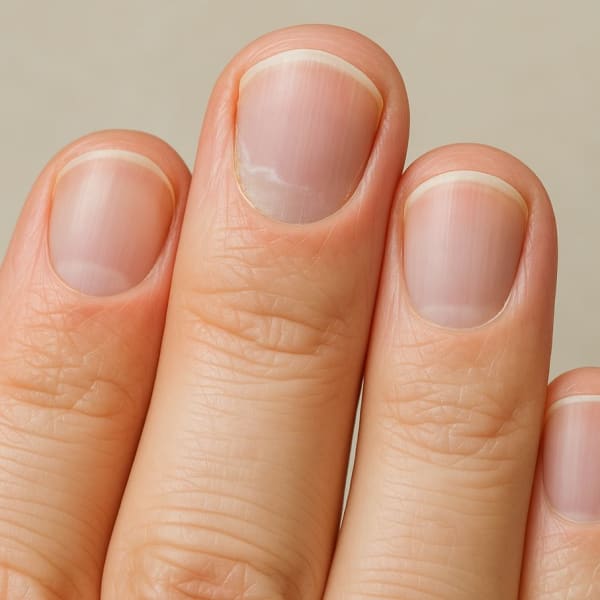
Q: I injured my nail causing the nail to lift from the nail bed. It's been about two months and the nail is growing but it's not reattaching. It's lifted down to the cuticle. I feel only a little pain if I hit or squeeze the nail hard. Is the nail damaged for good? Should I cut it back? Will I be able to apply a tip in the future?
A: Dr. Pheobe Rich: You have onycholysis on the nail, which is defined as separation of the nail plate from the nail bed. This is a common problem which is often caused by an injury to the nail. It usually repairs itself, although it may take six months or more in severe cases. The nail does not glue itself back down to the nail bed once it is detached. It has to grow out and attach as it is growing. Keep the nail cut back as far as you can to prevent a "lever action" from lifting the nail as the delicate cells are trying to reattach to the nail bed. Some people think it helps to keep nail cosmetics off the damaged nail while it is growing back and healing itself. It is very important to take precautions against getting a fungus in a nail that is weakened by the injury. Avoid prolonged water exposure when possible.
Dr. Godfrey Mix: It may just appear that the new nail is not reattaching. In his book, Nails: Therapy, Diagnosis, Surgery, Dr. Scher states that it takes the normal nail about two months to grow the 5 mm out from under the proximal nail fold. The replacement growth of an injured nail is slightly faster. With this in mind, you should be just seeing the edge of the new nail plate growing out from under your eponychium and it would be rather difficult to determine if it was attached or not. It takes approximately six months for a fingernail to replace itself completely. Only time will tell how badly the soft tissues of the matrix and nail bed were injured. The more severe the injury, the more chance there is that the nail plate will grow in malformed or remain unattached from the nail bed.
A number of years ago I hit my thumb with a hammer during a woodworking project. It was a very minor injury but about two weeks later I noticed that the nail was partially detached from the nail bed. Since I worked with fungal nails on a daily basis, I was worried that I would acquire a fungal infection under this injured nail plate. I kept the nail trimmed short and clean. Each day 1 used an antifungal liquid on the area. New nail plate was growing but was malformed on the injured side of the nail. It did not seem that it was attaching to the underlying nail bed. I thought that 1 was destined for a malformed nail for the rest of my life. After about 18 months the nail plate began reattaching to the nail bed and today one would never know that this nail had ever been injured. What I learned from this is to never say never, practice good sanitation, and let nature take its course.
Q: I have a client with strong nails but she develops white blisters on them. When they grow out to the nail edge, they peel and the nail breaks. What is this?
A: Dr. Jamie MacDougall: Your client may have one of several conditions. One possible condition is superficial white onychomycosis, a superficial infection of the top layers of protein in the nail plate. The infection does not usually cause the nail to separate off the nail bed as is the case in the more common subungual onychomycosis, but the infection may eventually damage enough protein so that by the time the nail has grown to the free edge it becomes brittle and fractures. This sort of peeling of the nail plate in layers is referred to as "onychoschizia." Treatment consists of using topical Clotrimazole solution applied twice daily with a toothbrush. No prescription is needed.
Another possibility would be some variant of psoriasis, lichen planus, or other skin condition that causes pitting. These occasionally look like blisters and the nails can appear hard until the nail grows out and then the characteristic brittleness appears.
A third possibility would be a variant of traumatic leukonychia. A slight irregularity in the deposition of nail protein as it forms can lead to the appearance of small partial transverse bands that may occasionally look like blisters. Most commonly this is caused by picking the proximal nail fold or overzealous manipulation with manicure tools.
[PAGEBREAK]
Q: I have a client who wears gels over her natural nails. She hit her nail really hard and although it didn't come off, it did bleed underneath the nail plate. Should I remove the overlay from the nail? Should I be worried about infection setting in?
A: Dr. Jamie MacDougall: When bleeding occurs under the nail plate because of an injury, it is referred to as a "traumatic hematoma." As blood pools in the hematoma, it eventually creates enough pressure that the rate of blood flow is reduced to the point where normal clotting occurs, then further bleeding stops.
As long as the normal skin barriers around the nail are not violated, it would be very difficult if not impossible for an infection to occur. If the nail plate fractures or if the distal edge of the nail has separated away from the nail bed, then caution would be appropriate — cleansing with hydrogen peroxide and applying topical antibiotic ointment should be sufficient to prevent infection. It should not be necessary to remove the overlay.
If the client experiences pain due to the buildup of the hematoma, an old trick is to have her take a paper clip, unfold it, heat one end over a gas flame (be careful not to burn the fingers holding the paper clip) and carefully touch it on the nail plate over the hematoma. It should be possible to melt a small hole in the nail plate which then relieves the pressure. If this is done, then care must be taken as outlined above to avoid infection. Eventually the hematoma will grow out and the nail should return to a normal appearance. One last word of caution: Occasionally, malignant melanomas can appear under fingernails and may look just like a hematoma. A "hematoma" that gradually enlarges may not be a hematoma at all and should be evaluated by a dermatologist.
Dr. Godfrey Mix: Let me start by answering the last part of your question first. Yes, you should be worried about an infection starting under this nail. Whenever there is bleeding, no matter what part of the body, an opening through the outer protective barrier of the body has been created. It sounds as though the protective seal between the hyponichium and the nail plate was broken. This opening in medical terms is called a "portal of entry" and through it organisms, such as bacteria and fungi, can gain entry into the underlying tissues. Given the right condition an infection will ensue. So as a general rule, whenever one sees bleeding she must always think about the possibility of an infection occurring in the area.
If the nail is partially lifted off the nail bed as the result of the injury, I do not think that the gel overlay should be removed. The procedure of removing it would only add trauma to the already injured nail and nail bed. Instead, trim the nail back as short as possible to reduce the risk of further injury from catching it on things and causing further lifting from the nail bed. The client must keep the area clean and apply an antibiotic ointment under the free edge of the nail as protection against infection. At the first sign of an infection (extra pain, swelling, redness, heat, or drainage) the client should seek medical help.