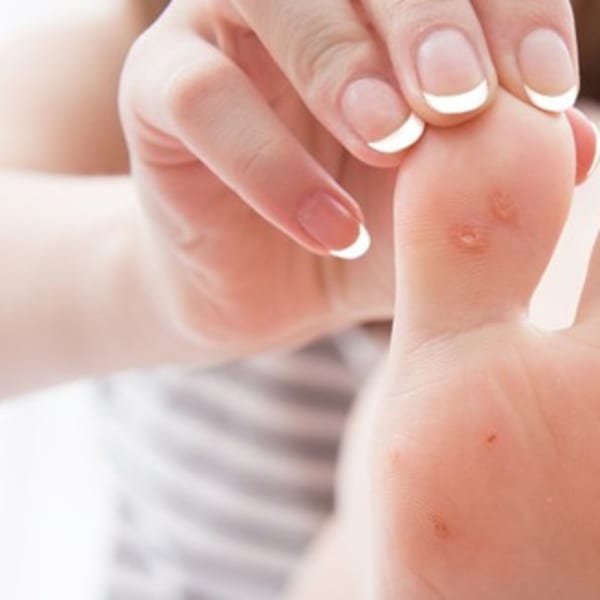
Warts are a common problem caused by contagious viruses. All warts come from direct or indirect contact with another wart. Each wart makes millions of viruses each day that can be passed to other people and cause warts.
by Orville Stone, MD
October 1, 1991
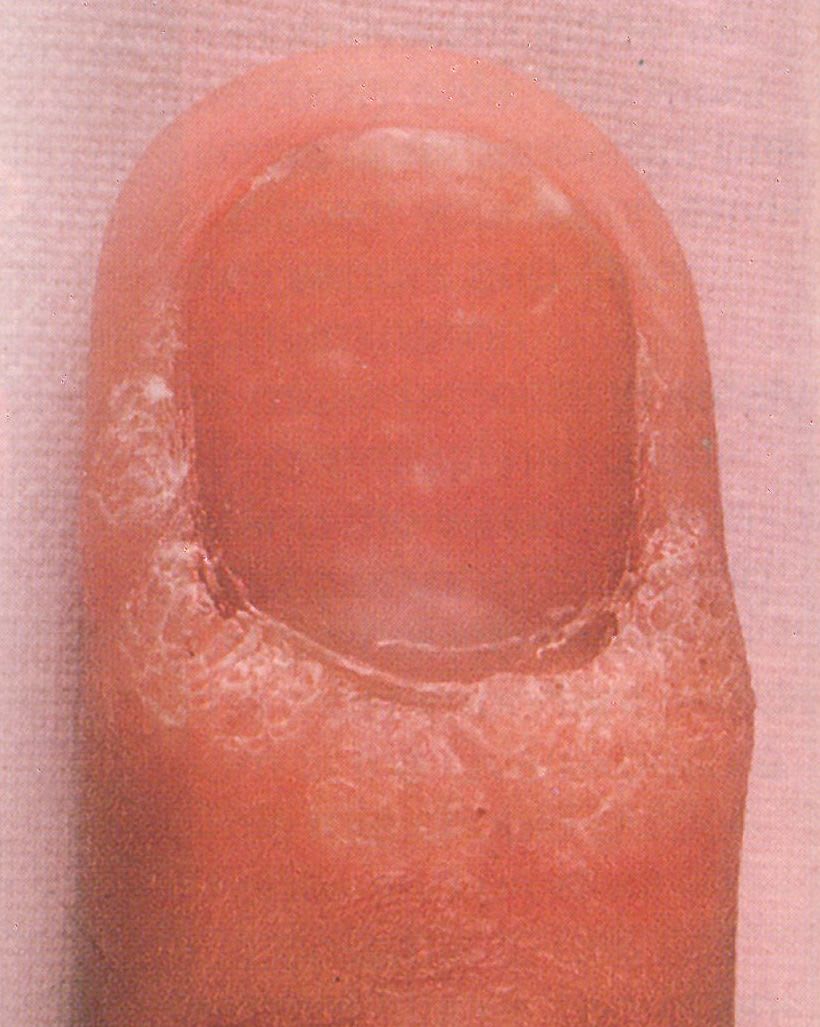
This person suffers from warts on the posterior and lateral nail folds. These warts should be burned or frozen off by a dermatologist before they spread under the nail.
4 min to read
Editor’s Note: “The Nail Doctor” is a monthly health column written by Orville J. Stone, M.D., a dermatologist who specializes in nail diseases. This column is a guide to help you recognize and understand common nail conditions. Remember, however, that your job as a nail technician is to beautify the nails, not to diagnose or treat physician ailments. When in doubt about the nature of a particular nail disorder, you should always contact your state board of cosmetology or a physician.
This person suffers from warts on the posterior and lateral nail folds. These warts should be burned or frozen off by a dermatologist before they spread under the nail.
Warts are a common problem caused by contagious viruses. All warts come from direct or indirect contact with another wart. Each wart makes millions of viruses each day that can be passed to other people and cause warts. Fortunately, only a few of these viruses gain entrance to a skin cell, which is where the virus grows and becomes a new wart.
Ad Loading...
Scrapes, cuts, or open wounds are especially prone to contamination. A wart virus can lie dormant in apparently normal skin before suddenly emerging. Studies have shown that skin cells infected with a wart virus can remain normal with no warts appear. Inactive viruses may be hiding in skin cells, waiting to grow at a later date.
When I treat warts, I caution the patient that there is a 95% to 98% chance of success that the wart will not return. While regular warts can disappear spontaneously without treatment, warts around or under the nail are more persistent, it’s frustrating to freeze or burn off a wart only to have it recur at the prior site. This happens when the virus is lying dormant in nearby skin cells. Contrary to popular belief, lasers are not a magic answer to treating warts. They are just a fancier – more expensive – way to burn off a wart.
People who have a wart near the nail can develop multiple warts from picking at it. The virus gets under the nail, where a wart can grow or be spread to another part of skin.
Warts near the nail appear on the posterior nail fold, the lateral nail fold, or the distal edge of the nail. These w arts can be removed by a variety of over-the-counter products, or they can be frozen or burned off by a dermatologist. Most over-the-counter products contain keratolytics, such as salicylic acid, which eat away at wart tissue. These treatments must be used faithfully to get results.
New Federal Drug Administration rules now allow wart treatments previously available only prescription to be purchase over-the-counter. These treatments can be effective on warts near the nail but they’re disappointing when wart is partially under the nail and are worthless on warts completed under the nail. I compare their effect to going out in your yard and cutting all the weeds off at level. You’re not rid of them.
Ad Loading...
You should refer clients with warts partially under the nail to physician. A wart that appears be progressively destroying the nail should be seen immediately by a dermatologist as it may be cancerous growth.
Warts on the posterior nail fold can spread to the lateral edges the nail fold. Warts at either of these sites should be removed a dermatologist before they spread to areas that are harder to treat. The physician burning or freezing off these warts has to be very cautious because vigorous therapy on the posterior nail fold can damage the nail matrix, causing a permanent nail deformity. I have seen many examples of this.
Warts along the lateral nail fold or distal edge of the nail present a special treatment problem. The wart is almost always partially under the nail’s edge. In my opinion, it is extremely difficult to treat these lesions unless the finger is first anesthetized and any nail over the wart is trimmed away. The entire wart must be visible for successful treatment. I then scrape out the wart tissue and cauterize (burn) the wart’s base. I always warn the patient that the nail plate might not perfectly reconnect to the nail bed after the treatment because of scarring, although I rarely see this problem. I do occasionally see recurrences of the wart that require repeat treatment.
When you’re doing salon cosmetic procedures on clients with warts, make every effort not to break the skin. Also, do work around the wart with your hands or instrument. Wash your hands after servicing the client and sanitize your work surface and tools, disposing of implements such as files that cannot be disinfected.
Recommend a topical treatment for warts around the nail, and refer the client to a dermatologist if the wart is on the lateral or distal nail fold or under the nail itself.
Ad Loading...
Orville J. Stone, M.D., is a dermatologist practicing in Southern Calif. He has taught at medical schools for 30 years. He has published 150 scientific papers; his first paper on nail disorders appeared in 1962
Uncured gel polish and microscopic e-file dust contain active acrylates that penetrate the skin, triggering permanent contact dermatitis. Learn the chemistry behind these irritants and how to protect your clients and yourself.
The Good Patch is a leading wearable wellness patch brand, offering wellness and skincare patches that support everyday needs including energy, sleep, relaxation and more.
Orthopedic PT reveals three daily exercises plus ergonomic advice that can help salon professionals avoid the aches and injuries caused by standing, bending and repetitive overhead work.
From acrylic monomers to airborne bio-dust, the air inside a nail salon carries risks most professionals never see coming. Aerovex Systems reveals the source-capture and room-purification strategies that are setting a new standard for salon safety.
Working in beauty doesn’t have to hurt. Learn how Somatic Movement helps hairstylists, lash artists, and other beauty pros release tension, improve posture, and extend their careers.
As a spa or salon professional, your clients expect more than just beauty—they expect safety, hygiene, and peace of mind. Fungal infections like Athlete’s Foot and Nail Fungus are more common than you think, especially in environments where tools and footbaths are reused without proper sanitation. This blog covers how to stop these issues before they start, using proven infection prevention strategies for salons and spas.
A federal initiative aimed at studying chemical exposure in nail salons has ended due to staffing and budget changes. Here’s what the project set out to do—and what its conclusion means for salon professionals.
For many people, a pedicure is a relaxing beauty ritual. But what most don’t realize is that this simple service, if done without proper hygiene and sanitation, can cause serious infections and long-term health issues.
Onycholysis is the separation of the nail plate from the nail bed. While it may look painful, it typically isn’t—at least not at first. But without proper care, this common nail disorder can lead to infections, deformities, and long-term damage.
Mckenzie Kool, Psychologist, MC, RPsych provides us with guidance on what may or not be helpful in speaking with someone who has suffered a significant loss.
Clients come to you to feel their best—not leave with a viral souvenir. Warts and cold sores can spread fast in busy salons, but a few smart habits make all the difference. Let’s talk about what’s really lurking in your salon (and how to kick it to the curb).
As Earth Day approaches, The Green Beauty Community Foundation and the Green Spa Network invite beauty pros to step forward and embrace sustainability through the Green Pledge--a powerful initiative designed by and for beauty industry leaders.
Don’t cancel Valentine’s Day altogether, urges Jill Palmquist. Instead, think of it as a (frilly, flowery, Champagne-bubbly) wake-up call to fall deeply in love with your own life.
Life coach and Culture Ambassador of Sam Villa, Andrew Carruthers, outlines how to tell if your burnout is temporary - or if it's time to make a bigger career change.