The Nail Doctor helps us interpret brown lines on our nails, and the potential effects of acetone.
by Staff
October 1, 1993
4 min to read
Q: What's causing a thin brown line under a nail?
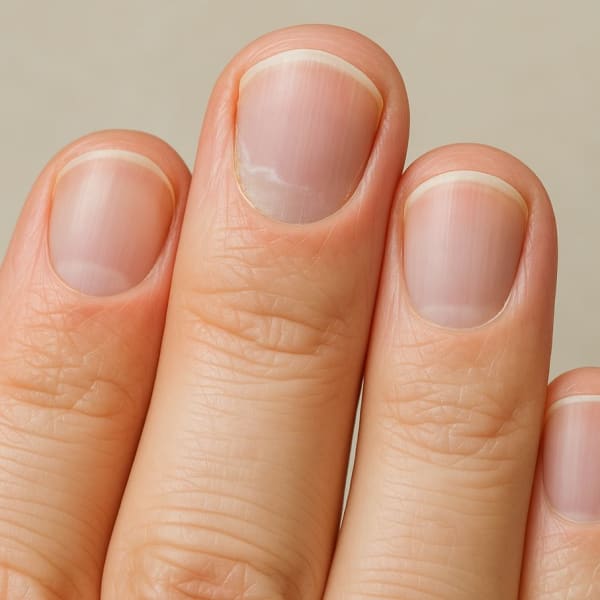
A few of my clients have developed a thin, 1/4-inch- long brown line under a nail at one time or another. It starts in the middle of the nail and eventually grows out. The line appears whether they wear natural or artificial nails. I can usually gently work out the line with a cotton-tipped orangewood stick when it grows a bit past the free edge. One of my clients suggested that it’s a hair that somehow works its way through the body and exits through the nail. I’m not worried about it, but I would like to know what it is.
Ad Loading...
A. The thin dark line could he caused by a number of conditions, none of which is cause for alarm. The symptoms you describe don’t indicate an infection or a tumor. I don’t believe the line represents the same disorder in all people. Some are undoubtedly splinter hemorrhages, which are tiny lines of clotted blood under the nail. Splinter hemorrhages, usually caused by injury to the nail, appear as 1/4-inch-long, pencil-thin brown or black lines located near the middle of the nail.
A traumatized capillary in the nail bed causes blood to “pool” under the nail plate and bed, resulting in a splinter-hemorrhage. The blood usually attaches to the underside of the nail plate and grows out with it. Because of the anatomical relationship between the nail plate and underlying nail bed, these small hemorrhages appear as longitudinal lines.
Lines in the nail plate can be caused by foreign bodies that have lodged under the nail plate. Depending on the client’s hobbies and occupation, it could be almost anything — dirt, hair, paint, or even a small piece of wire. If the object is tiny and the client is wearing nail polish at the time the object becomes lodged under her nail, the line won’t be visible until she removes the polish — making it appear to have developed suddenly. The object will eventually work itself out, or it might need a little prodding from the nail technician.
In response to your client’s hypothesis, a strand of hair cannot work itself out of the body through the nail. Hair is manufactured only by hair follicles, which are not found in the nail unit, and hair cannot be carried in the bloodstream. Even if a hair did somehow get into the bloodstream, it is impossible for the hair to work its way through the blood vessels and then exit the body via the nail. However, hairs frequently do become lodged under the nail.
Q: Can acetone cause liver cancer or cirrhosis?
Ad Loading...
A gentleman in the hazardous chemical industry told me that acetone can cause liver cancer and cirrhosis of the liver. He said the chemical eats through the nail tip and soaks through membranes. How susceptible to liver damage are nail technicians who work around this chemical all day, five days a week? What are the long-term health effects of acetone use? Is there a less toxic chemical that technicians can use on a daily basis?
A: Nail technicians are exposed to acetone for brief periods throughout the day to this chemical. Even if a nail technician were to inhale this chemical at high concentrations throughout each day, she would not suffer permanent damage. If there is improper ventilation in the salon, a nail technician may experience warning signs of overexposure to acetone, such as coughing and eye and throat irritation.
Acetone does not reach the nail bed in any substantial amount. Acetone does not eat through the nail; it evaporates too quickly from the nail. Even the small amount of acetone that may reach the nail bed evaporates instantly through the nail plate.
The main adverse effect of acetone is that it dries out the nail plate. The greatest inherent danger of acetone is its flammability. Used near a flame, acetone can cause a fire, and even an explosion. It should never be used around burning matches or cigarettes.
If the nail technician heeds these safety admonitions, there should be no short- or-long-term health hazard from acetone use for her or her clients. Unfortunately, no other chemicals remove nail enamel as quickly and effectively as acetone. Complete safety information about acetone can be obtained by re-questing the MSDS from the polish remover manufacturer.-Paul Kechijian, M.D.
Uncured gel polish and microscopic e-file dust contain active acrylates that penetrate the skin, triggering permanent contact dermatitis. Learn the chemistry behind these irritants and how to protect your clients and yourself.
The Good Patch is a leading wearable wellness patch brand, offering wellness and skincare patches that support everyday needs including energy, sleep, relaxation and more.
Orthopedic PT reveals three daily exercises plus ergonomic advice that can help salon professionals avoid the aches and injuries caused by standing, bending and repetitive overhead work.
From acrylic monomers to airborne bio-dust, the air inside a nail salon carries risks most professionals never see coming. Aerovex Systems reveals the source-capture and room-purification strategies that are setting a new standard for salon safety.
Working in beauty doesn’t have to hurt. Learn how Somatic Movement helps hairstylists, lash artists, and other beauty pros release tension, improve posture, and extend their careers.
As a spa or salon professional, your clients expect more than just beauty—they expect safety, hygiene, and peace of mind. Fungal infections like Athlete’s Foot and Nail Fungus are more common than you think, especially in environments where tools and footbaths are reused without proper sanitation. This blog covers how to stop these issues before they start, using proven infection prevention strategies for salons and spas.
A federal initiative aimed at studying chemical exposure in nail salons has ended due to staffing and budget changes. Here’s what the project set out to do—and what its conclusion means for salon professionals.
For many people, a pedicure is a relaxing beauty ritual. But what most don’t realize is that this simple service, if done without proper hygiene and sanitation, can cause serious infections and long-term health issues.
Onycholysis is the separation of the nail plate from the nail bed. While it may look painful, it typically isn’t—at least not at first. But without proper care, this common nail disorder can lead to infections, deformities, and long-term damage.
Mckenzie Kool, Psychologist, MC, RPsych provides us with guidance on what may or not be helpful in speaking with someone who has suffered a significant loss.
Clients come to you to feel their best—not leave with a viral souvenir. Warts and cold sores can spread fast in busy salons, but a few smart habits make all the difference. Let’s talk about what’s really lurking in your salon (and how to kick it to the curb).
As Earth Day approaches, The Green Beauty Community Foundation and the Green Spa Network invite beauty pros to step forward and embrace sustainability through the Green Pledge--a powerful initiative designed by and for beauty industry leaders.
Don’t cancel Valentine’s Day altogether, urges Jill Palmquist. Instead, think of it as a (frilly, flowery, Champagne-bubbly) wake-up call to fall deeply in love with your own life.
Life coach and Culture Ambassador of Sam Villa, Andrew Carruthers, outlines how to tell if your burnout is temporary - or if it's time to make a bigger career change.