Q:Are my ridges and the splitting due to cystic fibrosis?
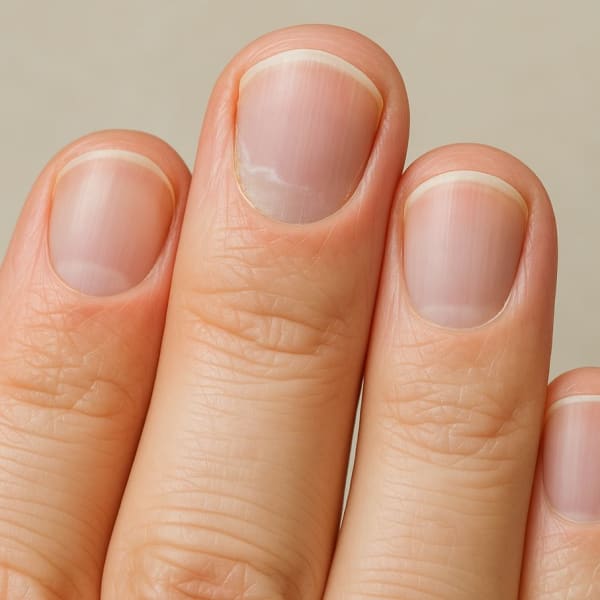
I have the lung disease cystic fibrosis and I have clubbed fingernails. My nails have ridges that split because my nails are very thin. Are the ridges and the splitting due to my lung condition?
A. Clubbing is a nail condition that frequently occurs in patients with lung disease. The ridges and splitting that you describe may also be due in part to the lung disease. However, it is likely that whatever the cause of your nail problems, your splitting and ridging will benefit from the following:
Always apply moisturizers after washing and drying your hands.
Clip and file your nails only after bathing, when the nails are soft and pliable.
Always file your nails in one direction, rather than back and forth.
Whenever an irregularity develops at the end of a nail, file it smooth to prevent it from snagging on something and further splitting the nail.
Although these measures will help the problem, there is no cure for clubbed fingernails.
Q: My client has unusual ridges on her nails. What could be causing them?
I have a healthy-looking, nineteen-year-old client who has never worn artificial nails. When she first came to my salon, I examined her nails and noticed she had unusual ridges on three of her nails. Her nails were otherwise healthy. She is thin and only remembers to eat one meal a day. She is supposed to take vitamins, but she doesn’t. She became concerned by my questions and called a registered dietician and her elector. They told her the ridges could be caused by malnutrition, or at worst, be early signs of cancer. I need to give her peace of mind. What are the ridges caused by?
A: Ridges in natural nails are normal. I am not aware of anyone who developed ridges on their nails because they had cancer. Nor am I aware of any cases where nail ridges were caused by malnutrition. Additionally, you say the client appears healthy, and signs of malnutrition would not be limited to the nails. Someone who is malnourished is very unlikely to appear healthy.
It is interesting that in the second of the two pictures you drew, the ridges were located further down the nail. This indicates that the ridges are growing out, and I would not be surprised if the ridges completely disappear as a new nail plate replaces the old.
I believe the ridges in this woman’s nails are a temporary phenomenon that resulted from a brief malfunction of the nail matrix. In any case, a few ridges in one nail should not cause concern. Please reassure her that she doesn’t have cancer and remind her to eat fruits and vegetables. She’ll be fine.
Q: Several of my clients developed dry white spots on their natural nails. Yet after going a month without polish on their nails, the spots disappeared. Are the spots caused by something internal? Is there a base coat I could use to prevent them? Also, what causes some of my clients’ natural nails to split down the center?
A: The dry white spots are most likely caused by minor injury to the nail, resulting in irregularity of the nail surface. The fact that the spots disappear after a month without polish on the nails strongly suggests that polish use is the cause.
Nail polish protects the nails. Unfortunately, removing polish with solvents such as acetone and ethyl acetate (the two most commonly used solvents in nail polish removers) tends to dehydrate the nail plate, causing layers of the nail to peel away and rough, dry white spots appear. As the old nail grows out, the dry spots gradually grow out with it.
Base coats and other applications will not prevent the dry white spots from developing because base coat is removed with the polish allowing the solvents to come into contact with the natural nail. Loss frequent use of polish removers will help, as will buffing the nail plate after using polish remover.
Nails splitting also can be caused by using polish removers, which can make the nail more brittle, or by trauma to the nail. Some nails just split naturally. Just as hairs develop split ends, the nail may be thinner in some areas and have a tendency to split as it grows long. If the nail matrix forms a thin nail that splits, you can reinforce the nail with an overlay.