Q: I would like to know how a medical professional can say that the menstrual cycle has nothing to do with the way products affect your nails. I would like to respond to The Nail Doctors response to the nail technician who wanted to know if applying artificial nails while a client is on her menstrual cycle could cause the products to crack and crumble off the nail. I would have liked to see the doctor better research how the menstrual cycle affects the nails instead of somewhat brushing the matter off. I had a client about five years ago who was a nurse at a local hospital. I was doing silk wraps on her for a long time with no problem, but suddenly the wraps started peeling off in sheets. I tried fiberglass, but the same thing happened. We went through this for about two months. I asked her if she was taking any medication or had changed her diet or was using a different: hand lotion or suntan oil. She said she wasn't doing anything different. I asked her if she was pregnant and she said no. Well, two to three weeks later she came in and told me she was about two-and-a-half months pregnant.
I would like to know how a medical professional can say that the menstrual cycle has nothing to do with the way products affect your nails. The female body goes through a lot during the month, even if you're not pregnant. I have some clients whose nails are very sensitive right before their period and I have to be very careful when doing their nails.
I would also like to tell you that my mother had a problem with her nails about a year ago. She went to her nail technician for her scheduled appointment and found out she had a fungal infection under all 10 of her nails. She had had her nails done just two weeks before that and there was nothing wrong. Her nail technician told her to see her doctor right away. The doctor told her she had a thyroid problem and that that was the cause of the fungal infection. The doctor cut back all of her nails so she could put the medication right on the nail beds.
Instead of saying that the menstrual cycle or anything else has nothing to do with your nails, do some more research and talk to a gynecologist or a chemist or a doctor who can help answer the question. The nails and hair can tell you a lot about your body, providing clues to disorders such as heart disease and poor circulation. Your nail beds turn a different color when you are cold. Some surgeons still watch the nail beds during surgery so they can watch the blood circulation.
A: It is difficult to determine the exact effect of menstruation on the nails because a fingernail takes six months and a toenail 12-18 months to grow completely. It is certainly logical to surmise that hormones have an effect on the nails; however when a client is having her menstrual cycle, only the live portion of the nail is affected, and that part of the nail is still being formed in the matrix, beneath the cuticle. I don't believe that putting an artificial product on the nails during a client's menstrual cycle affects how the product adheres to the nails.
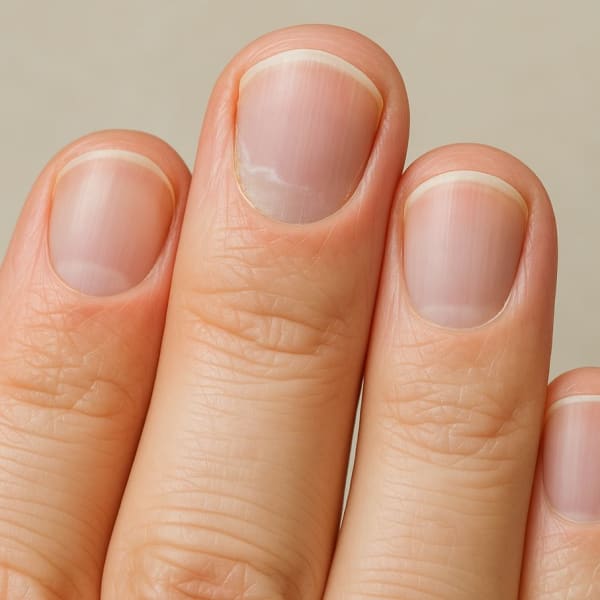
Some conditions have been associated with the menstrual cycle. For example, Beau's lines, which are transverse indentations on the surface of the nail plate, and transverse leukonychia, which are white lines going across the nail plate, have been associated with menstruation.
As for thyroid problems, they do not cause a fungal infection of the nails: however, they may cause the nail plate to separate from the nail bed. It is well known that when this separation occurs, fungus may get in, resulting in a secondary fungal infection.
[PAGEBREAK]
Q: I'm curious about women who are going through menopause or who have had hysterectomies and lack the proper amount of estrogen in their systems. I've noticed during my 19 years as a nail technician a similar symptom in women lacking estrogen: tired toenails.
I can usually pick out women with low estrogen levels by looking at their toenails. I know this sounds strange, but in every case the toenails lack luster and have dry ridges, usually on the big toenails. The condition doesn't show up as often on the fingernails.
These clients always tell me they aren't on estrogen. Their general complaint is that their skin is also very dry, regardless of how often they apply a moisturizing lotion. I tell them to mention their complaints to their doctor, and its amazing how many of these customers come back and tell me the doctor put them on estrogen and how they've already noticed a difference in their skin and toenails. They say they even feel better overall.
I would like your opinion on my observations. Also, I understand that some people have problems taking estrogen and I wonder if there is anything else, such as vitamins, that will help this condition.
A: To the best of my knowledge, there are no specific changes to the nails associated with post-hysterectomy or menopausal women. However, estrogen levels do have an effect on all body systems. It is true that nails become more dry and dull with age, and hormones may indeed play a role in these changes. Changes in the body's hydration levels also affect the skin; thus, I do believe your astute clinical observations may be valid. I have had patients tell me the same thing regarding estrogen and their nails.
Vitamins occasionally have helped and are therefore worth a try. Biotin, specifically, has been reported to improve brittle nails.
Q:I have a few clients who sometimes get a deep crack in the middle of the nail plate. Sometimes there is bleeding or the nail is lifting on each side of the crack. What can I do to prevent this problem? How can I explain to these clients that they should not receive any type of service on that nail?
A: A deep crack in the middle of the nail plate, particularly if associated with bleeding and/or lifting of the nail (called onycholysis), may be a sign of a possible underlying disorder. A fungal infection (onychomycosis), psoriasis, a nail bed infection, and many other conditions can cause this type of nail defect. Even a tumor, benign or malignant, is capable of causing a split nail with bleeding. Therefore, I agree with you that no service should be performed on such a nail. I suggest that you advise each of your clients who have this problem to see a dermatologist who can determine the cause of the split. The doctor may perform a series of tests to arrive at a specific diagnosis. These tests may include a potassium hydroxide wet mount and a culture to test for fungus. An X-ray and a nail biopsy may also be done to determine the cause of the problem.
Q: Is there a difference between acetone from the hardware store and from the beauty supply?
Q: Recently I was told by a product representative that there was a difference between acetone purchased at a hardware store and acetone purchased at a beauty supply store. He explained that "industrial" acetone from a hardware store contains a carcinogen that attaches itself permanently to the liver. When I mentioned this to another representative, she said she had never heard of such a thing and said she thought "100% acetone was 100% acetone." Can you shed some light? My school encouraged us to buy acetone at the hardware store because of the lower cost.
A: Acetone is not a carcinogen; it is the safest solvent technicians use, next to water. And acetone is acetone, regardless of where you purchase it. There are different grades of acetone; the cheaper grades contain oily impurities that can remain on the nail and cause product to lift. A disadvantage of industrial acetone is that it is more drying than cosmetic preparations because it does not contain any lubricants. I advise my patients to use acetone-free nail polish removers instead. These are less drying to the nail.