Q: A client came to me requesting a full set of acrylics. I examined her hands and noticed half of the nail was missing from one finger. The remainder of the nail was raised up and looked as if it could be easily pulled off. It was jagged around the edge as if chewed, and the rest of it was soft. It looked like tinea unguium [a fungal infection of the nail complex by a dermatophyte]. Another finger had two spots of mold on it, while another finger was red and swollen around the cuticle. The client said that she wasn’t nail biter and that she always wore acrylics. I advised her to avoid artificial nails and to see a doctor. My manager told me I had to perform the service with the client promising that she would seek medical advice. I had problems placing tips on her nails with a gel adhesive. Why? The client eventually saw a doctor and was told there was no problem with her nails.
A: The problem that you describe certainly indicates that there was a defect of some sort with the client’s nails. You were correct in advising her against acrylics and to seek medical advice. Nails that are jagged with partial portions of the nail plate missing are highly suggestive of tinea unguium, as you suspected. In addition, if there was a finger that was red and swollen around the skin and cuticle area, these are definitely symptoms of a paronychia, which is most cases in women is caused by the yeast fungus candida.
The most likely reason you had problems applying a tip with a gel adhesive is that her nails were diseased or abnormal, which would surely result in the inability of the tip to adhere correctly to the nail. This further stresses that your assessment that it was a nail disorder was correct.
Q: Can I fix a client's nail that constantly grows to one side?
A: A nail that continually grow to on side is referred to as a malalignment of the nail plate. This condition may be caused by a number of things. One possibility would be an abnormal growth of the nail bed in which the skin under the nail bed in which the skin under the nail pushes the nail in an unusual direction. Another possibility would be a nail that has been injured, resulting in scar formation in the nail matrix (growth center of the nail) or the nail bed.
Ask your client if this has happened. Both of these situations require intervention by a dermatologist and are not something the nail technician can fix herself.
Bony abnormalities of the distal phalynx, which is the bone underneath the nail unit, will also cause nails to grow incorrectly. An abnormality, such as a bone spur, would push the nail in an incorrect direction, causing in to be misaligned and grow to one side. This condition can only be diagnosed by an X-ray, and therefore requires medical intervention. Joint problems, which can occur in an older client who has osteoarthritis with inflammation of the distal interphalangeal joint (located very close to the cuticle), or in younger people with rheumatoid arthritis, can also cause crooked nails. These conditions cannot be corrected by the nail technician and require a dermatologist’s evaluation. It is not likely that this is a problem that you can solve (or hide) by applying an artificial nail or reshaping the nail with a file. I strongly urge you to advise your client to seek medical attention.
Q: Do ridges, splitting, and shredding at the end of the nails indicate a physiological problem?
A: It sounds like brittle nail syndrome, which occurs when the nail plate is unable to maintain moisture and become dehydrated. It occurs most frequently in individuals who already have a tendency for dry skin. This is because the syndrome is like having “dry skin of the nails.” There are many causes for this syndrome. In an otherwise healthy individual this can be treated by applying moisturizers to the nails on a regular basis and by taking oral biotin supplements, a minor B vitamin, daily. In addition, people with this disorder should avoid nail products containing formaldehyde or acetone.
Occasionally, the syndrome can be caused by medical problems. These include an underactive thyroid, low iron or zinc levels in the blood, or, if a sudden onset of this condition occurs in an elderly person, it might indicate a systemic disorder. All of these cases require a doctor’s evaluation for the possibility of an internal or hormonal problem.
Excess use of soap and water with strong chemicals or detergents can also be the cause of brittleness. If so, minimize exposure by wearing gloves and by not immersing hands for long periods.
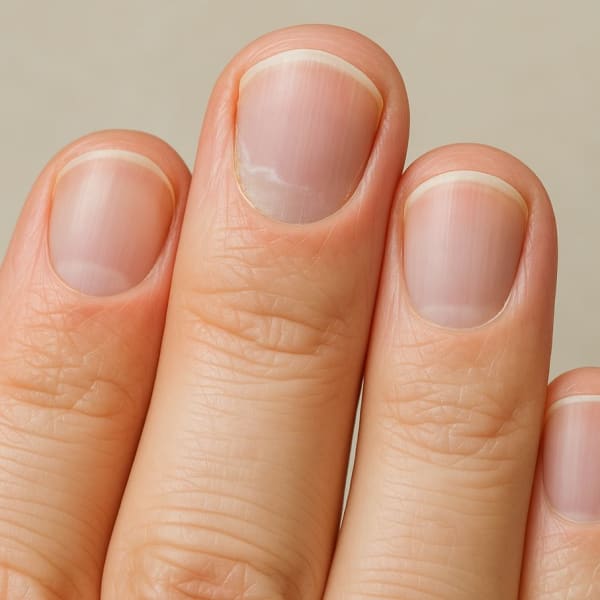
If there are only ridges in the nails going from the cuticle outward with no increased splitting, shedding, or peeling, then this may simply be due to the aging process. As individuals get older their nails become more ridged; this is similar to having wrinkles on the skin. There is no way to prevent ridges associated with aging, but lightly buffing the nails no more than once every 10 days should eliminate them (excessive buffing will make the nail plate too thin).