Q: I accidentally clipped my nail at the lunula when nipping acrylic and a large portion of my nail was removed. I treated it with iodine and kept it bandaged until it started to heal. Will my nail ever grow back?
A: Since the nail matrix or growth center ends underneath the nail plate in the lunula, an injury to the nail matrix can result in an abnormal nail or even loss of the nail plate. If the nail matrix has been injured slightly but no scar formation has developed, then the nail will eventually grow back, although it may take as long as six months. On the other hand, if the nail matrix has been injured severely enough to cause permanent scarring, then the nail will either grow back abnormally or it will not grow back at all. If the new nail growing in from the cuticle area does not appear to be normal, I recommend seeing a dermatologist.
Q: I have a male client in his 70s with nails that turn white then peel off. He went to a dermatologist who prescribed a cream called Mentax. So far, no results. Why is this happening?
A: There are several problems that cause nails to turn white and peel off. One of these is a fungal infection, and the client’s dermatologist must have made this diagnosis if Mentax cream was prescribed because it’s an antifungal preparation. Your client needs to be patient since it can take as long as four to six months to clear up a nail fungus. Ask your client if his dermatologist took samples from his nail to test for fungus because other conditions can cause white nails. Dehydration, for example, can cause the nails to become white and peel off. In addition, a systemic disease stemming from thyroid, liver, or kidney disorders can cause nails to peel and may even turn them white. Therefore, if no fungus is present in the nail, a medical evaluation by a physician would be recommended.
Q: What can be done about skin that grows up on the underside of the free edge? When I cut it, it grows back, and when I push it back it hurts.
A: First of all, you should never cut the skin or even push it back aggressively because it could bleed or become infected. However, it is not normal for skin to grow on the underside of the free edge (although for some people, their skin may connect at a higher point on the nail). One reason this could be happening is that you have poor circulation to the fingers. Also, people who have beginning stages of a connective tissue disorder may develop skin growing on the underside of the free edge. In either case, it’s important to seek medical evaluation by a dermatologist to eliminate the possibility of a systemic condition.
[PAGEBREAK]
Q: I have a sore under my nail plate on two of my fingers. They’re painful until I drain the pus, then in a few days the sores start hurting again. I think they’ve been misdiagnosed as fungus. Please suggest a treatment.
A: A sore under the nail plate with pus indicates an infection. The most common type of infection under the nail that produces pus is bacterial rather than fungal. A dermatologist should obtain a sample from underneath the nail for a culture to identify the problem, then recommend the proper treatment. It is not advisable to treat this condition on your own.
Q: I have a natural nail client in her early 30s who has pitted nails. What causes this condition and what can I do to help?
A: The most common cause of pitted nails is nail psoriasis. Other conditions, such as trauma, may cause pitted nails, but they are very rare. Ask your client if she has a family history of psoriasis or whether she has any skin lesions, which could be due to psoriasis. If the pitting is extensive or if the client says there is a history of psoriasis, then I would recommend she see a dermatologist because there are a number of treatments that can help pitted nails and/or nail psoriasis. In the meantime, be very gentle when manicuring her nails.
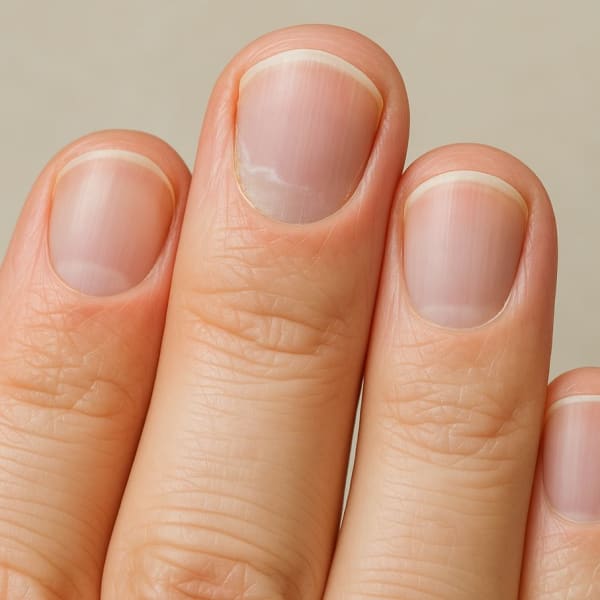
Q: I have a male client who has fine, white lines down the middle of his nails. His nails are also arched in the middle. Could dehydration be the cause?
A: Fine, white lines down the middle of the nail can be caused by many different things. It is possible that dehydration may be partly responsible; however, a fungal infection or injury to the nail matrix may also cause fine, white lines. If this is accompanied by arching in the middle of the nail, this is not normal. If the condition does not clear up on its own over a period of two months or so, then I would recommend your client see a dermatologist. Some form of treatment may be required.