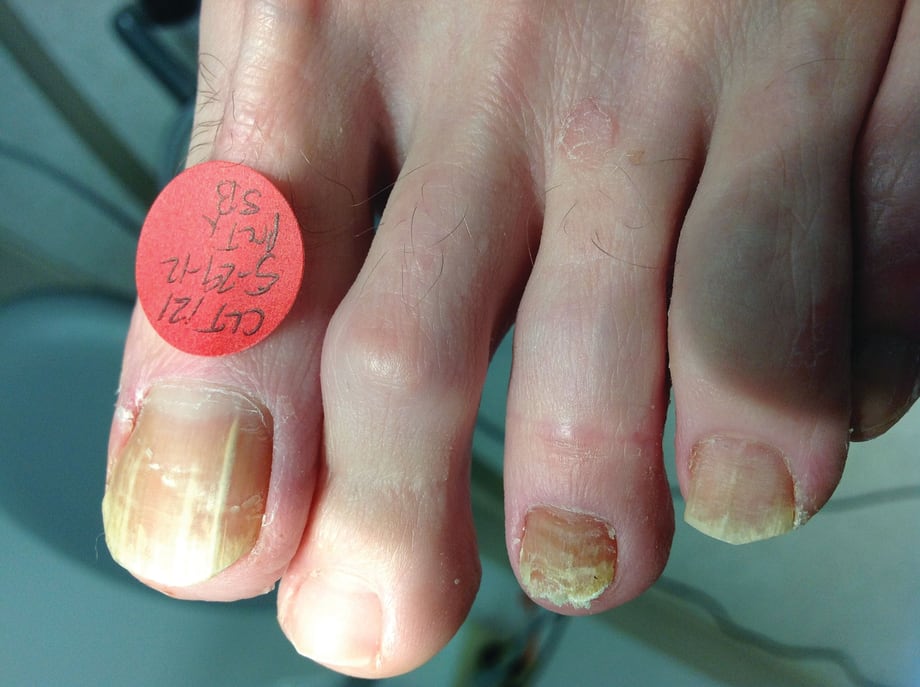
In the past, treatment for nail fungus was limited to home remedies and a prayer, topical treatments and some hope, or an oral prescription with a doctor’s oversight. Doctors needed to monitor patients because the medicine was known to cause liver damage.
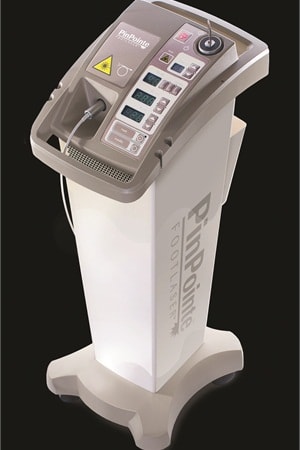
Today another option exists: laser treatment. “The laser creates a thermal effect,” explains Steve Duddy, president and CEO of NuvoLase, Inc., the manufacturers of PinPointe FootLaser. “Temperatures are raised to levels high enough to impact the growth of the fungus without causing discomfort to the patient,” says Duddy.
Ad Loading...
The PinPointe FootLaser lauds itself as the “first light-based device to receive FDA clearance specific to the treatment of onychomycosis” and, reportedly, over 100,000 patients have been treated with PinPointe FootLaser worldwide. The FDA restricts laser companies from making a claim of curing a fungal infection. Instead, specific wording must be used to offset any promises. “All lasers today with a clearance specifically for treating onychomycosis have the same label, and it is as follows: ‘The PinPointe FootLaser is indicated for use for the temporary increase of clear nail in patients with onychomycosis (e.g dermatophytes Trichophyton rubrum and T. mentagrophytes, and/or yeasts Candida albicans, etc.),’” says Duddy. The “temporary increase of clear nail” is the only claim the FDA supports currently.
Word games aside, laser treatment has an impressive performance record. PinPointe FootLaser boasts a 71% sustained improvement rate among clients, but individual doctors note rates can be even higher. “With more aggressive debridement before treatment, along with post-treatment environmental controls, as well as follow-up topical preparations to the skin and nails of the feet, success rates can be as high as 88%-92%,” says George Trachtenberg, D.P.M., who runs a practice in Vestal, N.Y.
The severity of the fungal infection is one factor that determines success. “With mild-moderate cases, patients have an excellent chance of success,” says Michael Bilinsky, D.P.M. and podiatric laser specialist near Beverly Hills, Calif. “With severe cases, clients have seen dramatic improvement, but when they expect to end up with a normal nail, they can be disappointed.” Dr. Bilinsky warns his patients that laser treatment offers absolutely no guarantee, so he prefers to under-promise and over-deliver. Success rates are affected not only by the severity of the infection, but also by a number of extenuating factors, including genetics, age, a patient’s health, footwear, hygiene, and more. Doctors prescribe a post-treatment plan, and success often hinges on how closely patients follow it.
Laser treatment is not covered by insurance as the condition is considered a cosmetic problem rather than a medical one. However, the cost isn’t so overwhelming as to be prohibitive, and patients have the added advantage of being able to shop around for their doctor instead of being assigned to one by an insurance company. “No two lasers, no two doctors, no two patients are the same,” says Dr. Bilinsky. “Some doctors will laser only the affected nails; some will laser all 10 nails since fungal material is lying on top of all the nails, even ones that appear unaffected.”
The treatment takes 20 to 40 minutes on the first visit. Costs average anywhere from $1,000 to $1,500. Some doctors charge on the low end for a first-time visit, then up to $500 for follow-up visits. Other doctors charge in the $1,200 to $1,500 range for all 10 toes, with one to two follow-up treatments included in the initial price. “The life-cycle of fungus includes a dormant stage,” explains Daniel Waldman, D.P.M., FACFAS, owner of Blue Ridge Foot Centers in Asheville, N.C. “Many doctors schedule a follow-up visit not only to monitor the growth of the fungus, but also to make sure patients are performing home care,” says Dr. Waldman.
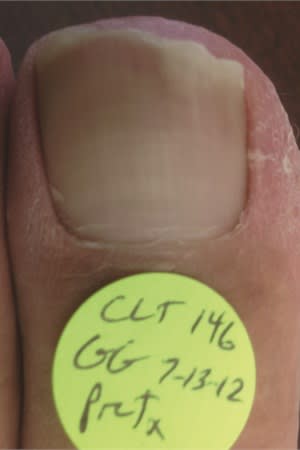
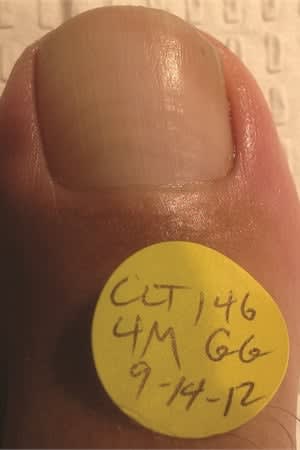
The laser penetrates the nail plate, so the nail is not removed nor will patients lose their nail post treatment. In truth, the treatment may seem anti-climactic. Once the laser has been applied, patients won’t see improvement for four to six months, with “maximum improvement not seen for a year,” explains Dr. Bilinsky. Follow-up care is crucial. For toenail infections, many doctors, including Bilinsky and Waldman, insist patients purchase an ultraviolet shoe sanitizer, which kills up to 95% of bacteria, fungus, and virus that can land on and grow on the foot.
Can I Bring This Into the Salon?
As salons expand into medi-spas, services such as skin peel, Botox, and Juvederm have shown up on menus. These services often require providers who possess training beyond what’s covered with a standard cosmetology license, such as a registered nurse working under a doctor’s license. Could laser treatment be the next add-on? Al Voss, a regulatory consultant for NuvoLase, offers salon owners some broad guidelines on the possibility. “The FDA says the laser machine is a prescriptive medical device that must be used by, or under the lawful order of, a person who practices medicine,” explains Voss.
This means a licensed medical practitioner (M.D., O.D., D.P.M., N.P., or P.A.) must prescribe the laser treatment. That seems clear enough, but everything becomes gray when the topic turns to who can carry out the prescription. Each state has its own set of rules, so it would seem the solution is to simply call the state board to learn the rules of your state. “But it’s not as easy as that,” says Voss. For example, in one state, the medical board may say only a physician can operate the laser, but other state regulatory boards may determine they don’t agree with what the medical board says, because they are responsible for making regulations for their own licensees. “It’s actually quite territorial,” notes Voss. “Dermatologists and plastic surgeons see esthetic treatments as within their province and are quite active in helping states regulate these procedures.”
A laser machine can run anywhere from $50,000 to $75,000, cost prohibitive for most salons. However, in states where regulations allow a visiting physician or licensed practitioner to administer the laser, salon owners may find opportunities to offer the service to clients in the salon. One place to start is by developing a relationship with a local podiatrist and dermatologist to instigate an opportunity for the doctor to visit the spa on scheduled days to perform laser treatment on spa clients.
Ad Loading...
To learn the rules governing your state, call the medical board and your profession’s regulatory board to determine who can carry out the licensed practitioners orders. For more specific information, find a laser provider in your area or contact NuvoLase’s customer service department.
Uncured gel polish and microscopic e-file dust contain active acrylates that penetrate the skin, triggering permanent contact dermatitis. Learn the chemistry behind these irritants and how to protect your clients and yourself.
The Good Patch is a leading wearable wellness patch brand, offering wellness and skincare patches that support everyday needs including energy, sleep, relaxation and more.
Orthopedic PT reveals three daily exercises plus ergonomic advice that can help salon professionals avoid the aches and injuries caused by standing, bending and repetitive overhead work.
From acrylic monomers to airborne bio-dust, the air inside a nail salon carries risks most professionals never see coming. Aerovex Systems reveals the source-capture and room-purification strategies that are setting a new standard for salon safety.
Working in beauty doesn’t have to hurt. Learn how Somatic Movement helps hairstylists, lash artists, and other beauty pros release tension, improve posture, and extend their careers.
As a spa or salon professional, your clients expect more than just beauty—they expect safety, hygiene, and peace of mind. Fungal infections like Athlete’s Foot and Nail Fungus are more common than you think, especially in environments where tools and footbaths are reused without proper sanitation. This blog covers how to stop these issues before they start, using proven infection prevention strategies for salons and spas.
A federal initiative aimed at studying chemical exposure in nail salons has ended due to staffing and budget changes. Here’s what the project set out to do—and what its conclusion means for salon professionals.
For many people, a pedicure is a relaxing beauty ritual. But what most don’t realize is that this simple service, if done without proper hygiene and sanitation, can cause serious infections and long-term health issues.
Onycholysis is the separation of the nail plate from the nail bed. While it may look painful, it typically isn’t—at least not at first. But without proper care, this common nail disorder can lead to infections, deformities, and long-term damage.
Mckenzie Kool, Psychologist, MC, RPsych provides us with guidance on what may or not be helpful in speaking with someone who has suffered a significant loss.
Clients come to you to feel their best—not leave with a viral souvenir. Warts and cold sores can spread fast in busy salons, but a few smart habits make all the difference. Let’s talk about what’s really lurking in your salon (and how to kick it to the curb).
As Earth Day approaches, The Green Beauty Community Foundation and the Green Spa Network invite beauty pros to step forward and embrace sustainability through the Green Pledge--a powerful initiative designed by and for beauty industry leaders.
Don’t cancel Valentine’s Day altogether, urges Jill Palmquist. Instead, think of it as a (frilly, flowery, Champagne-bubbly) wake-up call to fall deeply in love with your own life.
Life coach and Culture Ambassador of Sam Villa, Andrew Carruthers, outlines how to tell if your burnout is temporary - or if it's time to make a bigger career change.