The following article is being written with the sincere desire that the information provided will shed light on a most confusing subject to sculptured manicurists. By background, I have been a dentist for twenty-seven years and founded a sculptured nail company, “Creative Nail Design, Inc.”, two and a half years ago in order to combine my medical knowledge and a chemical background to bring health and beauty together in an important and neglected area of the beauty industry.
I have conducted a research study on the subject of “Fungus and Mildew” and wish to share this information with the reader.
Fungal organisms are contagious and are spread by skin contact with another person. The organisms are in the same family that causes athletes foot and we know how easily that problem is spread!
The resistance of the person’s body often plays an important role in catching and/or spreading the organism. For example, if the operator and/or patron are on medications like antibiotics, etc., the person’s body will have the bacteria suppressed and often times this will allow virus and fungal organisms to grow unchecked. Thus it is important to make the manicurist aware of these facts so she may take proper precautions with her patron or herself.
If the manicurist is an active or latent carrier of fungus, she must wear surgical gloves when working to avoid infecting her patrons. If she sees an active case of fungus, placement of nails must not be done. Treatment consists of using an over-the-counter preparation called liquid Tinactin three times a day until the problem clears.
(Creative takes no position officially of endorsing herein named “brand” products i.e., “Tinactin”. Use of said products is at the sole risk of reader, and Creative Nail Design, Inc. shall be held harmless for said use.)
Nails ... their composition and care
The following is factual data relating to nail physiology, pathology and anatomy that may be of help in conducting your classes or in answering questions.
Anatomy —
1) The nail plate consists of three layers of dead cells all of which arise from different portions of the nail matrix.
2) The nail matrix is composed of cells containing keratohyalin granules, which is the material responsible for the nail cells hardening.
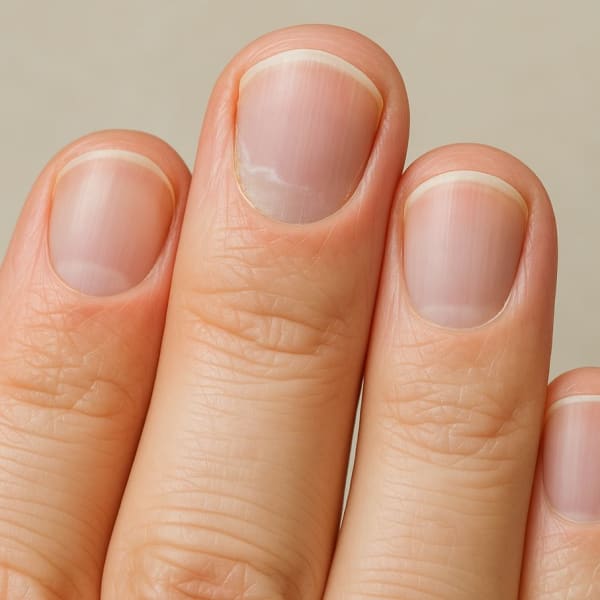
3) The Lunula (or half moon) is white because it is composed of the new cells from the matrix which contain the keratohyalin granules. As the nail grows the cells lose the granules and become clear.
4) The Nail Bed — is composed of arteries, veins, capillaries, lymphatic system, and nerve tissue. It is interesting to note that the bed is composed of ridges of connective tissue that have connections to a thin, tight tissue covering bone called the periosteum. The nail bed function is to supply nutrients to the surrounding living tissue, remove waste products, and act as a support for the nail plate.
5) The keratohyalin granules are composed of
Amino acids 48%
Sulfur 3.2 to 5%
Lipids (fats) 14%
Water 14%
The balance of the material is calcium phosphates and carbonates.
Pathology —
The chief concern we have is to address the problem of fungus and fungus like forms.
1) For practical purposes one may assume that all the terms for fungal forms ie. fungus, mildew, mold etc. are caused by the same organisms. Some organisms cause a green, blue or orange color, but they are basically all the same.
2) Fungal organisms are everywhere in nature, and are on the human outer tissues ie. skin and nails at all times, but in different degrees. The same statement applies to bacteria. The nails are more susceptible to fungal infections because the fingers and toes are cooler, due to a decreased blood supply to these extremes of the body anatomy. Combine this fact with the knowledge that the fingers are often damp and we have a nice breeding ground for the fungal organism’s.
3) Medically, many diseases lower the immune system of the body and a sick person, or one on medication, is more susceptible to fungal disease. This reasoning follows my discussion of allergy as it relates to antigen-antibody relationships.
PREVENTION & TECHNIQUE —
The best preventative measures for avoiding fungal infections are as follows:
1) Consider the health status of the patron — if she is in poor health, the risk is greatly increased for problems.
2) As everyone is a “carrier” of fungal organisms, the manicurist must be made aware to be on the alert for an epidemic of fungus among her patrons. There is an increased chance she may be the person spreading the fungus. The best advice to a manicurist is to suggest they disinfect their hands by scrubbing, with a preparation called HIBICLENS, which is bacteriocidal (kills the bacteria and/or fungal organism.) Rinse with clear, warm water and dry.
3) Use “Hibiclens” routinely on patrons. Have the patron scrub their nails for at least 15 seconds with a stiff brush and rinse with warm water. This is an excellent routine for all patrons, if the manicurist is truly devoted to their profession.
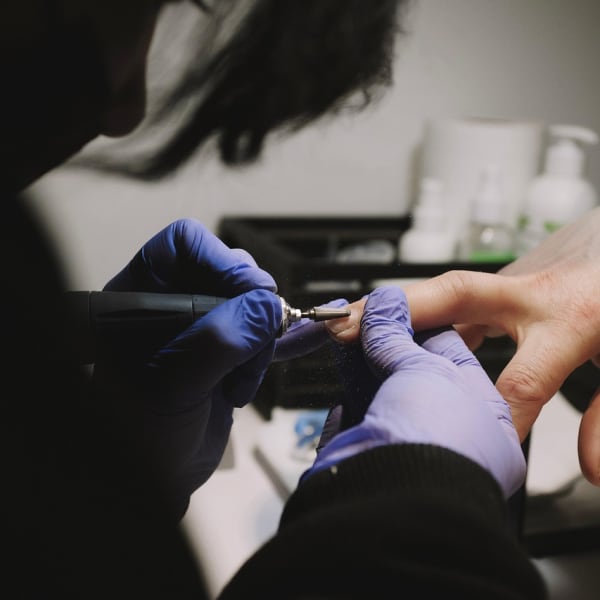
4) Prepare the nail with a minimum of roughing up with a disc.
5) Use Nail Fresh at least 2 or 3 times — this step is vital to kill any remaining germs, to remove grease and oil, and to remove excess moisture.
6) Carry out the sculpting with clean instruments and technique.
Treatment
1) When fungus is present, remove the sculptured nail and suggest the patron consult a dermatologist.
2) Treatment by the manicurist is not indicated, as it is beyond the scope of their license.
3) We are not advocating treatment by a manicurist, but I suggest that Hibiclens is available over the counter and is an excellent germicidal preparation. Used in conjunction with over the counter anti-fungals such as liquid Tinactin 3 times daily the fungal problem may be helped. The point to stress is that our official position is consultation with a dermatologist.
Allergies ... how and why they affect us
Many thousands of people have allergies from causes such as pollen, dust, foods, hot, cold, excessive moisture, excessive heat, medicines, chemicals and even to other people!
What is an allergy? By definition it is a manifestation of anaphylaxis.
Anaphylaxis is defined as a severe state of sensitivity after exposure to an antigen. The anaphylactic reaction may be mild, or so severe that a person may die.
An Antigen is usually a protein agent such as pollen, bacteria, or can be chemical such as any material used in the beauty business.
Anti bodies — are substances produced by the Reticuloendothelial system of the body and are responsible for building up a person’s immunity to antigens.
Histamine — a substance released by the sensitive cells of the body.
What happens? The antigen in most of us is neutralized by a corresponding anti-body and we acquire an immunity to the offender. Each time the enemy (antigen) hits our body one of our soldiers (anti-bodies) captures and thus neutralizes the invader.
If the foreign antigen hits our body and no anti-body has been built up we have a situation where the cells release histamine, and this produces the classic symptoms of allergy such as skin rash, red and hot skin, nasal and throat problems, G.I. problems such as vomiting etc., headache, and nervousness. In a nut shell the antigen becomes a poison to our body.
The allergy may be caused by small or large exposures to the antigen, and one may not predict when a person will become allergic to anything. We do know that certain people are born with a reticuloendothelial system which is not capable of manufacturing anti-bodies correctly. These people are highly sensitive and allergic to many antigens.
What’s the cure? Anyone showing signs of an allergy to beauty products should be referred to an M.D. and never be exposed again to the offending antigen.