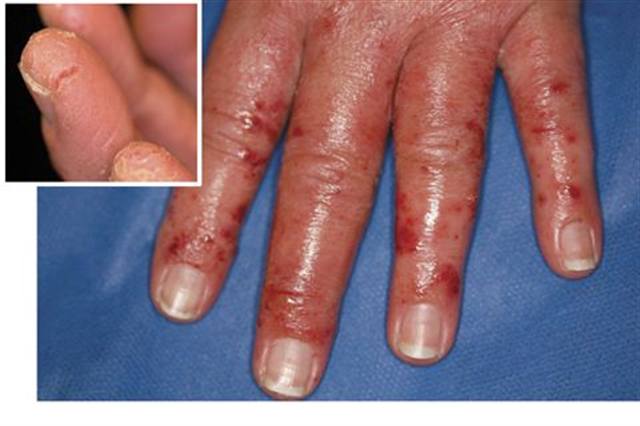
Caused by allergens that come into contact with the skin, allergic contact dermatitis often clears up on its own when sufferers avoid the offending agent.
Dermatitis (dr-m-’ti-ts):inflammation of the skin. When an allergen comes into contact with the skin, redness, swelling, a rash, or blisters develop, creating an itchy, irritated area on the skin.
The body has a fascinating way of protecting us. A blister will develop to protect burned skin; the heart pumps faster to respond to exercise; the body sweats to cool us off. Sometimes, the protective response of the body is to become sensitive, causing a reaction when we don’t want it to. We sneeze from pollen; our eyes itch from being around cats; our skin becomes irritated (and then we become irritated) when we walk through poison ivy. These reactions are the body being hypersensitive to its environment.
Ad Loading...
"There are two types of hypersensitivity: immediate-type hypersensitivity and delayed-type hypersensitivity," says Dr. Peter Schalock, assistant professor of dermatology at Harvard Medical School. An example of immediate-type would be hives or the throat starting to close. Delayed-type could be a rash or other reaction on the skin, and it might take hours or even days to appear. "If a client were to react to salon products," says Dr. Schalock, "delayed-type hypersensitivity is the more likely response."
Contact dermatitis is an example of hypersensitivity. Literally defined as "inflamed skin," dermatitis appears in a localized area as a rash, small blisters, swelling, or redness. Contact dermatitis has two categories of distinction: irritant contact dermatitis and allergic contact dermatitis. Irritant contact dermatitis is caused by a substance that is likely to cause a reaction in nearly anyone who is exposed to it in large quantities.
Allergic contact dermatitis is caused by your body coming into contact with an allergen and reacting. It’s the body’s immune system being hypersensitive to a foreign agent. "The body may come into contact with the allergen through direct contact, such as touching, or through airborne contact, such as an allergen landing on the skin," says Dr. Schalock. When the allergen comes into contact with the skin, redness, swelling, a rash, or blisters develop, creating an itchy, irritated area on the skin. If the exposure is brief and then removed, the reaction will clear on its own.
Nearly anything can be the cause of allergic contact dermatitis, because each person’s body responds differently to allergens. So, jewelry, plants, lotions, glues, polish, acrylics, wool, gasoline, perfume, metals — the list goes on and on — could cause the skin to react and swell in one person, but be completely benign to another. Another complexity of allergic contact dermatitis is that a person could have been in contact with a substance — a lotion, detergent, salon products — for years with no reaction and then suddenly develop a reaction without explanation.
"Once a reaction develops, it’s a permanent reaction," says Dr. Bruce Robinson, a clinical instructor of dermatology at Mt. Sinai Hospital who also has a private practice in New York City. This can make it difficult to assess the cause because many times nothing has changed except the body’s reaction. It often takes a bit of detective work, says Dr. Robinson.
Ad Loading...
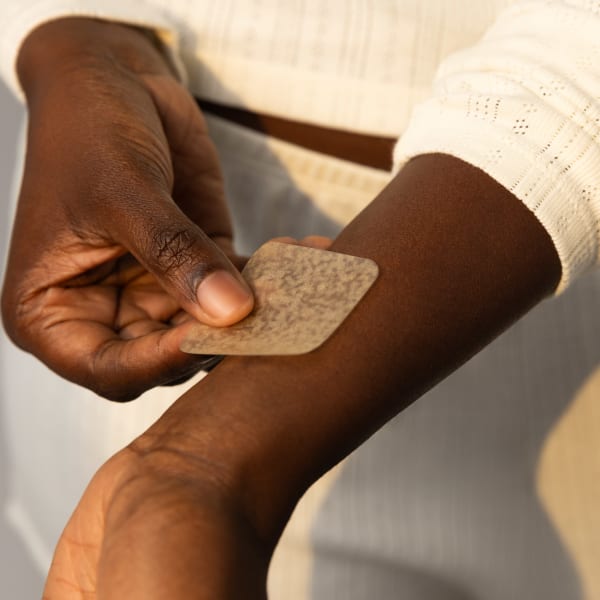
A dermatologist will need to do a patch test to determine the cause of the reaction. A patch test is when a doctor tapes allergens directly to the skin and leaves them there for 48 hours. The doctor will then remove the allergens and assess the skin. Another assessment is made 48 hours later to see if the skin develops a reaction. However, even a patch test may not reveal the cause of the allergic contact dermatitis, in which case, a process of elimination begins as doctor and patient together try to determine the cause.
Treatment for contact dermatitis begins by avoiding the allergen. However, topical creams are also prescribed to clear up the condition and to ease the itch. "Left untreated," Dr. Schalock explains, "allergic contact dermatitis tends to become less inflamed, red, and bubbly. The skin gets thicker and more scaly." Sometimes the thickened skin will split and cause painful fissures. In these severe cases, says Dr. Schalock, an oral prednisone may be necessary.
What’s a Tech to Do?
The job of the nail tech is to beautify nails, and there are many options available to do the job well. Even if a client comes into the salon with a reaction on her skin that you suspect is allergic contact dermatitis, there should be no harm in providing the service, says Dr. Schalock. Techs should be particularly careful that no product, including lotions or soap, come into contact with the irritated area on the skin.
In some cases, a tech will develop allergic contact dermatitis herself from coming into repeated contact with the allergens at the salon. When this happens, she can often continue working by wearing a protective barrier, such as gloves and long sleeves, to prevent the pro duct from coming into contact with her skin. She may need to research product ingredients to determine the cause of her reaction and then find a product that doesn’t contain the offending ingredient.
Ad Loading...
It may be that a client develops allergic contact dermatitis from certain salon products. She could report itching, small blisters around her cuticles, possibly even some scabbing as the blisters burst then heal between appointments. It’s also possible for dermatitis to appear on other parts of a client’s body, such as the face, for example. This comes from the product being transferred from the nails to the face through touching.
When a tech realizes a client has developed a reaction to a product in the salon, she can advise the client to visit a dermatologist to try to determine the specific cause of the allergic reaction, such as an epoxy or a particular ingredient. In the meantime, remove the enhancement product, offer the client natural nail services, and wait for the reaction to clear. Once the skin is clear and healthy, it is safe to try different products for enhancement services to see which work on the client without a reaction. Ideally, says Dr. Schalock, a tech will be able to find something that works for the client while a dermatologist finds out what is causing the allergic reaction.
A word of caution: Though unlikely with allergic contact dermatitis, if a client ever responds with hives or shortness of breath instead of a simple surface reaction of a rash, discontinue services until a doctor has determined the source of the reaction.
Uncured gel polish and microscopic e-file dust contain active acrylates that penetrate the skin, triggering permanent contact dermatitis. Learn the chemistry behind these irritants and how to protect your clients and yourself.
The Good Patch is a leading wearable wellness patch brand, offering wellness and skincare patches that support everyday needs including energy, sleep, relaxation and more.
Orthopedic PT reveals three daily exercises plus ergonomic advice that can help salon professionals avoid the aches and injuries caused by standing, bending and repetitive overhead work.
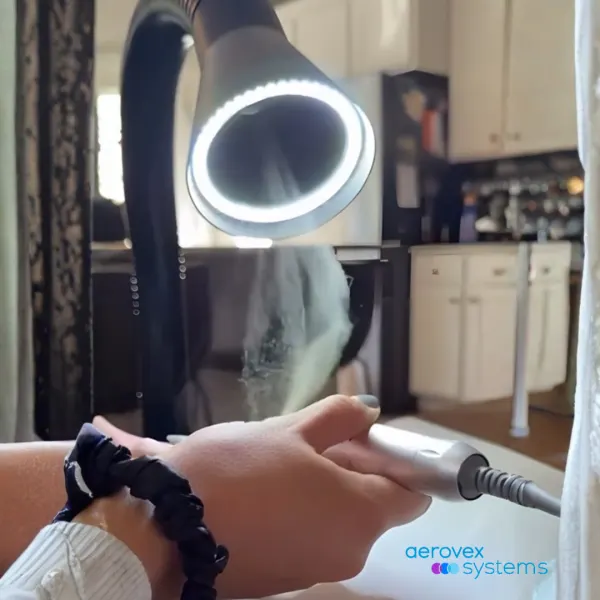
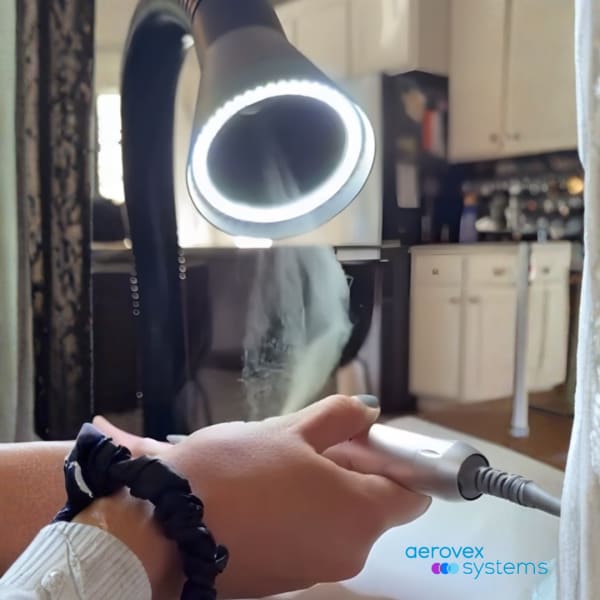
From acrylic monomers to airborne bio-dust, the air inside a nail salon carries risks most professionals never see coming. Aerovex Systems reveals the source-capture and room-purification strategies that are setting a new standard for salon safety.
Working in beauty doesn’t have to hurt. Learn how Somatic Movement helps hairstylists, lash artists, and other beauty pros release tension, improve posture, and extend their careers.
As a spa or salon professional, your clients expect more than just beauty—they expect safety, hygiene, and peace of mind. Fungal infections like Athlete’s Foot and Nail Fungus are more common than you think, especially in environments where tools and footbaths are reused without proper sanitation. This blog covers how to stop these issues before they start, using proven infection prevention strategies for salons and spas.
A federal initiative aimed at studying chemical exposure in nail salons has ended due to staffing and budget changes. Here’s what the project set out to do—and what its conclusion means for salon professionals.
For many people, a pedicure is a relaxing beauty ritual. But what most don’t realize is that this simple service, if done without proper hygiene and sanitation, can cause serious infections and long-term health issues.
Onycholysis is the separation of the nail plate from the nail bed. While it may look painful, it typically isn’t—at least not at first. But without proper care, this common nail disorder can lead to infections, deformities, and long-term damage.
Mckenzie Kool, Psychologist, MC, RPsych provides us with guidance on what may or not be helpful in speaking with someone who has suffered a significant loss.
Clients come to you to feel their best—not leave with a viral souvenir. Warts and cold sores can spread fast in busy salons, but a few smart habits make all the difference. Let’s talk about what’s really lurking in your salon (and how to kick it to the curb).
As Earth Day approaches, The Green Beauty Community Foundation and the Green Spa Network invite beauty pros to step forward and embrace sustainability through the Green Pledge--a powerful initiative designed by and for beauty industry leaders.
Don’t cancel Valentine’s Day altogether, urges Jill Palmquist. Instead, think of it as a (frilly, flowery, Champagne-bubbly) wake-up call to fall deeply in love with your own life.
Life coach and Culture Ambassador of Sam Villa, Andrew Carruthers, outlines how to tell if your burnout is temporary - or if it's time to make a bigger career change.