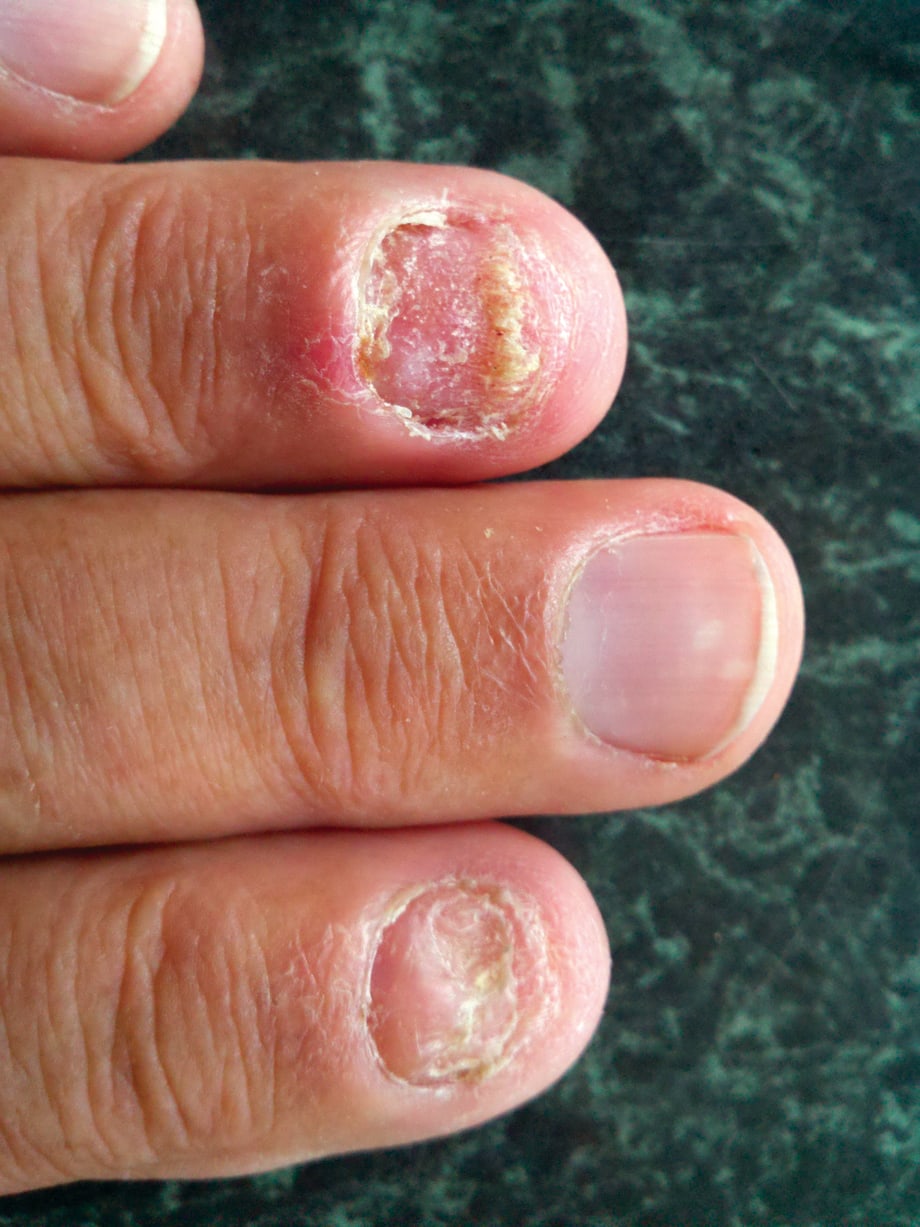
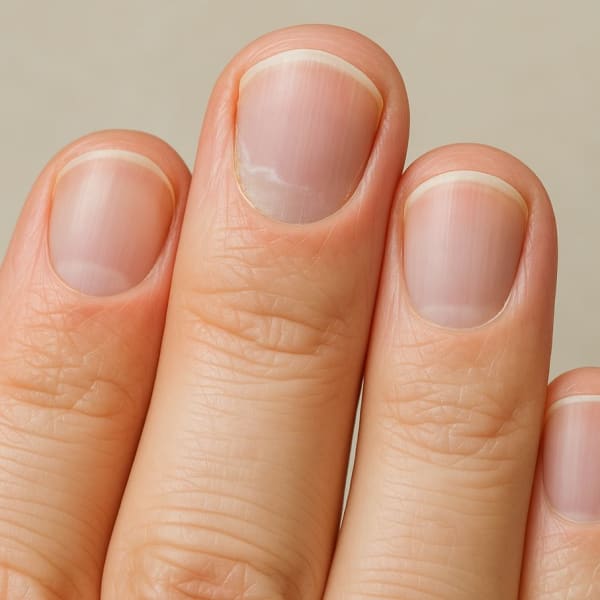
Many people are familiar with the concept of atrophy. The word is commonly used I reference to condition that affect the elderly, someone who has had an extended hospital stay, or someone who lives a sedentary life. “Atrophy” is simply the wasting away of a part of the body. Many times a person’ muscles are described as having been “atrophied.” This means the muscles have decreased in size, weakened, and have generally lost the ability to perform as expected.
Ad Loading...
The same thing can happen to nails. Whether the result of damage to the matrix, which would affect only one nail, or a larger health issue, which could affect all 20, the nails can atrophy. When a nail is atrophied, it loses its healthy look, begins to shrink in size, and may eventually wither away altogether. Unlike muscles, however, the nail can’t regain its vitality and health. Once a nail atrophies, a condition known as onychatrophia, the condition is not reversible. “Onychatrophia is a scarring process,” says Dr. Philippe Abimelec, a dermatologist from Paris, France, who specializes in hair and nails. Similar to a scar on the skin, once the damage is done, the nail won’t recover.
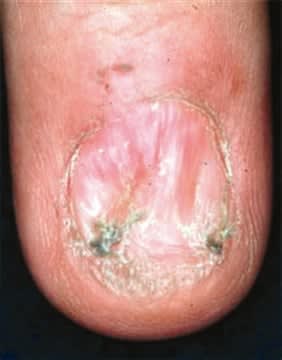
Nails are known to be an indicator on a person’s overall health. Many times, systemic health issues cause nail problems such as splitting, yellowing, and clubbing. Similar to these indicators, onychatrophia also is evidence of alarger health problem. Because it’s a secondary effect, not a primary condition, onychatrophia can be the result of a wide burns or damage to the matrix, genetic range of health problems. Some of these issues include trauma, such as diseases, vascular problems, thyroid issues, skin diseases such as lichen planus, Stevens-Johnson syndrome, and Lyell’ syndrome, among others, says Dr. Abimelec. “There may be itching at the initial stage, which I often a result of the disease that induced it,” says Dr. Abimelec. Other than that, onychatrophia is not likely to cause pain or discomfort.
Lichen planus (seen here) is one of the possible factors leading to onychatrophia.
There are varying degrees of onychatrophia. A person may have only one nail that has partially atrophied but will never worsen because the condition that caused it was identified and treated early. On the other hand, sometimes the primary cause is ongoing and damage to the nails is so severe a person may lose all her nails. Though the condition affects both men and women, it is not limited to adults. Children and infants can be born with, or suffer from, diseases that cause nails to atrophy.
Doctors can determine if a nail has atrophied simply by looking at it, says Dr. Abimelec. “You will see a nail remnant, nail destruction, and nail absence,” he explains. Doctors will treat the condition that caused the atrophy, but no treatment is available to improve onychatrophia. The reason for this is that the problem isn’t in the nails; onychatrophia is characteristic of a larger problem and cannot be treated in isolation. At times, a patient may respond to treatment and recover from the larger health issue. However, though the cause is removed, once the nails have atrophied they will not return to normal.
WHAT’S A TECH TO DO?
Unfortunately, onychatrophia gives the nail an unattractive appearance. Because many people are unfamiliar with onychatrophia, the condition can be confused by the casual observer with a fungus. The unsightly nail may lead the suff erer to seek out a nail tech to cover what remains of the nail, and the tech will likely be eager to help. However, while it’s tempting to imagine all the ways enhancements could improve the look of atrophied nails, Dr. Abimelec cautions techs about applying product over the damaged area. “It is not recommended, since there is no more nail,” he says.
Ad Loading...
Before you dismiss enhancements entirely, though, suggest that the client visit a doctor to confi rm that the nail has atrophied. A tech can suspect onychatrophia, but not diagnose it. You want to help the client exhaust all options before giving up hope for the full recovery of the nail. A doctor will be able to identify onychatrophia, determine if there is fungus present, or confi rm the skin surrounding the nail is not compromised or susceptible to infection. In addition, a doctor might identify a larger health issue that is damaging the client’s nails.
If the nail is clean, free from infection, and sturdy enough to hold an enhancement, techs may be able to work with the client and a dermatologist to come up with a compromise on ways to beautify the nail. It may be that enhancements can be applied to a nail without harm, even only for a short time, such as for a special event, but a technician won’t want to make that decision without the opinion of a doctor.
Even in the case of a natural nail manicure or pedicure, certain risks are inherent when you work on nails that have atrophied. Since the nail is likely to be thin and damaged, the tech is likely to buff the surrounding skin while caring for the nail. This could irritate or tear the skin, leaving it open to infection. Techs should proceed with caution, using common sense and protecting themselves and their clients by working within the scope of their license. Take this opportunity to strengthen your relationship with a local podiatrist or dermatologist, and work together with the client to arrive at the best possible solution.
Uncured gel polish and microscopic e-file dust contain active acrylates that penetrate the skin, triggering permanent contact dermatitis. Learn the chemistry behind these irritants and how to protect your clients and yourself.
The Good Patch is a leading wearable wellness patch brand, offering wellness and skincare patches that support everyday needs including energy, sleep, relaxation and more.
Orthopedic PT reveals three daily exercises plus ergonomic advice that can help salon professionals avoid the aches and injuries caused by standing, bending and repetitive overhead work.
From acrylic monomers to airborne bio-dust, the air inside a nail salon carries risks most professionals never see coming. Aerovex Systems reveals the source-capture and room-purification strategies that are setting a new standard for salon safety.
Working in beauty doesn’t have to hurt. Learn how Somatic Movement helps hairstylists, lash artists, and other beauty pros release tension, improve posture, and extend their careers.
As a spa or salon professional, your clients expect more than just beauty—they expect safety, hygiene, and peace of mind. Fungal infections like Athlete’s Foot and Nail Fungus are more common than you think, especially in environments where tools and footbaths are reused without proper sanitation. This blog covers how to stop these issues before they start, using proven infection prevention strategies for salons and spas.
A federal initiative aimed at studying chemical exposure in nail salons has ended due to staffing and budget changes. Here’s what the project set out to do—and what its conclusion means for salon professionals.
For many people, a pedicure is a relaxing beauty ritual. But what most don’t realize is that this simple service, if done without proper hygiene and sanitation, can cause serious infections and long-term health issues.
Onycholysis is the separation of the nail plate from the nail bed. While it may look painful, it typically isn’t—at least not at first. But without proper care, this common nail disorder can lead to infections, deformities, and long-term damage.
Mckenzie Kool, Psychologist, MC, RPsych provides us with guidance on what may or not be helpful in speaking with someone who has suffered a significant loss.
Clients come to you to feel their best—not leave with a viral souvenir. Warts and cold sores can spread fast in busy salons, but a few smart habits make all the difference. Let’s talk about what’s really lurking in your salon (and how to kick it to the curb).
As Earth Day approaches, The Green Beauty Community Foundation and the Green Spa Network invite beauty pros to step forward and embrace sustainability through the Green Pledge--a powerful initiative designed by and for beauty industry leaders.
Don’t cancel Valentine’s Day altogether, urges Jill Palmquist. Instead, think of it as a (frilly, flowery, Champagne-bubbly) wake-up call to fall deeply in love with your own life.
Life coach and Culture Ambassador of Sam Villa, Andrew Carruthers, outlines how to tell if your burnout is temporary - or if it's time to make a bigger career change.