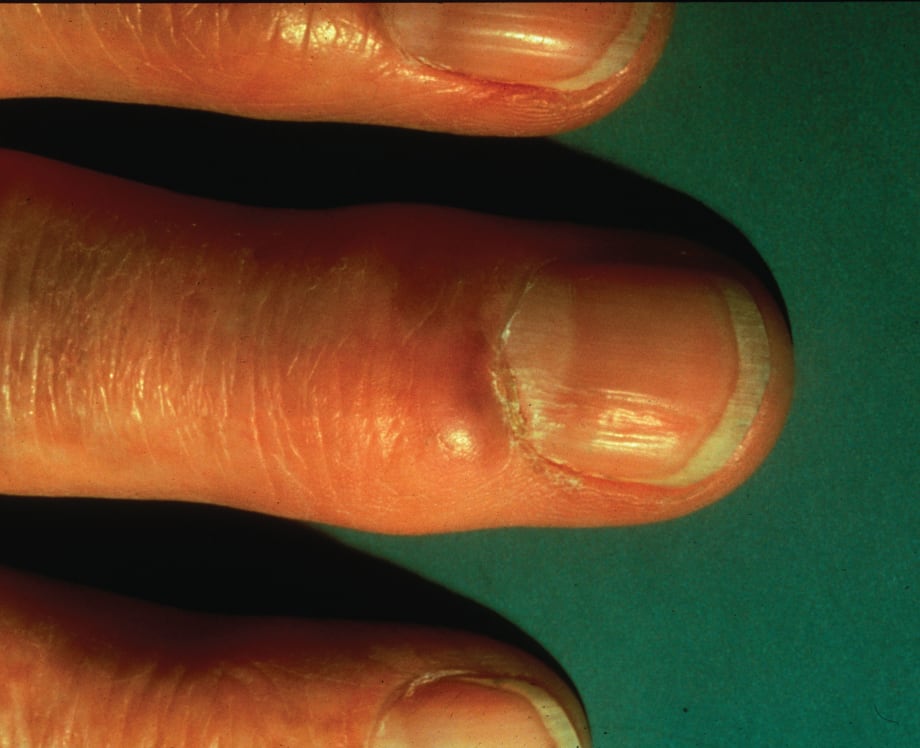
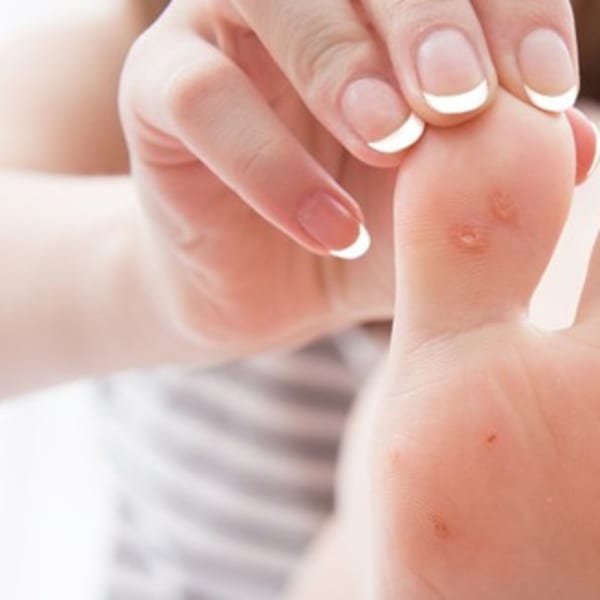
Myxoid cysts are small, rounded deformities that occur around the fingers and toes. Though often harmless, a visit to the doctor is still suggested to rule out any larger issue.
myxoid (mix-oid) mucous; resembling mucous; cyst (sist) a closed sack with a distinct membrane that develops abnormally.
The body occasionally develops lumps and bumps that are filled with fluid. These growths are medically defined as “cysts.” Though peculiar, they are often painless. Two types of cysts that nail techs may see in the course of their day are the “ganglion cyst” and the “myxoid” or “mucous” cyst. Many times these can be confused as the same condition, but they are actually quite different.
Ad Loading...
“Ganglion cysts form when the joint-space lining herniates its way out from the joint space,” says Dr. Jerome Aronberg, a dermatologist in private practice in Clayton, Mo., and assistant clinical professor of dermatology at Washington University in St. Louis. “The ganglion cyst has a direct connection to the nearby joint space, and any treatment of this lesion should be undertaken with care, so as to prevent damage to the connected joint space.” The treatment would be to find the connection and ligate it or destroy it, says Dr. Aronberg. He notes that a ganglion cyst is found most often in people who have arthritic fingers, generally osteoarthritis, with bony spurs in the area of the joint spaces. The cysts most often form between the distal interphalangeal joint (the joint of the finger closest to the nail) and the nail plate. Treatment may require the attention of a hand plastic surgeon.
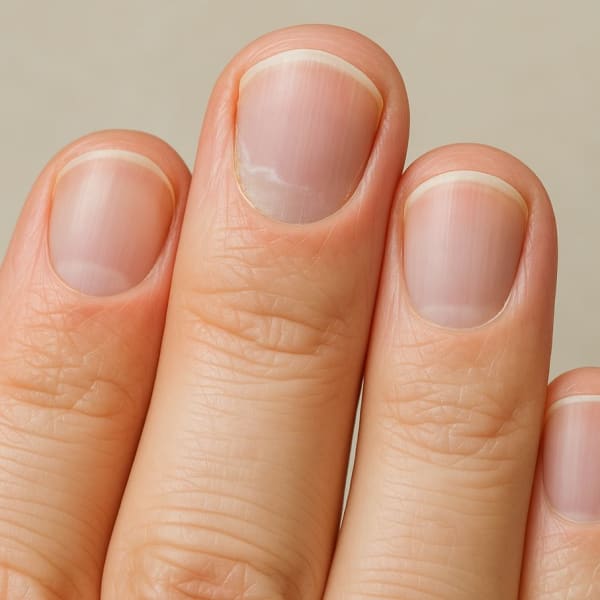
A myxoid cyst, also called a digital mucous cyst, is identified by the clear mucous that fills it. It’s a firm, smooth, rounded bump on the skin, often having a bluish tint. Inside, it is filled with clear, sticky, gelatinous fluid. The cysts appear most often on the fingers but can also show up on the toes. “The myxoid cyst generally occurs in the proximal nail fold (the skin surrounding the cuticle),” says Dr. Aronberg. Cysts form from some sort of minor trauma to the site. The minor trauma can be caused by a repetitious act, including something as simple as typing or even repetitive rubbing of the area. A patient may not even be able to identify the cause.
The cyst may grow in a spot on the finger that is far enough away from the nail fold to prevent the nail from becoming distorted, but many times the cyst will cause the nail to change shape. When the cyst rests on top of the nail matrix, a depression or groove occurs on the nail plate, because of the pressure on the matrix, says Dr. Aronberg. “However, should the cyst happen to occur under the matrix, then the unit is forced upwards and the result is a bump in the nail rather than a depression,” he explains.
[PAGEBREAK]
Like most cysts, the myxoid cyst is generally painless, though complaints of aching may be voiced as cysts increase in size. It’s important to note that even without pain, care should be taken when bumps occur around the nail. Clients should always seek a medical evaluation because tumors, either benign or malignant, can also cause bumps on, or surrounding, the nails, cautions Dr. Aronberg.
Ad Loading...
Often the term “cyst” causes alarm and concern, but “it’s important to realize that these aren’t really ‘cysts,’ in that there is no cyst wall to the lesion, but rather it’s an area of collected gelatinous material,” says Dr. Aronberg. So, in actuality, these are “pseudocysts.” This is important to note because it means the cyst is treated differently than, say, an ovarian cyst. “A biopsy is not necessary, because there is no cyst to dissect out,” he says. “The typical clear gelatinous material that is expressed out of the cyst when they are lanced is sufficient to accurately diagnose them.”
Doctors treat the area with one of a variety of methods, including freezing, intralesional injections of cortisone, or multiple incisions and draining. “I will often have my patients do their own incision and draining of the cyst, followed by compressive dressings, though there is concern about the introduction of an infection into the site,” says Dr. Aronberg, “The average number of ‘stabbings’ before the area finally scars down is about six,” he says. Even after treatment, it is possible for the cyst to reappear.
Though patients may be able to drain the cyst themselves, it is still wise to have the growth checked by a doctor before making the initial incision to be sure the growth is actually a myxoid cyst and not something more serious. There are times when the cyst occurs directly under the nail plate, which may require the removal of part of the nail.
WHAT’S A TECH TO DO?
If a client comes in with either a ganglion or myxoid cyst, educate her on the possibility of it being a cyst and suggest she consult her family doctor or dermatologist. Continue with services, being mindful to work gently around the cyst.
Ad Loading...
Though it’s possible for clients to puncture and drain the cyst at home, it’s not advisable for the tech to do it in the salon in case an infection develops after the client leaves the salon. “I would doubt that the cyst would rupture while the tech is working on the nail, as these are not really very superficial,” says Dr. Aronberg. However, in the unlikely event that the cyst does rupture, techs should squeeze out all of the gelatinous material, clean the wound, and apply a clean gauze to the area.
Uncured gel polish and microscopic e-file dust contain active acrylates that penetrate the skin, triggering permanent contact dermatitis. Learn the chemistry behind these irritants and how to protect your clients and yourself.
The Good Patch is a leading wearable wellness patch brand, offering wellness and skincare patches that support everyday needs including energy, sleep, relaxation and more.
Orthopedic PT reveals three daily exercises plus ergonomic advice that can help salon professionals avoid the aches and injuries caused by standing, bending and repetitive overhead work.
From acrylic monomers to airborne bio-dust, the air inside a nail salon carries risks most professionals never see coming. Aerovex Systems reveals the source-capture and room-purification strategies that are setting a new standard for salon safety.
Working in beauty doesn’t have to hurt. Learn how Somatic Movement helps hairstylists, lash artists, and other beauty pros release tension, improve posture, and extend their careers.
As a spa or salon professional, your clients expect more than just beauty—they expect safety, hygiene, and peace of mind. Fungal infections like Athlete’s Foot and Nail Fungus are more common than you think, especially in environments where tools and footbaths are reused without proper sanitation. This blog covers how to stop these issues before they start, using proven infection prevention strategies for salons and spas.
A federal initiative aimed at studying chemical exposure in nail salons has ended due to staffing and budget changes. Here’s what the project set out to do—and what its conclusion means for salon professionals.
For many people, a pedicure is a relaxing beauty ritual. But what most don’t realize is that this simple service, if done without proper hygiene and sanitation, can cause serious infections and long-term health issues.
Onycholysis is the separation of the nail plate from the nail bed. While it may look painful, it typically isn’t—at least not at first. But without proper care, this common nail disorder can lead to infections, deformities, and long-term damage.
Mckenzie Kool, Psychologist, MC, RPsych provides us with guidance on what may or not be helpful in speaking with someone who has suffered a significant loss.
Clients come to you to feel their best—not leave with a viral souvenir. Warts and cold sores can spread fast in busy salons, but a few smart habits make all the difference. Let’s talk about what’s really lurking in your salon (and how to kick it to the curb).
As Earth Day approaches, The Green Beauty Community Foundation and the Green Spa Network invite beauty pros to step forward and embrace sustainability through the Green Pledge--a powerful initiative designed by and for beauty industry leaders.
Don’t cancel Valentine’s Day altogether, urges Jill Palmquist. Instead, think of it as a (frilly, flowery, Champagne-bubbly) wake-up call to fall deeply in love with your own life.
Life coach and Culture Ambassador of Sam Villa, Andrew Carruthers, outlines how to tell if your burnout is temporary - or if it's time to make a bigger career change.