Nanotechnology is one of the fastest-growing industries on the planet, with research going into its use in electronics, energy, construction, and even into cosmetics.
Nanotechnology: The study and manipulation of materials on an atomic or molecular scale.
Nanometer: One billionth of a meter.
Micrometre (micron): One millionth of a meter. A human hair strand averages 100 micrometres across, and a red blood cell is approximately 8 micrometres in diameter.
4 min to read
Imagine plugging your cell phone into your clothing and charging it with the energy your clothes have accumulated as you’ve walked throughout the day. Or looking through a window lined with invisible nano particles that make it impossible for dirt and water molecules to adhere, so the window never needs to be washed. Or even imagine a medical treatment in which man-made nano particles are designed to only enter cancer cells, and when a laser is activated the particles heat up to destroy their host cancer cells.
These are some of the thoughts being floated by today’s leading scientists as they guess how nanotechnology will revolutionize our lives. But what is nanotechnology, and how does it apply to the salon and nail tech?
Ad Loading...
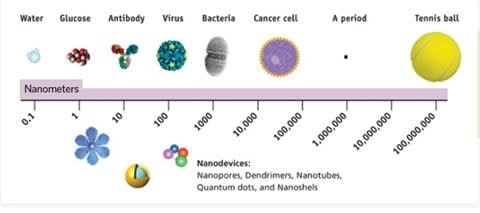
Nanotechnology is defined as the study and control of matter that is sized from one to 100 nanometers. A nanometer then, is equal to one billionth of a standard meter, which equates to being about 100,000th the width of a human hair. So nanotechnology is dealing with very small materials. But these small particles are nothing new. In fact, humans have been creating them for centuries, but it’s only recently that we’ve been able to study them and understand their unique functions.
Many stained-glass windows from the Middle Ages have nano-sized particles that help add to the shimmering effect and color vibrancy we see, and ancient samurai swords have been found to have nano particles as well. These both were an unknown by-product from manufacturers at the time, but with recent advancements in imaging microscopes, we can now identify these particles and begin to study their usefulness.
NANO-BEAUTY
In the cosmetic industry, the most obvious application for nanotechnology has been in sunscreen. Titanium dioxide is an ingredient that absorbs UV light and protects skin, but it leaves a visible color on the wearer’s skin. So titanium dioxide is manufactured to be small enough to become invisible on the skin, but still large enough to reflect and absorb the harmful UV rays.
Nano-sized particles are also used in hydrating lotions, where soy-based nanospheres are filled with vitamins and hydrating emollients to be delivered deeper into the skin. There is still much research to be done on nanotechnology. The Food and Drug Administration (FDA) has started a Nanotechnology Task Force to research the effects of using nano particles in food, medicine, and cosmetics, and the European Union (EU) is undertaking similar actions.
Ad Loading...
Scientific consultant Doug Schoon of Schoon Scientific explains some of the concerns regarding nanotechnology use: “The most common concern with nanotechnology is what effects these nano particles can have inside our bodies over the long term.” There is speculation that nano particles can enter the bloodstream and collect in organs or other areas in the body.
The FDA’s task force has not come out with any conclusive evidence to say this can happen, but they also haven’t said that it can’t — they are still in the information-gathering stage.
“We’re in the very beginning phase of nano marketing,” says Schoon, “especially in the beauty industry. But as the science comes out on the safety and usefulness of nano particles, I think we’ll be seeing more and more companies begin to use them.”
As of now, there are not many companies using nano particles in lotions, gels, or acrylics. The cost of using nano particles is still a bit prohibitive, and many are waiting for definitive results and statements from organizations like the FDA and EU.
[PAGEBREAK]
Ad Loading...
This scale is in nanometers, with a glucose molecule being roughly one nanometer wide. Nanotechnology is the study of particles that are from one to 100 nanometers. (Smaller than the virus illustrated on this scale.) Source: National Cancer Institute.
NANO’S FIRST STEPS INTO THE NAIL INDUSTRY
In the nail industry, one of the most prominent uses of nanotechnology is seen in Entity Beauty’s Nanovive Skin Revival System and Gel One Technology. Lee-Anne Henderson, director of educational sales and distributor relations, recently returned from Germany where she spoke about Entity’s use and the safety of nanotechnology.
“The most important thing for us is education at this point, because so little is known about nanotechnology,” says Henderson. “Our skin care products use nano-spheres to deliver anti-aging vitamins to deeper layers of the skin, but they are not small enough to pass through the dermis or slip into the bloodstream. And our Gel One system uses nano particles for color saturation and stronger bonds, but once the particles cure it eliminates the risk of them going anywhere but the nail plate.”
Henderson also emphasizes that Entity’s education for application stresses to keep the product from touching the client’s skin, which is a standard procedure for any gel, and that many private companies have performed test experiments to ensure the products are safe for use.
As for the future of nanotechnology, Schoon likens the current time to when computers first came out. “No one used them for the first 10 to 15 years, because they had to develop the software and hardware to make them practical, and then get the cost down. But once everyone could buy one it revolutionized how we live. I think nanotechnology will prove similar, but it will take some years before we start to see a widespread shift.”
Uncured gel polish and microscopic e-file dust contain active acrylates that penetrate the skin, triggering permanent contact dermatitis. Learn the chemistry behind these irritants and how to protect your clients and yourself.
The Good Patch is a leading wearable wellness patch brand, offering wellness and skincare patches that support everyday needs including energy, sleep, relaxation and more.
Orthopedic PT reveals three daily exercises plus ergonomic advice that can help salon professionals avoid the aches and injuries caused by standing, bending and repetitive overhead work.
From acrylic monomers to airborne bio-dust, the air inside a nail salon carries risks most professionals never see coming. Aerovex Systems reveals the source-capture and room-purification strategies that are setting a new standard for salon safety.
Working in beauty doesn’t have to hurt. Learn how Somatic Movement helps hairstylists, lash artists, and other beauty pros release tension, improve posture, and extend their careers.
As a spa or salon professional, your clients expect more than just beauty—they expect safety, hygiene, and peace of mind. Fungal infections like Athlete’s Foot and Nail Fungus are more common than you think, especially in environments where tools and footbaths are reused without proper sanitation. This blog covers how to stop these issues before they start, using proven infection prevention strategies for salons and spas.
A federal initiative aimed at studying chemical exposure in nail salons has ended due to staffing and budget changes. Here’s what the project set out to do—and what its conclusion means for salon professionals.
For many people, a pedicure is a relaxing beauty ritual. But what most don’t realize is that this simple service, if done without proper hygiene and sanitation, can cause serious infections and long-term health issues.
Onycholysis is the separation of the nail plate from the nail bed. While it may look painful, it typically isn’t—at least not at first. But without proper care, this common nail disorder can lead to infections, deformities, and long-term damage.
Mckenzie Kool, Psychologist, MC, RPsych provides us with guidance on what may or not be helpful in speaking with someone who has suffered a significant loss.
Clients come to you to feel their best—not leave with a viral souvenir. Warts and cold sores can spread fast in busy salons, but a few smart habits make all the difference. Let’s talk about what’s really lurking in your salon (and how to kick it to the curb).
As Earth Day approaches, The Green Beauty Community Foundation and the Green Spa Network invite beauty pros to step forward and embrace sustainability through the Green Pledge--a powerful initiative designed by and for beauty industry leaders.
Don’t cancel Valentine’s Day altogether, urges Jill Palmquist. Instead, think of it as a (frilly, flowery, Champagne-bubbly) wake-up call to fall deeply in love with your own life.
Life coach and Culture Ambassador of Sam Villa, Andrew Carruthers, outlines how to tell if your burnout is temporary - or if it's time to make a bigger career change.