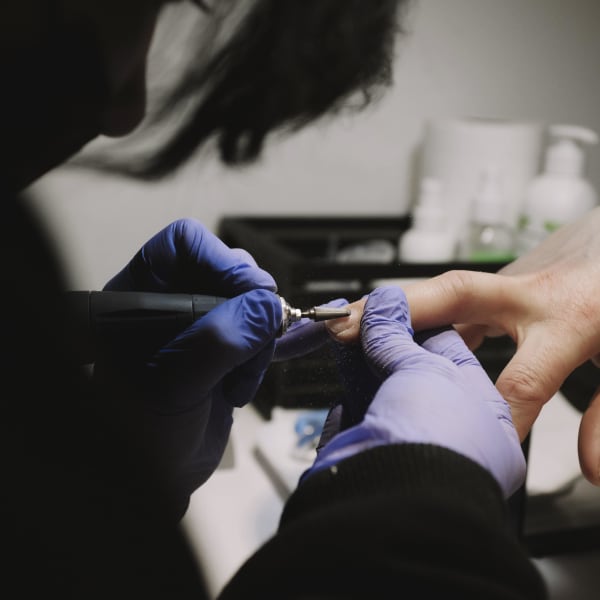
Attention to fine detail or long periods of concentrated labor is standard operating procedure for many nail technicians. Unfortunately these work conditions can be major factors in developing vision problems.
Your eyes have occasionally bothered you before, but now they’re getting worse. You can focus perfectly in the morning, but by lunch you’ve got a headache and are seeing two smiles lines instead of one. A couple of clients later, you’re feeling a bit woozy and your neck is getting sore. You wonder if you’re coming down with something.
You swear (again) that you’ll see the doctor, but by the time you get home, you feel fine and forget to make an appointment. Your eyes are not fine, you discover the following day, because your symptoms appear all over again.
Eyestrain isn’t a new occupational hazard, but it has been getting more attention recently because of its effects on the new breed of computer users.
Nail technicians and computer workers are exposed to many of the same factors and stressors that may bring about eyestrain: long periods concentrating on work or working with non-natural sources of light.
Know the Symptoms
Eyestrain, clinically known as asthenopia, is a collection of pain and symptoms. The muscles in and around the eye exert the power that allows us to focus our vision on an object. Overexerting these muscles tires them out, which in turn leads to eyestrain, says Emily Hsui, O.D. of the American Eye Institute (Los Angeles).
Some of the more common symptoms or complaints from eyestrain suffers include:
Blurring of objects
Lack of stamina for close work
Easily fatigued
Lack of patience for close work
Feeling pressure behind the eyes
Dull pain in and/or behind the eyes
Headaches around the eyes
Dull aches deep within the skull
Vertigo to the point of vomiting
Even forgetting to blink while concentrating on a task can cause eyestrain. “Working up close takes a lot of concentration, and if you are concentrating so hard on what you are doing, it’s possible that you can actually forget to blink. Blinking is how your eye keeps the cornea wet. When the cornea is dried out, the refractive surface Is no longer smith, making it difficult to focus,” says Dr. Hsui.
Eyestrain can also be brought on by a nail technician’s own eye weakness, such as overcorrected nearsightedness or astigmatism, as well as uncorrected vision problems.
The more obscure causes of eyestrain are “dazzling” and artificial light, emotional fatigue, and aggravation by inflammation of the lids or eye tissues, says Dr. Hsui.
A telltale sign of eyestrain is how you feel as your workday, you may have eyestrain problems.
Prevention Stops Strain
Take a few minutes to take stock of your eyesight and work environment.
Since the 1950s, ophthalmologists have identified fluorescent lighting as an eyestrain culprit. If fluorescent lighting is unavoidable at your salon, see about moving the fixtures to mounts above the windows or perpendicular to your workstation.
The strenuous demands nail technicians place on their eyesight can be that much more demanding if the eyes don’t have the proper refractive correction to begin with. An old prescription coupled with scratched lenses and hours of detail work in a nail technician’s typical day is a recipe for eyestrain.
Sometimes eyestrain will cause a nail technician to hold the client’s hand unnaturally close or distant while working on it. This can lead to both neck and back problems or can exaggerate existing conditions. According to Dr. Hsui, this sort of fatigue only worsens without rest, an impractical luxury when clients have already booked your time.
Nail technicians who are prone to illness or physical or emotional strain may find that their eyestrain is compounded by these problems. In addition, tension whether it is in the eye, muscles, or both, can make eyestrain worse, says Dr. Hsui.
Mary Jenkins, owner of Claws in Tampa, Fla., and all of her nail technicians say that eyestrain is a factor they deal with as part of their hobs. “Blurring and double-vision is a problem for the nail technician in our salon sometimes. Looking away from our work frequently and taking regular breaks is how we deal with it,” Jenkins says.
Taking care of eyestrain isn’t much more difficult than avoiding the things that cause it as much as possible. After you check out your work environment, consider making these changes:
1. Go see your optometrist once a year. Make sure your prescription is current and replace your lenses if it isn’t. Have an anti-reflective coating applied to your prescription lenses to help reduce eyestrain caused by glare, says Dr. Hsui. Artificial tears can help if dry eyes cause the problem, which is often a problem for contact wearers.
2. Rest when you need to and take regular breaks. “Take the time to look up from your work and look at something relatively far away,” Dr. Hsui says. “This lets your focusing power relax and relaxes the eyes.” If you encounter physical exertion, illness, or emotional strain, make yourself more comfortable until you can rest.
3. Use magnification devices. By magnifying the area you’re working on, maybe with an attachment on your lamp, your eyes don’t work as hard, letting your eye muscles relax.
4. Control the lighting. If it is practical, move your workstation closer to windows (natural light is much better for you than artificial light) and away from mirrors (as glare is a cause of dazzling). Consider investing in a work lamp that uses non-fluorescent lighting.
5. Wear safety goggles. If you are wearing prescription glasses already, you can get safety glasses made with your prescription says Doug Schoon, director of R&D at Creative Nail Design (Vista, Calif.). He also recommends side shields, which you can purchase to clip on the sides of the glass frames.
You might also want to keep a pair of uncorrected safety glasses in a drawer for your client, Schoon suggests.