Fungal infections of the fingernail are relatively rare and can only be treated with internal prescription medications.
by Staff
April 1, 1992
10 min to read
Taking technicians at their word, most of the nail disorders they see are fungal infections. Most technicians use the term “fungus” to describe varying nail diseases and conditions, most of which have nothing to do with fungus. There are no published statistics on the occurrence of true I fungal infections of the nails. But in the five to seven patients with nail disorders I see per day, only about one patient per month has a genuine fungal infection of the fingernails, and I’ve never seen a genuine fungal infection under an acrylic nail.
A fungal infection can be diagnosed only by an experienced clinician, usually a dermatologist. I regularly see different nail disorders in my practice that are called fungal infections but are really acrylic nail reactions, psoriasis, inflammation of the nail matrix, yeast infections, and other nail disorders. The person who misidentifies and treats all nail disorders as fungal infections will “cure” many of the conditions simply because they would have healed without treatment. I estimate that technicians do not see even one true fungal infection of the fingernail per year.
Ad Loading...
DERMATOPHYTE, MOLD, AND YEAST
First, let’s define “fungal infection.” The word fungus comes from the Latin name for mushroom. Fungi are a part of the plant kingdom that contain no chlorophyll, which gives plants their coloring and allows them to make their own food. Instead, fungi have digestive enzymes that allow them to feed off dead plant and animal remains.
It’s estimated that there are more than 100,000 species of fungi. There are specialized forms of fungi: dermatophytes, yeast, and mold. These distinctions are made because the different forms require different nutrients to survive.
True fungal infections of the fingernails are caused by dermatophytes, which are part of a larger group called fungi imperfecti. Dermatophytes are a highly specialized group of organisms that digest keratin, which is what nails and hair are made of. Most true fungal infections of the fingernail are caused by one dermatophyte, trichophyton rubrum.
Yeasts are technically part of the fungi kingdom but they are very different from dermatophytes. Instead of eating keratin, they eat sugar, which can be secreted by wet skin, and they require moisture to grow.
Ad Loading...
Yeast infections occur in moist regions of the body: the vagina, the mouth, and under the posterior nail fold (chronic paronychia). Yeast infections can also grow on bandaged nails or when there are chronically wet pockets under and around the nail. Yeast also can grow in a wet pocket between lifted artificial product and the nail plate.
Candida albicans is the most common yeast organism to cause fingernail disease. I see approximately 20-35 yeast infections of the nail for every one fungal infection of the nail. What nail technicians and their clients think is fungus is often actually a yeast infection, which is treated with different medications than fungal infections.
Mold is part of a large group of fungi that grow on non-living organic matter such as oranges or bread. Molds rarely cause human disease because mold can’t feed on human cells. Scopulariopsis, however, is a type of mold that can grow under an injured large toenail that has responded to trauma by forming a thick layer of debris between the nail plate and nail bed. Scopulariopsis doesn’t affect the fingernails. There is no place for the term “mold” in the discussion of fingernail disease.
TRICHOPHYTON RUBRUM
Trichophyton rubrum is the dermatophyte that causes 99% of fungal infections of the fingernails, 95% of athlete’s foot infections, 90% of jock itch infections, and more than 50% of ringworm infections. These disorders have different names, but they are essentially the same infection process.
Ad Loading...
The way a fungus grows and survives is by eating dead keratin. But just as a grazing cow moves to a different area when she eats all the grass and gets to dirt, fungi move to a new area when they’ve eaten all the keratin, often creating “ringed lesions,” as commonly seen with athlete’s foot and jockey itch. Unfortunately, many non-fungal skin lesions also form rings, confusing general physicians who frequently assume all ringed lesions are fungal infections.
Fungal spores (a dormant form of the living fungus organism) are everywhere in the environment and can be found on most peoples skin. True fungus infections are most common on the feet or groin. Fungal infections of the toenails are much more common than fungal infections of the fingernails because the feet are subjected to more trauma than the hands and because they are often encased in warm, moist shoes. Usually only one hand is infected, and a fungal infection of the nails is commonly limited to a few nails on one hand. A fungal infection of the nails is often accompanied by a fungal infection of the skin on the same hand that looks like a scaly rash. A person who has a fungal infection of the fingernails will most likely also have a fungal infection of the toenails.
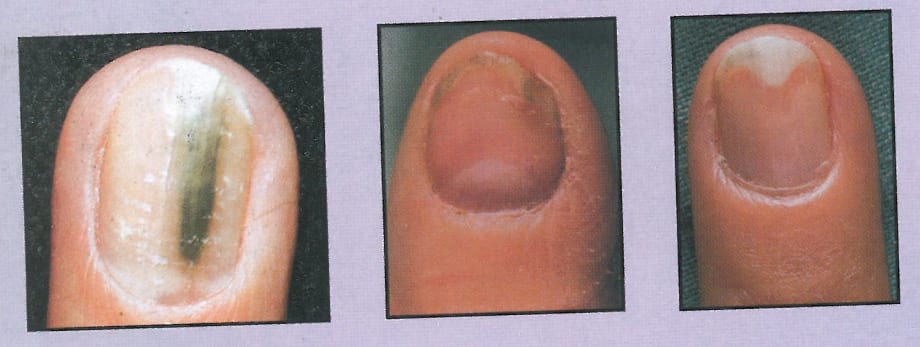
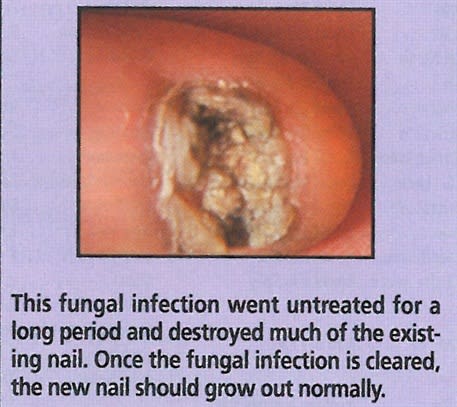
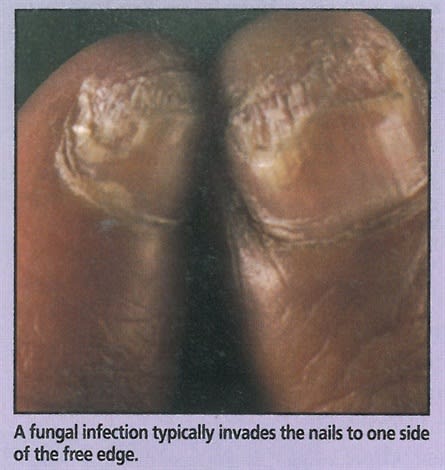
Fungal infections of the fingernails usually begin at the side of the nail’s free edge. The fungus typically invades the area between the nail plate and the nail bed, causing the nail plate to separate from the nail bed. The nail plate will usually thicken and crumble from beneath. Unless it’s clipped back, the nail plate will conceal the infection. Brown, yellow, gray, black, or green by-product of the fungus is often present.
If untreated, the fungal infection will move toward the matrix to look for more nourishment. However, since the matrix contains live cells (and the fungi cannot invade living tissue), it will not permanently damage the nail.
A fungal infection can only be diagnosed by a wet mount or culture —tests that must be performed by a physician. To do a wet mount, part of the nail or debris from under the nail is placed in a potassium hydroxide solution on a slide for 15-30 minutes and is then examined under the microscope. In qualified hands, this is a simple, inexpensive procedure. (It costs $8 for the test in my office, and the diagnosis is guaranteed.)
Ad Loading...
To perform a fungus culture, nail scrapings or clippings are placed on culture plates (plastic cups lined with gelatin-like material and other added ingredients) and grown. A culture is simple to do but not as easy to interpret because one has to be able to identify the different species of fungus.
I do my own fungus cultures, but I don’t consider reports from other physicians reliable unless they specify what fungus was present. There are thousands of fungi that could be present on a deformed or diseased nail without contributing to the deformity or disease. Fungal spores are everywhere; you can easily scrape them off the floor, but that doesn’t mean they’re causing “fungus floor.” Just because fungus spores are present does not mean there is a fungal infection.
FUNGAL INFECTION THERAPY
There is an old recipe for rabbit stew that says, “first you must catch a rabbit.” Likewise, in order to treat a fungal infection, you must be certain you have a fungal infection. A vast amount of the information about treating fungal infections of the nail is based on the treatment of other nail disorders and cannot be applied to true fungal infections.
All fingernail experts and scientific articles and books agree that topical antifungals, whether over- the-counter or prescription, do not work on fungal infections of the nails or hair because they just can’t get to the fungus effectively enough to kill it. There are products being researched that appear to work topically, but they have not been released on the market.
Ad Loading...
Tolnaftate, a synthetic antifungal developed in the 1960s, is effective against fungal infections of the skin. Tinactin, the brand name of the first and most widely used tolnaftate product, states on the label that it is not effective on hair or nail fungal infections. It is also not effective on yeast infections of the skin or nails.
More potent antifungals have been introduced since tolnaftate. Clotrimazole (trade name Lotrimin) and miconazole (trade names Micatin and Monostat) are just two powerful topical antifungal treatments that now can be purchased over-the-counter. Clotrimazole, miconazole, and the newer topical antifungals work by interfering with the formation of dermatophyte and yeast cell walls. Since these products can also treat yeast infections such as chronic paronychia around the nail, they are significant contributions to nail care. They will not, however, treat fungus under the nail.
Even though fungal infections of the nails cannot be diagnosed without a wet mount or culture, and even though topical antifungals have been shown not to work on fungal infections, misinformation on fungus abounds. I recently read in a newspaper health column that a pediatrician had cured a fungal infection of the nail on a small child by applying white vinegar to the nail. Not only can small children not get fungus of the nail, but vinegar doesn’t contain a strong enough concentration of antifungal agents to kill fungus on the nail.
Such misidentification of nail disorders as fungal infections perpetuates the belief that fungal infections of the nail are common and easy to cure with home remedies. It’s true that household chemicals such as bleach and high concentrations of iodide will kill fungus, but they cannot penetrate or get under the nail in adequate concentrations to kill the fungus without destroying any living cells they come in contact with; which means that any product effective enough to kill a fungus under a nail when used topically is also powerful enough to damage the nail or finger.
To treat fungal infections of the nails effectively, a patient must be vin’s toxicity, adverse reactions are very rare, and I personally am impressed with its safety record. It takes four to six months to treat fingernails with griseofulvin and 10 months or longer to treat toenails.
Ad Loading...
Ketoconizole (Nizoral) is an even more effective internal antifungal, but it can cause liver changes in about one patient in 15,000. Even this ratio is enough to warrant caution in its use. There is a new, more effective and safe oral product already available in Europe that has not been approved by the Food and Drug Administration.
Although there are numerous nail treatments that claim to prevent, treat, and cure fungal infections of the nail, there is currently no effective topical treatment — available over-the-counter or by prescription — for a fungal infection of the nail. If topical antifungals worked on the nails, it would be ridiculous to use internal therapy.
THE VOCABULARY OF FUNGUS
Candida albicans: A type of yeast responsible for most human yeast infections. It requires moisture to grow and it feeds on sugars. Yeast infections commonly occur in the vagina, mouth, or under the posterior nail; fold (manifesting as chronic paronychia). Its sphere-shaped organisms reproduce by budding, whereby a small sphere grows on the side of a larger, adult sphere.
Clotrimazole: A topical, broad-spectrum antifungal used to treat both dermatophyte and yeast infections on skin. It’s available over-the-counter as Lotrimin. It does not work on dermatophyte fungal infections of the nails.
Ad Loading...
Dermatophyte: A form of fungus that lives on dead skin and feeds on keratin. It causes ringworm, jock itch, athlete’s foot, and fungal infections of the hair and nails. Dermatophytes are the most common fungus organism to infect the nails.
Fungi: Members of the plant kingdom that don’t make their own food. Dermatophytes, yeast, and mold are forms of fungus. There are more than 100,000 species of fungus, but just two fungus organisms —Candida albicans (a yeast) and trichophyton rubrum (a dermatophyte) — can affect the fingernails. Trichophyton rubrum causes fungal infections of the fingernails, while Candida albicans is the most common cause of chronic paronychia.
Miconazole: A broad-spectrum antifungal used to treat both dermatophyte and yeast infections on the skin. It’s available over-the-counter as Micatin. It does not work on dermatophyte fungal infections of the nail.
Mold: A form of fungus that eats non-living organic material such as oranges and bread. Mold rarely causes human infection because it cannot digest human cells. Scopulariopsis is the one mold organism that can invade the nails, but it can only affect a damaged, separated large toenail.
Tolnaftate: A synthetic topical antifungal that is effective against ringworm but not against yeast infections. It does not work on fungal infections of the hair or nails and it is not as effective as other over-the- counter products such as Lotrimin or Micatin for skin.
Ad Loading...
Trichophyton rubrum: The most common dermatophyte fungus, which causes fungal infections of the skin and nails. It is also the most common cause of toenail fungal infections, though there are several other dermatophytes that invade the toenails. Trichophyton rubrum rarely affects hair.
Yeast: A family of fungi organisms that digest sugar and require moisture to grow. Candida albicans is the yeast organism that most commonly infects humans. Other forms of yeast also produce alcohol and cause bread to rise.
Uncured gel polish and microscopic e-file dust contain active acrylates that penetrate the skin, triggering permanent contact dermatitis. Learn the chemistry behind these irritants and how to protect your clients and yourself.
The Good Patch is a leading wearable wellness patch brand, offering wellness and skincare patches that support everyday needs including energy, sleep, relaxation and more.
Orthopedic PT reveals three daily exercises plus ergonomic advice that can help salon professionals avoid the aches and injuries caused by standing, bending and repetitive overhead work.
From acrylic monomers to airborne bio-dust, the air inside a nail salon carries risks most professionals never see coming. Aerovex Systems reveals the source-capture and room-purification strategies that are setting a new standard for salon safety.
Working in beauty doesn’t have to hurt. Learn how Somatic Movement helps hairstylists, lash artists, and other beauty pros release tension, improve posture, and extend their careers.
As a spa or salon professional, your clients expect more than just beauty—they expect safety, hygiene, and peace of mind. Fungal infections like Athlete’s Foot and Nail Fungus are more common than you think, especially in environments where tools and footbaths are reused without proper sanitation. This blog covers how to stop these issues before they start, using proven infection prevention strategies for salons and spas.
A federal initiative aimed at studying chemical exposure in nail salons has ended due to staffing and budget changes. Here’s what the project set out to do—and what its conclusion means for salon professionals.
For many people, a pedicure is a relaxing beauty ritual. But what most don’t realize is that this simple service, if done without proper hygiene and sanitation, can cause serious infections and long-term health issues.
Onycholysis is the separation of the nail plate from the nail bed. While it may look painful, it typically isn’t—at least not at first. But without proper care, this common nail disorder can lead to infections, deformities, and long-term damage.
Mckenzie Kool, Psychologist, MC, RPsych provides us with guidance on what may or not be helpful in speaking with someone who has suffered a significant loss.
Clients come to you to feel their best—not leave with a viral souvenir. Warts and cold sores can spread fast in busy salons, but a few smart habits make all the difference. Let’s talk about what’s really lurking in your salon (and how to kick it to the curb).
As Earth Day approaches, The Green Beauty Community Foundation and the Green Spa Network invite beauty pros to step forward and embrace sustainability through the Green Pledge--a powerful initiative designed by and for beauty industry leaders.
Don’t cancel Valentine’s Day altogether, urges Jill Palmquist. Instead, think of it as a (frilly, flowery, Champagne-bubbly) wake-up call to fall deeply in love with your own life.
Life coach and Culture Ambassador of Sam Villa, Andrew Carruthers, outlines how to tell if your burnout is temporary - or if it's time to make a bigger career change.