Though doctors cite a lack of scientific evidence that hormones influence product lifting, some nail technicians say their clients’ experiences provide all the proof they need.
While plenty of scientific evidence exists to support the fact that ingesting hormones influences natural nails, such is not the case when it comes to artificial nails. Science can neither prove nor disprove that hormone treatments cause lifting problems because no scientific medical studies have been conducted. But while the medical community says there’s no correlation between hormone medications and enhancements, many a nail technician claims to have proof positive right in her own lab – the salon.
“If nail technicians make observations about lifting, there may be some truth to it,” says NAILS own Nail Doctor, Richard K. Scher, M.D., head of the Section for Diagnosis and Treatment of Nail Disorders at Columbia University-Presbyterian Medical Center. “However, without [the publication of scientific studies] providing evidence, definitive statements cannot be made.”
Nail Techs Offer Anecdotal Evidence
With no medical evidence to support either viewpoint, nail technicians have been free to interpret incidences of lifting in clients who are taking some form of hormones. Jo Laki, owner of Jo’s Naughty Nails in Hamlin, Pa., says she questions every client who comes into the shop about the medications they take and records the information faithfully on each client card. Because of this policy, she is aware of three clients who are taking different forms of hormones: a 45-year-old teacher’s aide on thyroid medication, a 60-year-old retiree taking both hormones and heart medication, and a 50-year-old teacher on estrogen therapy.
Laki concluded that the occupations or hobbies of the two working clients couldn’t be the cause of the lifting because the adhesion problems occurred even when the two teachers were on summer vacation. She questioned the clients about other habits or hobbies that may cause their acrylic to lift, and saw no reason to have unusual lifting.
Finally, Laki focused scrutiny on her own procedures. She troubleshooted her prep and application and was satisfied that the lifting couldn’t be a technical problem.
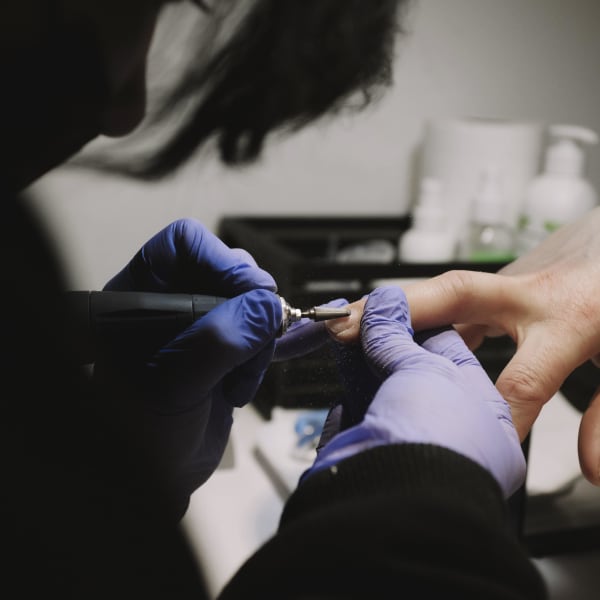
“I am especially careful about my preparation and application on these three clients,” says Laki. “I don’t leave any dust on the nail plate. Twice on each nail I spray on alcohol and use lint-free wipes to remove the dust. I apply a dehydrator and then primer. I apply the acrylic product so that I do a minimal amount of filing. And I keep product off the skin and away from the cuticles.” Laki says she doesn’t have any consistent lifting problems with other clients she services regularly. Satisfied that she had done enough detective work, Laki decided to work with the problems of these clients. Now, each comes in every 12 days for a fill, instead of every 14-17 days.
Some technicians report other changes in adhesion that seem to occur only in clients taking hormones. “New clients who are taking birth control pills usually have a two- to four-week period where problems with lifting will occur,” says Debbie Doerrlamm, owner of Wicked Wich Nails in Ronkonkoma, N.Y. “I notice the same thing with my clients who are taking other forms of hormones. Eventually, the body seems to regulate itself and lifting problems disappear. But for some reason, the nail plates seem to reject the acrylic at first.”
[PAGEBREAK]
Doerrlamm also questioned clients as to their nail care habits and on-the-job actions involving their nails and came up empty. Then she examined her technique and couldn’t pinpoint service breakdowns.
Other nail technicians also report having clients who either can’t keep nails on at all because of hormone treatments or those who experience lifting when they stop. Either way, say nail technicians, it is a change in the client’s body chemistry that affects product performance.
“I believe that everything we eat, drink, or take is reflected in the condition of our hair and nails,” Laki says. “When women take hormones, it must cause some sort of unknown chemical reaction that changes the nail plate’s makeup so that it rejects the acrylic when it tries to bond.”
While no documentation exists to prove or disprove Laki’s theory, doctors readily admit that hormones affect changes in the natural nails. “Estrogen and menopause are a big unknown. I personally believe that in some women, hormones play a big role in the texture, brittleness, and fragility of nails,” says Phoebe Rich, M.D., Clinical Assistant Professor of Dermatology at Oregon Health Sciences University. “It is not universal, however, because some women notice no changes in their nails while taking hormones or during menopause.”
Therefore, it may not be that big of a stretch to find some relationship between the medication and acrylic nails.
Other medical sources, including Dr. Scher, are warm to the possibility that this type of lifting could be caused by the illness being treated (rather than the medications being used to treat it) or even the client’s age, which tends to affect the way the nails grow.
And the Scientists Say ...
If you saw the movie Contact with Jodie Foster, you may remember a scene where Foster’s character introduces a scientific theory to Matthew McConaughay’s character on the White House balcony. Foster states that it is usually the simplest explanation for something that tends to be the right one.
Bearing this in mind, says Doug Schoon, director of research and development for Creative Nail Design (Vista, Calif.), the most likely explanation for lifting is nail technician error during nail prep or application. This is because any changes in the nails or adhesion as the result of medications would not be visible overnight or even in two or three weeks.
“Nails only grow 1/10-inch per month, so any chemical changes in the body would take time to manifest themselves,” he says. “If hormones affect the new, growing nail, then those changes will not be visible until the nail grows past the eponychium.
“Hormones control everything in the body — they are the chemical messengers,” explains Schoon. “Everything is affected by them, both quickly and slowly. For instance, mood swings can come and go quickly, but changes to hair and nails happen over time. There is no conceivable or plausible explanation for any type of medication making the lifting occur right away. If the nail is adhered to the nail plate and it is properly and tightly sealed, no substance that we know of will change that seal immediately. Only a change in the chemical makeup of the nail plate itself could affect the seal, and that just doesn’t happen overnight.”
Schoon also points out that perception clouds our view. “People have selective memories and therefore it may seem like only the clients taking hormones are lifting, when really the problem might be more common with other clients as well,” he says.
To back this point up, he relates a classic example: “It is commonly accepted myth that during a full moon more accidents happen, more murders, and more stabbings occur. Researchers did a poll of emergency room doctors and nurses and asked them if they agreed that during a full moon there are more patient admissions. The overwhelming majority said yes, they thought so. However, a review of admissions records proved that admissions were no higher than other busy periods. When it was busy during a full moon, everyone commented on that and remembered that. They didn’t make those comments during other busy times, so they didn’t remember them as much,” says Schoon.
The same phenomenon can be related to nail technicians. “They remember the three clients they know are taking birth control pills and the fact that they are having problems with adhesion, but forget about other clients who aren’t taking birth control pills and have the same problems,” he says.
[PAGEBREAK]
Nor does Monique Maginnis, a nail technician at Salon 51 in Perth, Australia, believe hormones cause lifting. “I have had many clients in my six years doing nails from all walks of life and with varying health problems, including hormone replacement therapy. I also had one client doing in vitro fertilization, which required massive hormone treatments to harvest her eggs. None of my clients ever suffered from lifting,” she says. “I am not saying that I don’t have my problem clients – I do. But I can’t attribute it to medications.”
Until a study conclusively proves or disproves a link between hormones and the adhesion of acrylic, we may never know for sure. However, that the suspicion leads to a thorough client history and full troubleshooting of one’s own procedures is a promising outcome.
Troubleshooting Lifting
Traditional acrylic services still remain the second most requested salon services, according to NAILS 1998-1999 Fact Book, with 85% of salons offering the service to clients. Chances are your salon has a large number of acrylic-wearing clients. It may be hard to keep track of what could be causing service breakdowns. Here is a checklist of items that, if neglected, could lead to lifting.
1. Take a client history
Prevent problems before they occur. Thoroughly review the client’s history, list of regular medications she takes, and any hobbies or job duties that could affect her nails. Record this on her client card and be sure to remind her to update you about any lifestyle changes that occur
2. Proper preparation of the nail plate
More than 80% of the problems nail technicians have with lifting occur because they did not take the time to properly clean, dehydrate, and prime the nail plate. Refer to the manufacturer’s instructions and follow them implicitly. Be sure not to forget even the simplest steps, like washing your hands before the service.
3. Application and filing
Be sure that when you apply the product, you do so according to the manufacturer’s instructions, using the proper ratio of liquid to powder and application procedures. For instance, don’t overwork odorless products because they tend to bubble, and keep product away from the cuticles and sidewalls. Be sure not to file the acrylic before it is completely cured and don’t overfile the nails.
4. Regular fills and maintenance
While it is your responsibility to make sure the client’s nails don’t lift, enlist her help. Explain the importance of regular fills (especially if lifting is a regular problem). Also, educate your client on how to use her nails and what to do if problems occur that will minimize repairs and future problems.
5.Other things to watch
Regulate the temperature in the salon, the temperature at which you store your products, and the temperature of your client’s hands. Be careful not to contaminate products and watch for products that have expired. Check to make sure you are using the right product — some product lines have bottles of product remover that look similar to monomer.