What if no doctor or medical study could confirm it, but through a network of your peers you learned many nail techs develop similar pain in their wrists, fingers, and thumbs? Would you choose to proactively reduce your risk of pain based only on anecdotal evidence?
Let me ask you a question. Do you ever find yourself rubbing your thumbs? You know what I mean. You start by rubbing that big muscle at the bottom of the thumb (the thenar muscle, which seems larger and stronger on your left hand than the right), then you move to rub the lower joint of the thumb. You do that for a while, and then you realize you’re squeezing your arm from your wrist to your elbow, rotating your wrist, giving yourself a mini-hand massage, and thinking your better book an appointment for a full-body massage, because, darn it, you’re sore!
If you have no idea what I’m talking about, I’m going to guess you’ve done nails for less than five years. Or you’re still young. Or ... you think it’s normal. It’s important that you know something. That pain is not normal. Pain is your body telling you that if you don’t start taking care of it, it’s going to revolt, and it could leave you in a lot worse pain.
Ad Loading...
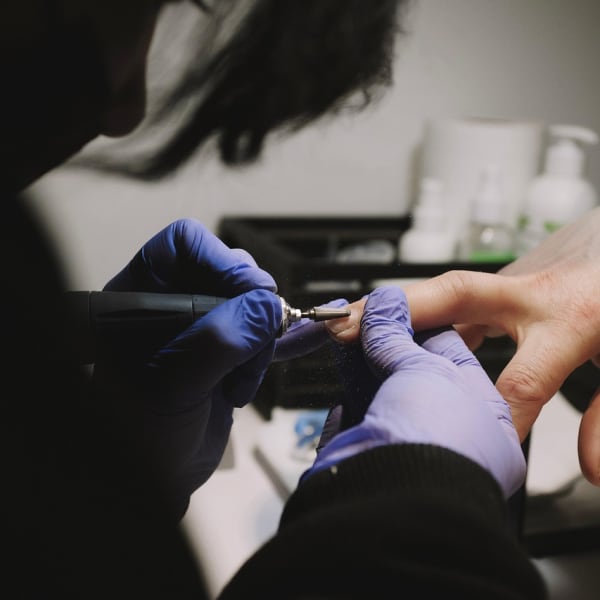
When techs are working on their clients’ hands, the thumb muscles of the supporting hand controls and guides the placement of the client’s finger. The other four fingers are used mainly for support, and they bear the weight of the client’s hands. “Strain from repeated motion, such as lifting, pulling, bending, and turning the client’s fingers can cause serious damage to the thumb,” says Robin Stopper, nail tech and owner of Nails by Robin in Tavares, Fla. “Symptoms such as pain, burning, weakness, tingling, numbness, and swelling can occur from overuse of these muscles,” says Stopper. She reminds techs that it’s important to recognize these symptoms early and take steps to prevent them before they start.
Robin Stopper has done nails for 26 years. That’s a long time to be hand wrestling with clients while you try to manipulate and maneuver them into the right position. Eleven years ago, Stopper’s body decided it had had enough. She went to the doctor because of her pain, and the doctor told her she needed to stop doing nails. Her posture while doing nails, the tension that had developed in her hands, and the mechanics of her job had caught up with her. “Quitting wasn’t an option,” says Stopper. “I was single and living in Fort Lauderdale. I owned my own house and ran a successful business. I knew I couldn’t just give up. So I asked myself what I could do to get around the pain.”
Stopper remembers the days when her pain was so bad she would need to rest between clients and apply medication to her hands throughout the day. “Sometimes I would sweat so bad from the pain that the sweat would drop onto my client’s hands,” says Stopper. Her desperation caused her to piece together a makeshift mechanism for clients to use as a wrist rest. “The tool held the weight of my clients’ hands,” she explains, “and because it rolled in all directions, I was still able to direct my clients’ fingers, but I didn’t have to bear their weight.” Stopper says she felt immediate relief from using her homemade device, and eleven years later is proud to say she’s still doing nails. Last year, she was finally able to make the device, dubbed the Wrist-Assist, available for purchase through her website (www.wrist-assist.com).
Other techs relate to Stopper’s story of pain. Elizabeth Higginbotham, a nail tech from Franklin, Tenn., has been in the nail business for six short years. About a year and a half ago, she started to feel pain in her hands and wrists. “It started off that I would have pain for a day or two, but then the pain would go away,” says Higginbotham. “One day it came and didn’t go away.” Higginbotham describes the frustrating process of trying to find a doctor who could help her: “One doctor told me I needed to keep a brace on my hands for three weeks straight,” she says. “I lost three weeks of work, and it didn’t help at all.” Cortisone treatments have relieved some of the pain, says Higginbotham, but it hasn’t provided permanent relief. She’s been diagnosed with a form of tendonitis, and though she hasn’t left her job, she’s paying a toll for staying. She often takes Advil or Aleve for the pain, ices her hands and wrists, and she still wears braces at night.
Have I got your attention? Listen, I know we techs are a bull-headed lot. We think it’s not going to happen to us, or that we can handle it if it does. I have news for you. These stories are every bit as reliable as any medical study. We need to take our health into our own hands. Techs who have been in the industry longer are warning newbies: Counteract the effects of the job. Use ergonomic tools to reduce body strain. Prevent the problem, or you’ll end up treating it.
Ad Loading...
Proactive Treatment Teresa Grant is a certified hand therapist in Broome County, N.Y.; she is also a licensed massage therapist and a registered and licensed occupational therapist. I described to her how a nail tech performs her job, and conceded there’s nothing on the books about it, but enough anecdotal evidence exists to suggest our work could cause long-term damage to our thumbs and wrists. I explained many techs never make a trip to the doctor until the pain gets to the point where it can’t be ignored, such as with carpal tunnel, arthritis, or tendonitis. Could techs, I asked, do anything to avoid the apparent risks of the job?
“Massage is important,” says Grant. She also suggested certain stretches and targeted therapy could help techs. She recommends techs develop a maintenance plan of, for example, 15 minutes of massage on each hand at least once a month, and possibly every other week. If that sounds too expensive, consider asking a massage therapist to barter her work for nail services. Grant also suggested techs learn stretches that relieve the muscles in the wrist. She described one where the hand starts in a “karate chop” position, and then the fingers are pulled back. Grant suggest techs make an appointment with a hand or occupational therapist to learn the correct ways to stretch the muscles and to create a personalized prevention plan.
Cindy Wentzel, owner of Nails at the Carriage House in Newmanstown, Pa., knows about wrist and hand pain, about trying to find a doctor who can help her, and about being proactive about her pain. “I’ve had pain since 1991,” says Wentzel. She describes the situation that aggravates it: “It’s actually when clients think they’re helping me,” she laughs. She says clients position their hands a certain way thinking it gives her a better angle, but all it does is cause her hands and wrist to tighten as she struggles with them to get their hands into the right position. “I have to tell them to stop helping!” she says.
Wentzel says using the Wrist-Assist, the tool developed by Stopper, has helped her find relief. “It makes a big difference in the pain in my neck,” says Wentzel. “I noticed it right away when I started using it.” She says the Wrist-Assist also helps relieve the pain in her hands and wrists since she no longer tires her muscles out by bearing the weight of her clients’ hands for hours a day, and her muscles aren’t being strained trying to get their hands into the right position.
The question isn’t whether the repetitive motion we do each day will catch up to us. The question is when and how. Techs who have been in the business for the past 25 years have issued the warning. It’s time to learn and practice new ways of working to avoid the pain so many techs describe. Hopefully, we’ll make positive changes that we can teach to each other — and to the next generation of techs. Let’s not only recognize, but also solve, the potential occupational hazards of our industry, and in doing so, keep ourselves healthy and pain-free.
Ad Loading...
Three Steps to Prevent Pain Christine Corey is a personal trainer in Sarasota, Fla. She suggests techs implement three main components into their preventative-care routine: compression, stretching, and massage.
Compression: Place a golf ball at the pain point either between your palms or on a hard surface and push down for two seconds. Roll the ball around for a release massage. Repeat as necessary.
Stretching: Stretching can be done either as a static stretch by keeping a straight arm and pulling fingers back toward to the body. Hold for two seconds and release. (A) Stretching can also be done as an active stretch, which stretches with movement. A figure 8 is an example. Start with hands in a prayer position with fingers interlocked. Rotate hands so that the right hand is on top. Twist in a figure 8 move to bring the left hand on top. Do a set of ten one way and then reverse with a set of ten the opposite way. (B)
Massage: Have a friend massage your hands by interlocking the fingers and rubbing the muscles of your hands and thumb in a circular motion. Use steady pressure, but not to the point of pain.
Uncured gel polish and microscopic e-file dust contain active acrylates that penetrate the skin, triggering permanent contact dermatitis. Learn the chemistry behind these irritants and how to protect your clients and yourself.
The Good Patch is a leading wearable wellness patch brand, offering wellness and skincare patches that support everyday needs including energy, sleep, relaxation and more.
Orthopedic PT reveals three daily exercises plus ergonomic advice that can help salon professionals avoid the aches and injuries caused by standing, bending and repetitive overhead work.
From acrylic monomers to airborne bio-dust, the air inside a nail salon carries risks most professionals never see coming. Aerovex Systems reveals the source-capture and room-purification strategies that are setting a new standard for salon safety.
Working in beauty doesn’t have to hurt. Learn how Somatic Movement helps hairstylists, lash artists, and other beauty pros release tension, improve posture, and extend their careers.
As a spa or salon professional, your clients expect more than just beauty—they expect safety, hygiene, and peace of mind. Fungal infections like Athlete’s Foot and Nail Fungus are more common than you think, especially in environments where tools and footbaths are reused without proper sanitation. This blog covers how to stop these issues before they start, using proven infection prevention strategies for salons and spas.
A federal initiative aimed at studying chemical exposure in nail salons has ended due to staffing and budget changes. Here’s what the project set out to do—and what its conclusion means for salon professionals.
For many people, a pedicure is a relaxing beauty ritual. But what most don’t realize is that this simple service, if done without proper hygiene and sanitation, can cause serious infections and long-term health issues.
Onycholysis is the separation of the nail plate from the nail bed. While it may look painful, it typically isn’t—at least not at first. But without proper care, this common nail disorder can lead to infections, deformities, and long-term damage.
Mckenzie Kool, Psychologist, MC, RPsych provides us with guidance on what may or not be helpful in speaking with someone who has suffered a significant loss.
Clients come to you to feel their best—not leave with a viral souvenir. Warts and cold sores can spread fast in busy salons, but a few smart habits make all the difference. Let’s talk about what’s really lurking in your salon (and how to kick it to the curb).
As Earth Day approaches, The Green Beauty Community Foundation and the Green Spa Network invite beauty pros to step forward and embrace sustainability through the Green Pledge--a powerful initiative designed by and for beauty industry leaders.
Don’t cancel Valentine’s Day altogether, urges Jill Palmquist. Instead, think of it as a (frilly, flowery, Champagne-bubbly) wake-up call to fall deeply in love with your own life.
Life coach and Culture Ambassador of Sam Villa, Andrew Carruthers, outlines how to tell if your burnout is temporary - or if it's time to make a bigger career change.