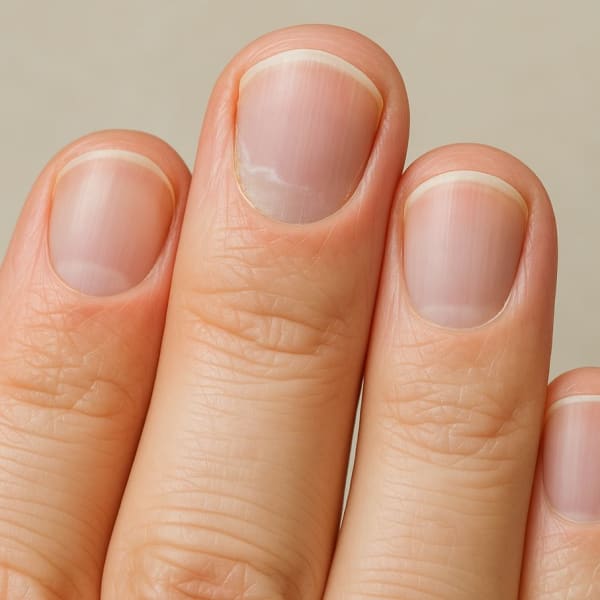
i am seeing a widespread condition, mostly on the toenails, that starts as small white dots and can get much larger, covering 80% of the nail. This condition can be filed away, but sometimes by the next pedicure it is back.
One client saw her doctor, and he filed it away with an electric file and went quite deep into the nail plate. Several months later, it has not reappeared. When I file it away am I not going deep enough? Can the condition be prevented or treated?
Dr.Mix: What is being described in this question is classic white superficial onychomycosis or leukonychia mycotica. The causative fungi are usually tinea mentagrophytes that attack, in this case, the superficial nail plate. There are other fungi that on occasion may also cause this condition. The podiatrist sees this condition commonly on the toenails. It is less common on the fingernails because they are not subjected to the warm, moist environment of shoes.
I see this condition much more commonly in the elderly and in patients who are debilitated. Individuals who are on immunosuppressant drugs for cancer and individuals who have immuno-difficient disease processes such as AIDS are also more prone to this type of fungal infection. Since this condition is on the superficial portion of the nail plate, it can be ground off with a drill or file. However, I have yet to see this “cure” the problem. Other topical or internal medications also must be used to “cure” the condition. I emphasize cure in quotes because it is very difficult to completely eradicate this infection of the nail. Topical clotrimazole, miconazole, or tincture of iodine applied twice daily have shown some success. The newer antifungals are quite successful in treating this problem, but the cost of treatment may outweigh the actual benefit the patient receives.
Under the proper conditions, tinea mentagrophytes may be transferred to other clients. The nail professional who chooses to work with nails that have a superficial onychomycosis must practice scrupulous sanitation and disinfection procedures. All instruments must be sanitized and then placed in a disinfectant solution that has antifungal properties for the required length of time. This simple process will reduce to acceptable levels the risk of transferring the fungus to other clients.
I have heard that a face mask can actually trap dust and vapor in your breathing zone with nowhere else to go but up the nose. Is this true?
Sunil Sirdesai: The filters in the mask will trap dust larger or equal to the mesh size, and vapor will be absorbed by the charcoal, which is present in the filter. A disposable mask has to be discarded at regular intervals. If they are not changed, the mesh will be overloaded with the dust and will force it up the nose, while charcoal in the mask will lose its efficacy when it is fully absorbed with vapors. The mask loses some effectiveness every time you come in contact with dust or vapor until it becomes totally ineffective. Note that white masks don’t have charcoal; gray masks indicate charcoal.
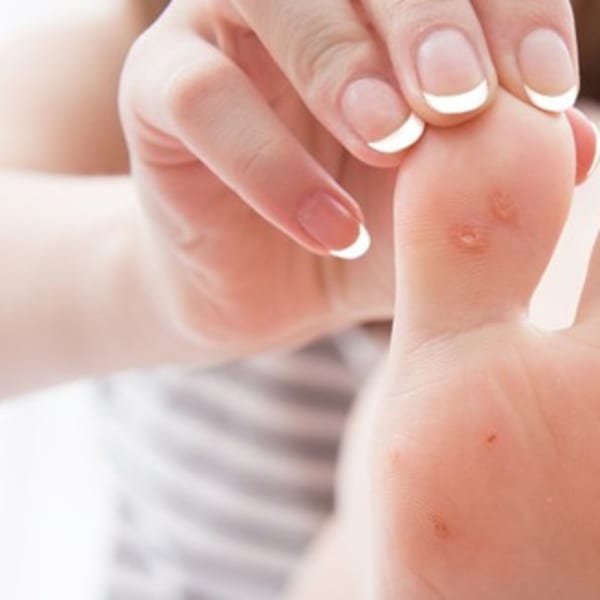
My friends, foot has white and dark scaly patches and circular holes. She said it started out small, with itching and bumps, then it spread all over the bottom of the foot and is now spreading to the top of her foot. Also, the foot peels and is very rough and dry. Her doctor said she was allergic to something. Do you agree?
Mix: I do not think what you are describing is an allergy. The condition described sounds more like a fungal infection of the feet called “moccasin foot” because of the moccasin-like pattern seen on the foot.
Fungal skin infections of the feet are generally seen as two distinct types. The first is an acute form called acute inflammatory tinea pedis. Inflamed blisters (large or small) that may break and ooze characterize this infection. Itching is present and the skin may crack and become soft in the infected areas. This type of fungal infection is often first seen between the toes. The causative organism is usually tinea mentagrophytes.
The second type is a dry, scaly form called chronic hyperkeratotic tinea pedis. Hyperkeratotic refers to a buildup of callus and dry skin. In this form, the edges of the dry scaly areas of skin are slightly red and inflamed. Itching may or may not be present. The heels, soles, and sides of the feet are usually involved in a typical moccasin pattern. The fungal species tinea rubrum is the usual causative organism in tinea pedis.
The chronic hyperkeratotic form of tinea pedis may be treated with prescription topical antifungals or with the newer oral antifungal medications. Tinea rubrum is very difficult to treat; therefore, if the topical form of treatment is used, it should be used daily for two to three months. The oral treatment can be completed in two to three weeks.
Are health care professionals with artificial nails more likely to carry or spread bacteria or fungus that non-nail wearers?
Rich: Many operating room supervisors would like to know that answer for certain! My opinion is that the safest, least contaminated nail is a short, freshly scrubbed, unadorned nail. The longer the nail (artificial or natural), the more likely that some bacteria are hidden under its free edge. The artificial nail theoretically can harbor bacteria more readily than a natural nail due to microscopic breaks and cracks around the edge of the overlay. Fungus (actually yeast) is a problem when onycholysis or paronychia is present in either natural or artificial nails.
I have a 70-year-old client who has vertical splits down the middle of most of her nails. As soon as the nail grows to the free edge, it splits. I give her a basic manicure on her natural nails every two weeks. She said the problem began when she started getting manicures. She used to use frosted polish but now only uses a nail hardening treatment without polish. I need some advice before I turn to artificial nails.
Rich: Your patient may have brittle nails or ridged nails from the aging process. You don’t say whether the split is at the distal end (toward the free edge) of a longitudinal ridge or groove, but I would bet it is. As the nails age, they develop fine ridges and valleys that run longitudinally. The valleys represent thinner areas of the nail plate. Sometimes at the free edge of the nail these valleys split. These splits can be very difficult to repair because even when the nail is filled back, the thin, weak valley areas of the nail continues to split. Occasionally a layer of polish will protect the weak area of the nail enough to allow it to grow out.
A patch of silk or fiberglass or a gel overlay will help camouflage the problem and shouldn’t exacerbate it. You mentioned that your client was using a nail hardener. I suggest using a nail hardener that is formaldehyde-free. Formaldehyde can make the nail more brittle and subject to breaking.