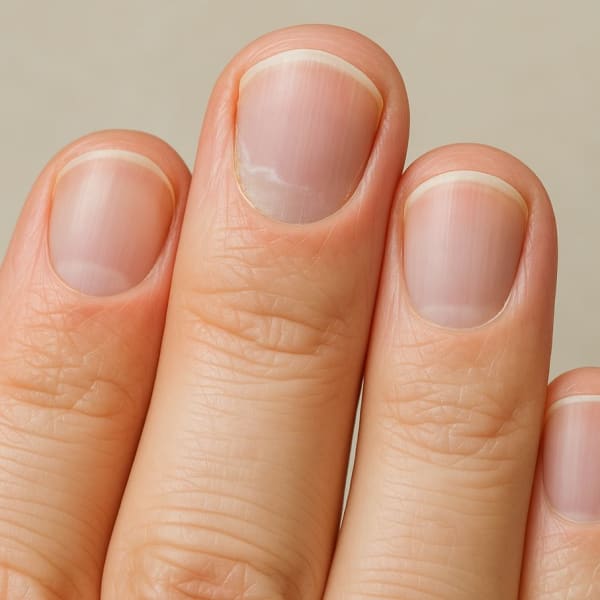
Problems with fingernails don’t just happen to adults. Children have nail problems as well, and whether they’re coming to you for services for themselves, or if it’s the child of one of your adult clients, understanding the nail problems of children makes you a more well-rounded nail technician. Nail problems in children and adolescents may often mirror those disorders found in adults. However, there are a number of situations when differences exist.
The most common nail condition seen, onychomycosis (fungal nail infection), may occur in young children, although it occurs more frequently in adults. When nail fungus does appear on children’s nails, it is usually associated with a similar infection in one or both parents. The source of the infection, therefore, is a parent; many times being related to someone who is prone to onychomycosis (the parent in this case) will leave the child susceptible to onychomycosis, too. Recent data have shown that in a high percentage of cases, susceptibility to onychomycosis is inherited. With respect to post-pubertal teenagers, nail fungus can also occur, but overall incidence is also somewhat lower than in adults. The tendency among dermatologists is to treat children with local medications only, such as antifungal creams, gels, solutions, and powders. Because of their side effects, oral medications are generally limited to adults, although in severe or resistant cases they may also be used on children.
Psoriasis of the nails also affects children. The occurrence rate of this disorder is less in children than adults, but if there is a family history of psoriasis, then a particular child may be more susceptible. It is very important for nail technicians to be aware of nail psoriasis, because all too often it is misdiagnosed as a fungal infection. Common signs of this disorder in-elude little dents on the surface of the nail (pits) and separation of the nail plate from the nail bed. In addition, the nail bed may become very thick and have an orange color known as an “oil spot.” The most: effective treatment for nail psoriasis is some form of cortisone. In children, we use cortisone creams predominantly, but in adults, cortisone injections around the nails have been very helpful. Physical injury or trauma to the nails may make the psoriasis worse, so remind your clients with nail psoriasis to be extra careful.
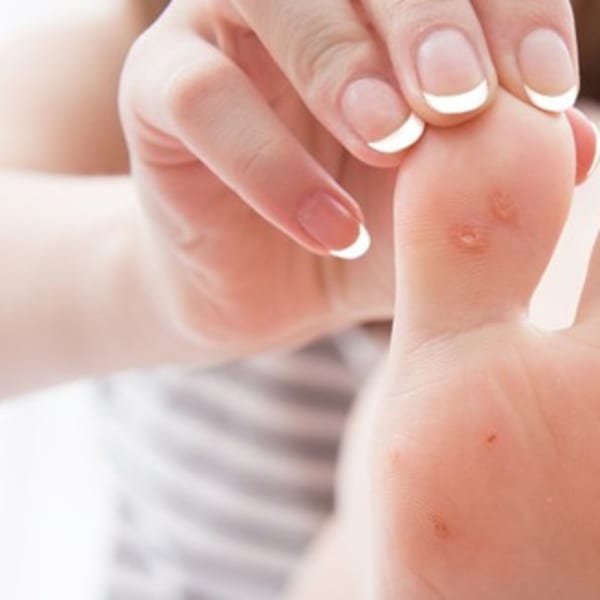
Warts around the nails (periungual) and under the nails (subungual) are often seen in children. Unlike nail psoriasis and onychomycosis, peri- and subungual warts occur more often in this age group than in adults. Since viruses cause warts, they can be transmitted from one person to another. It is wise for nail technicians to be aware that if they are performing procedures using implements on teenagers or children with warts (verrucae) of the nails, not thoroughly disinfecting their implements could spread the disease to other clients. Clients with periungual and subungual warts should be strongly advised to see their dermatologist for medical treatment. Removing warts usually involves some form of surgery, such as burning them off (electro coagulation) or freezing them off with liquid nitrogen. Your client can use a topically applied wart remover, but they seem to be less effective for treating warts around the nails. Your client can try one before opting for the surgical solution to her wart problem.
Another problem encountered in children are dark bands of the nail extending from the cuticle outward to the nail tip. These bands are usually of more concern in adults than in children. Nonetheless, when seeing such bands, nail technicians should advise the client to seek medical attention. Most of these bands in children are birthmarks. They are like having a mole (nevus) of the matrix, and they may, under some circumstances, require a biopsy or removal. In adults, they are more worrisome because in rare cases they could be a manifestation of a melanoma, a more serious form of skin cancer.
One of the conditions that requires differentiation would be a bruise under the nail (subungual hematoma). Often the patient may not remember an injury that caused the discoloration and thus it is essential for a physician to prove the color is due to blood (from a bruise) and not a possible melanoma. When in doubt, refer the client to her doctor.
A variety of hereditary conditions that affect the nails may signify other more serious health problems, and the nail technician may be in a position to be the first to recognize these conditions and perform a valuable service in recommending medical evaluation.
Some examples include the nail-patella (kneecap) syndrome. With this condition, the nails are abnormal and have triangle-shaped moons. The patient may have no kneecaps and is susceptible to kidney disease.
Another such condition is yellow nail syndrome, where the nails are yellow and have no cuticles. These patients often have swollen ankles as well as lung disease (specifically emphysema, which children do get, but only rarely) and chronic sinus conditions.
A hereditary disorder called dyskeratosis congentia produces very small, thin, and deformed nails and is associated with a seriously low blood count. Again, an astute nail technician will often be the first one to notice some of these abnormalities, and she may be the only one to recognize their significance.
Diabetic children and adolescents are particularly prone to infections around the nails, known as paronychia. With paronychia, the cuticle skin is red, swollen, and somewhat: tender. The most common cause is the yeast fungus called Candida; nail technicians should not perform any mechanical manipulations around the cuticles, including cutting, trimming, or pushing back the cuticles. Such procedures will make the infection worse and could spread it further, not only in the infected person but to others as well. Again, treatment by a dermatologist is critical; it may include topical and oral medications.
It maybe said that the nail technician has a unique opportunity to be a real heroine when young clients come to her salon for services. Although children and adolescents have somewhat different nail problems than adults, they still have much in common. Since the younger age groups are frequenting nail salons more and more often, a heightened awareness among nail technicians can only serve to prove further that they are true professionals with important responsibilities.