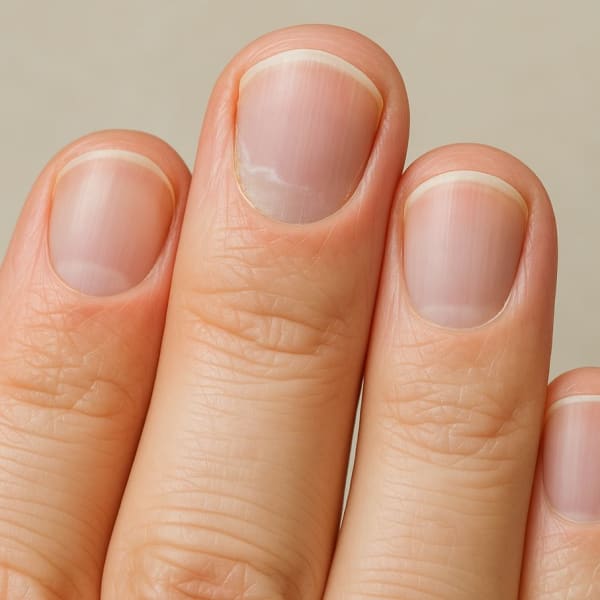
Scarring of the proximal nail fold region involving the matrix (nail growth center) is referred to as pterygium. This disorder is actually an overgrowth of the proximal nail fold onto the nail bed. Pterygium is derived from a Greek word, pterygion, which means “little wing” or “fin.” It is also referred to as wing-like. By definition, pterygium forms if there is scar tissue in the nail matrix. Since the nail matrix at that particular site cannot manufacture nail plate, the proximal nail fold skin grows out with the skin of the nail bed, giving rise to the triangular formation known as pterygium.
A number of skin and nail disorders may cause pterygium to form. One skin disorder cited most frequently is lichen planus, which occurs in the nails in approximately 10% of people who have this disorder. Severe destruction of the matrix with subsequent scar formation (pterygium) indicates the presence of lichen planus. Lichen planus of the nail may be very destructive to the nail plate in the adult form as a result of nail matrix destruction. Interestingly enough, when it occurs in children it is not destructive and it usually does not produce permanent scarring as it does in adults.
Another disorder that can give rise to pterygium formation is pemphigus vulgaris, which usually affects the skin but can affect the nail as well. It is characterized by huge blisters called bullae and small blisters called vesicles. When this condition involves the nail matrix, it can result in permanent scar formation. There are some hereditary disorders of the skin which are characterized by bullous changes, such as epidermolysis bullosa, which is a severly deforming condition that occurs at birth, or shortly thereafter, and manifests itself in childhood with destruction of the nails and pterygium formation.
Pterygium formation may also occur secondary to injury, such as from a severe blow from a hammer or a car door, which results in destruction of the nail matrix.
Some patients who have impaired circulation to the fingers, such as a condition known as Buerger’s Disease, can also develop permanent destruction of the nail matrix and pterygium formation.
Another disorder, a collagen vascular disease known as systemic scleroderma, may give rise to pterygium formation if the nail matrix is scarred and or destroyed. In addition to the characteristic pterygium that forms in scleroderma cases, inverse pterygium can also occur. This condition causes scarring in the tip of the finger rather than in the cuticle area, resulting in destruction at that site. Its appearance is very different than the usual wing-like pterygium that is generally seen with scleroderma.
Raynaud’s phenomenon, the condition that may occur after exposure to cold and causes the fingers to turn red, white, or blue, is a precursor to some patients with scleroderma. Severe Raynaud’s, where the nail matrix is affected and scarred, can give rise to pterygium.
Clients who severely and extensively bite their cuticles (a psychologically induced nail disorder) risk infection and destruction of the nail matrix, which may cause pterygium formation.
There are two approaches to treat pterygium. The first is used if the pterygium is now permanent due to scarring, but the primary disease is now inactive. Under some circumstances, these clients may be helped by surgical reconstruction with removal of the pterygium and the scar tissue in the matrix, which results in a nail more cosmetically acceptable than it was before. In patients whose pterygium formation is due to pemphigus or lichen planus and is still in an active stage, then the treatment would be directed at the primary disorder. Once the disorder is brought under control, further scarring will not occur and pterygium can be reduced or even prevented. This is also true in patients with circulatory problems in the fingers that give rise to vasospasm (sharp and often persistent contraction of a blood vessel reducing its caliber and blood flow) and permanent destruction of the nail matrix. If these disorders are treated with medications that open up the blood supply to the fingers, then the condition will not progress to further damage and more extensive pterygium formation.