I have two clients, one is 63 years old and the other is 30 years old, and both have a nail that splits right down the center. They each say it has done this for years and don’t remember when it started. I have covered it with acrylic to keep it from smagging on everything and hopefully to get a little length on the nail. What causes this and is there anything that I can do for them?
A nail that is split down the middle is usually secondary to an injury or trauma that was sustained sometime in the past. In many situations, patients do not remember having received such an injury. One of the more common causes of this type of trauma can be over-vigorous pushing back of the cuticle, which injures the nail matrix/nail bed and can result in scar formation and hence, a split nail.
In general, a nail that is split down the middle and has been that way for more than 6-12 months will not resolve with any medication or treatment. Camouflaging it with a nail tip or an acrylic nail can temporarily solve the problem for the client, but will not eliminate the split permanently. The only way to eliminate the split permanently is to have the scar surgically removed and repaired. There is a risk, however, if this is done that the scar may either remain or even become larger.
I have a client who I use acrylic products on, and it appears as though her nail layers or cuticles underneath are peeling, and her fingernails are very sore. Is this because of the acrylic? What would you recommend that I do to help this client?
There are two potential problems in using acrylic nails. One is if the client is allergic to the acrylic material. If this is the case, then acrylic cannot be used by your client at all or it could result in a very serious allergic reaction affecting the nail unit and giving rise to permanent nail damage. I would suggest that your client see a dermatologist and be tested for an acrylic allergy.
I would recommend that the acrylic nails be removed in order to determine if the problem still persists in the absence of the acrylic. This may alleviate the discomfort and peeling of the cuticles. The peeling of the nail and cuticles is most likely due to dryness or dehydration (loss of moisture) and your client may be better off not using acrylic products on her nails.
I am a hairdresser and for the last eight years, my nails have lifted off the nail bed at the tip, but stay attached at the base and sides. It is extremely painful when I hit my nail on a surface. I first noticed this after I had Lyme Disease and began taking Rocifin IV. At the time, I wore sculptured nails but have not worn them for years. I have taken medications for nail fungus, but is not a fungus. There are time when I get pain in the finger and the tip, and it gets very hot and lifts some more. Other times I will get a discoloration of the underside of the nail. That is when it starts to reattach, but not for long. I have seen two dermatologists, a general practitioner, and an internist – no luck so far. Could you please tell me what to do?
Lifting of the nails off the nail bed is referred to as onycholysis. When it occurs with extreme pain or discomfort, it is possible that you could be allergic to the hair dyes that you come into contact with. Another possibility is a yeast infection of the nail bed, which is more common in people whose hands are wet a great deal, which may be the case since you are a hairdresser. This can only be determined by taking samples of the nail and doing what is called a KOH wet mount to see if there are yeast cells present and by doing a culture to see if there is other fungus present. If this is unsuccessful, then the nail plate itself can be sent to a laboratory where it can be processed in a similar fashion to a biopsy (it is not a real biopsy) to see if there is anything in the nail that did not show up on the KOH and culture. Other causes of onycholysis include thyroids disorder, allergy to nail cosmetics, and allergy to certain foods. All of these things need to be evaluated and assessed by a dermatologist familiar with nail disorders.
In regard to Lyme Disease, this is not known to be a cause of nail lifting or onycholysis. Sculptured nails can cause onycholysis, of course, but if they have not been worn for years, it is not likely that they are the cause. Likewise there are certain medications that can cause onycholysis, some of which include antibiotics. For example, the tetracyclines can cause what is called photo-onycholysis, where the nails lift in the person who takes the antibiotic and then goes out into the sunlight. These possible causes need to be investigated by your dermatologist.
Once the cause is determined, then the proper treatment can be instituted. One other condition that can cause onycholysis is psoriasis, which usually affects the skin, but can involve the nails only (without skin involvement) in about 5% - 10% of individuals. This also would have to be diagnosed by a dermatologist. But the history that you present does not render the diagnosis of psoriasis very likely.
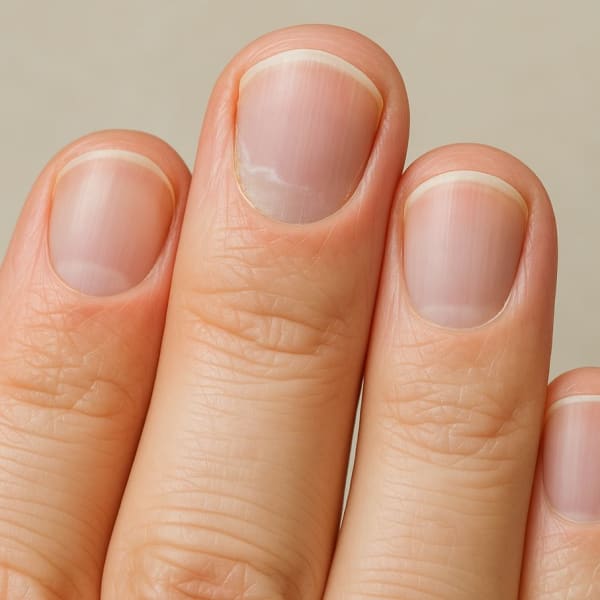
My client is in her 30s and has been getting basic manicures since February. She suddenly developed white spots and the following week, the spots appeared to have spread on the nail plate (and they were larger). She said she was under stress. Is this a fungus? Her doctor told her not to get any more manicures.
White spots on the nail occurring a short time after a manicure are usually caused by trauma due to over-vigorous manipulation in the area of the cuticles with metal or wooden instruments, or vigorous cutting of the cuticles. What happens is the nail matrix is injured and when the nail matrix is injured it shows up a few weeks later on the surface of the nail as a white spot. Therefore it is not necessary for the client to give up manicuring, but significant caution must be exercised in avoiding injury to the nail matrix (growth center) in the region of the cuticle. The nail matrix is right next to the cuticle and the trauma of over-vigorous manipulation can cause the white spots. It is true that a fungus can cause white spots on the nails, but white spots on the surface of the nails due to fungus usually occur on the toenails and are very unusual on the fingernails. However, if there is a possibility that this is fungus, which in this situation I would say is unlikely, then a dermatologist familiar with nail disorders should evaluate the patient and test for fungus. If there is no fungus there, then that confirms that trauma is the problem. If trauma is avoided, the white spots will grow out and disappear.
What can I use to get the fungus off of the nail right away? I have tried several topical ointments, but it doesn’t always remove the color. Can this be done? Can color be removed?
Fungus cannot be removed from the nail right away; it requires long-term treatment with a topical antifungal or several months’ treatment with an oral antifungal. However, your description of discoloration of the nail does not sound to me like it is due to fungus. Although it is possible for fungus to discolor a nail, there are many other causes of nail discoloration. For example, dark-colored nail enamels can cause the nails to become yellow. Diabetes, in some cases, can also cause nails to become yellow. Topical ointments alone are not likely to remove the discoloration from the nails. If the nails are colored brown to black, this could be due to melanin in the nail, which is similar to having a mole effect the nail the same way a mole affects the skin. It is likely that if the client has nail discoloration that persists and does not disappear, it should be evaluated as to what is causing the discoloration. There are even medications that can cause nail discoloration. A proper diagnosis of the discoloration is necessary.