Fungus, the dastardly, insidious villain that plaques many artificial nail users, has gained a bad reputation around town, and is casting shadows on the reputation of the nail industry across the nation.
by Suzette Hill, NAILS staff writer
February 1, 1990
Tension is high and tempers are flaring about an old problem that is getting new and increased attention in the media: fungus. The dastardly, insidious villain that plaques many artificial nail users has gained a bad reputation around town, and is casting shadows on the reputation of the nail industry across the nation.
This notoriety, however, is unnecessary. Fungus, if properly treated in a timely manner, need not to be more than a mild inconvenience to artificial nail user. Part of the solution is recognizing fungi for what they are: Simple plants.
A FUNGUS AMONG US
Fungi are a class of plants, classically without leaves or roots, which live on organic matter. The fungi that grow on human skin are micro organisms, visible only under a microscope.
According to Dr. David Sire, a dermatologist in Fullerton, California, fungi have learned to live on artificial sources of protein. Certain fungi specialize in living on keratin, the protein that forms the nail plate and hair. The fungi digest keratin and use it as an energy source for themselves, but at the same time cause problems in the nail bed and plate.
Fungi are introduced to the human body by trauma, injury, infection, and allergies, and grow inward.
“These creatures are reproduced by spores, which are microscopic structures that blow in the wind and contaminate the soil, and are pretty much ever-present in our world.” Says Sire. “It’s common for some sort of injury, even a minor break in the skin, to then allow a portal of entry for the spore to enter the skin and begin to grow.”
When a fungus resides in the human nail, it usually sets up housekeeping between the nail bed and the nail plate.
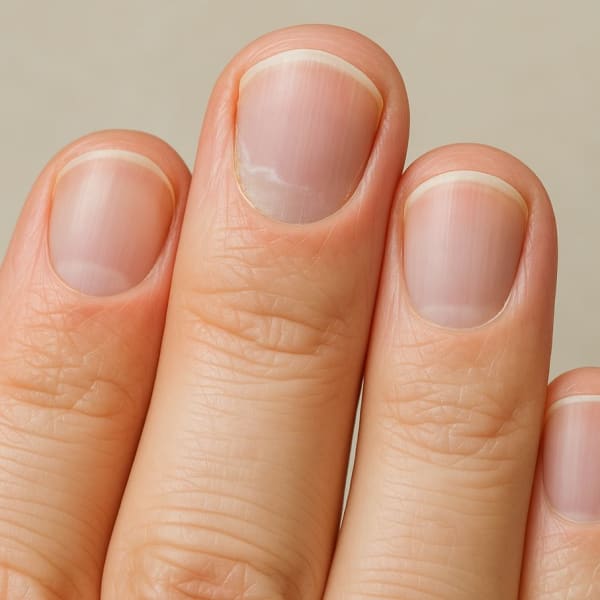
Although many think fungus is green or brown in color, it is more often white and yellow, says Sire.
“When fungi grow, they cause an irritation and you’ll see a thickening of the nail plate itself, or a build-up of scale between the nail plate and the nail bed,” explains Sire. “It will appear either as a whitish or yellowish discolored material that begins to form on the nail bed.”
Stop Right There! Fungus isn’t white or yellow at all, it’s green or brown, isn’t it?
Not according to Sire, who says the green color is usually caused by a bacterial infection, which is completely different from a fungus. It is also important to keep in mind that bacterial infections, characteristically green or brown in color, can appear in conjunction with fungal infections.
“Frequently the brown discoloration is caused by a bacterial infection, although there are some rare kinds of deep fungi that cause it… in my experience, if you culture the green nail for bacteria, you almost always find [it],” asserts Sire.
“Sometimes I’ll see patients who had artificial nails and who’d been diagnose as having fungus infection without anybody doing the proper fungal studies or bacterial cultures,” says Sire.
Once the fungus begins to grow, it takes up more space and actually lifts the nail plate up and off the nail bed, creating a space which Sire says classically extends from the outer tip of the skin, in towards the finger.
If the fungal infection is not arrested and reversed, it can ultimately spread all the way through the nail into the matrix area, and the whole nail can be lifted off and lost.
“Sometimes the nails will get very pliable and move easily from side, and frequently the nail will fall out from the infection.” states Sire. “It usually grows back but most of the time it gets re-infected.
And, infected. Remember, the fungi are living on the nail bed, so they can just re-infect the new nail.”
According to Sire, if the fungal infection spread to the matrix area the nail could be permanently deformed.
GETTING THE PICTURE
Just what causes a fungal infection? Many people believe fungal infections are caused by lifting of artificial nail products, which allows moisture to enter. Conversely, others believe the nail bed “sweats” and the build-up of moistures under artificial nails causes fungal infections.
Although Sire allows that both situations are possible, he believes the infections are more often caused by contact dermatitis, an allergy to the products being used.
“You can get a fungus infection from the top of the nail which discolored areas, white flecks on the top of the nail, but most of the nail bed and the nail plate, and that is where the separation is caused. I believe they’re caused by contact dermatitis, which lifts the nail plate off the nail bed.
“Yes, the nail bed does have sweat glands in it, as does the rest of the skin, and there is some moisture attached, but you need to remember that the nail bed and the nail plate are a unit and they stay together,” explains Sire.
For this reason, the natural moisture content of the nail will not cause the nail plate to lift from the nail bed and form a fungus infection, Sire says, even if fungi spores are present.
Fungi spores are necessary for the formation of fungi. According to the physician, they are found everywhere in nature. Sire likens fungi spores enter the skin through a break, such as a scratch or laceration, in a fungal infection can result.
“If you put an artificial nail over your nail plate, they still can get from the outside of your skin, and go under the nail says Sire.
But if the spores are so invidious in nature, why don’t all artificial nail users get fungus infections? The answer is not easily found. First, the spores must gain entrance to the nail bed. As discussed before, they can only access the nail bed by injury, trauma, allergy, or any situation which causes an irritation and allows the spores to enter the skin, they do create a window of opportunity for spores already present.
“One of the problems is caused by allergies, either to the monomers or to formaldehyde resins, that set up a situation in which the organism can get into the nail bed and cause the infection,” relates Sire.
IS THERE A DOCTOR IN THE HOUSE
So what should a nail technician do when confronted by these symptoms? When a client spots, white spots, or onycholysis (separation of the nail bed from the nail plate) on her natural nails, many nail technicians diagnose it as a fungal infection, buff the nail, and apply a commercial anti-fungal preparation.
Often though, it is not a fungal infection, and a doctor is the only one who can determine the root of the problem and treat it properly.
“Sometimes they can be bacterial infections, sometimes they can be fungal infections, or they can be psoriasis, and technicians need to be aware that all of these things can look alike.” asserts Sire. “Proper diagnosis is imperative to treat it properly, whether we have an antibiotic for bacteria, an anti fungal medicine if it’s fungus, or an anti-inflammatory if it’s psoriasis.”
These symptoms can also be caused by yeast infections, hereditary condition, or contact dermatitis.
For these reasons, Sire stresses the importance of letting a doctor diagnose the condition and prescribe the proper medications.
“By trimming the nail and treating it, [the nail technician] can superficially make the artificial nail, but frequently it’ll come back, or it’ll become more extensive.” explains Sire. “Then you’ve taken the small problem of removing the artificial nails, treating the infection, and being done with it, and created a six-month to one-year program for the woman to get 10 nail, or eight nails, to grow back in.
“If a contact sensitivity is developing, then a dermatologist needs to determine that so the nails can all be removed quickly before we end up with an extensive nail problem.”
Sire also advises against treating infection before sending the client to a doctor because commercial preparation may mask symptoms, and make the condition more difficult for the doctor to diagnose.
Many different adverse nail conditions are complicated to diagnose, especially visually, because the symptoms are similar to those of other nail conditions. For this reason, it is essential to defer from treating nail clients until the person has the condition examined and treated by a doctor.
If professional nail technician take this stance, the villain may not be completely forced to become a medicine-abiding condition.