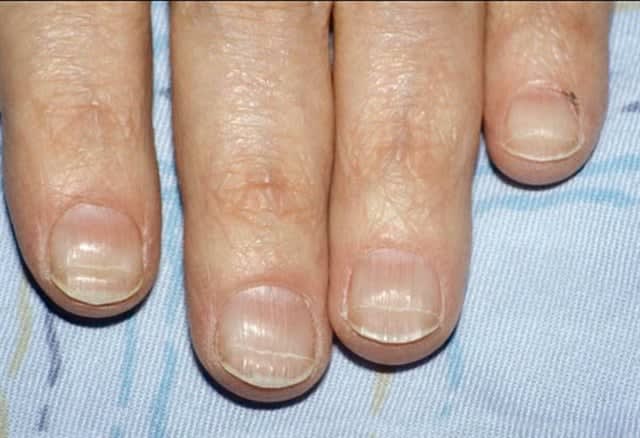
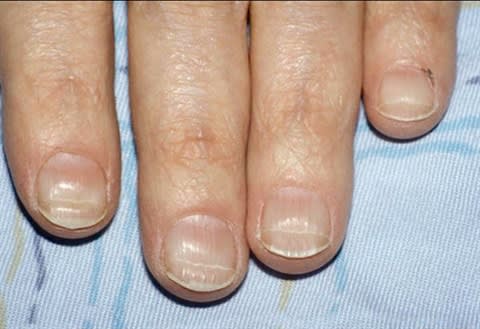
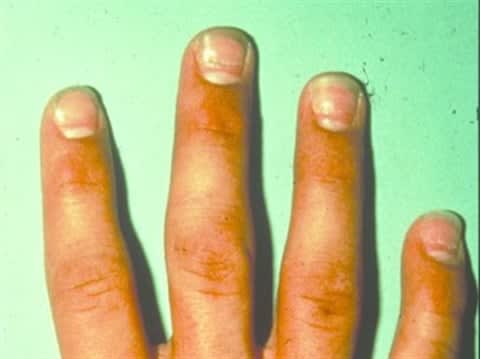
Beau's lines: a ridged or grooved line that runs horizontally across the nail
5 min to read
Beau's lines: a ridged or grooved line that runs horizontally across the nail
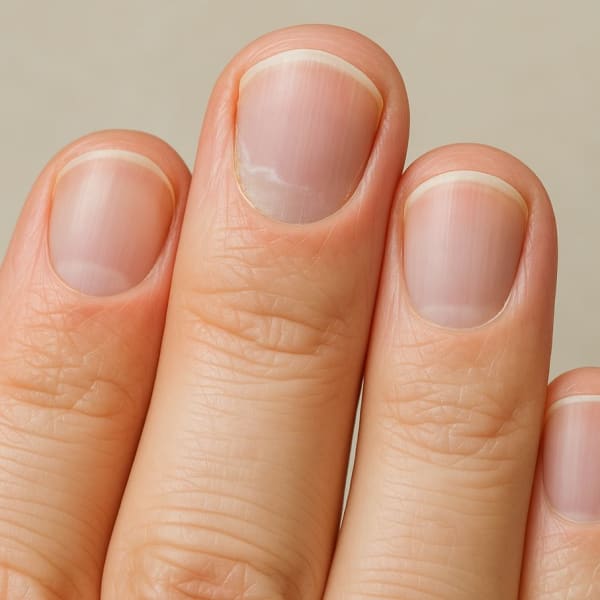
Beau’s lines appear on the nails as horizontal ridges or grooves. The French physician Joseph- Honoré-Simon Beau is credited with the name because he was one of the first to document the relationship between physical “tells” or indicators and systemic (whole body) health problems. When the body suffers a trauma — internally or externally — there is often evidence of the trauma on the nails. Beau’s lines are an example of the body producing evidence of a systemic problem.
Beau’s lines are caused when the body stops producing nail cells for a period of time, anywhere from a day or longer. When the body starts producing those cells again, the nails begin to grow. As the nail grows out, Beau’s lines will appear on the nail and techs will be able to see where the nail’s development was affected.
Ad Loading...
Most commonly Beau’s nails can be traced back to a high fever or an infection, but other systemic problems can also be the cause. Patients who undergo chemotherapy, for example, can develop Beau’s nails, because the chemicals can cause systemic trauma.
“On the other hand,” says Dr. Robert Brodell, M.D., a professor of Internal Medicine at Northeastern Ohio Universities College of Medicine, “local trauma can also stun the nail matrix and the same Beau’s lines can be produced on only one nail.” Local trauma is caused by an external force, such as a hammer, a nail being crushed, or some other memorable and painful event. Techs may have seen Beau’s lines on a nail without realizing the lines are actually a medical condition. Often the client can remember the incident that caused the local trauma, so techs may not have given much thought to the lines. Most techs understand that though the nail matrix was damaged, the subsequent ridge or groove will eventually grow out.
When the issue is a systemic problem instead of a local trauma, Beau’s lines can appear on multiple nails, and may even show up on toenails. Techs can identify Beau’s lines because they are not only visible, they add the texture of a ridge or groove to the nail. “Remember,” says Dr. Brodell, “there is a palpable horizontal defect in the nail plate. It’s not just a band of discoloration.”
When Beau’s lines appear on the nails, clients will naturally be alarmed. Clients can see and feel the change in their nails and they may fear the condition is permanent — especially when multiple nails are affected. If Beau’s lines appear on a client who has nail enhancements, the client may even think her nail tech is to blame for the defect, citing vigorous filing or another external factor. Clients may even think they have developed an allergic reaction to the product and ask to have their nails removed. Techs can be confident that Beau’s lines are entirely harmless. Clients may worry that their nails are “going bad” says Dr. Brodell, but Beau’s lines present no danger to the client at all. As the healthy nail grows out, the lines will grow out also, and techs will eventually be able to file them off when they reach the free edge.
What’s A Tech To Do? Because Beau’s lines are the result of systemic problems or local trauma, there is nothing techs (or clients for that matter) can do to prevent them from developing. However, once Beau’s lines appear, techs can begin by educating the client about this condition. Ask the client if she has had any infection, fever, or illness in the past number of months. Remember, it will take a significant amount of time for Beau’s lines to grow out from the matrix enough to be visible, so a fever last week isn’t going to result in visible Beau’s lines this week. Shock or a traumatic event can affect the body in strange ways, so don’t dismiss any explanation the client suggests. For example, Beau’s lines have been documented in the case of heart attacks and malaria. They have also been documented in divers and climbers, who have experienced the pressure of a severe change in altitude, which can disrupt the production of the nail cells.[PAGEBREAK]
Ad Loading...
Let the client know that her body has experienced a trauma, and the lines are simply evidence that the body had a problem. Show her the healthy nail that is growing at the cuticle behind the Beau’s lines. Let her know that as the healthy nail continues to grow, the lines will grow out and will eventually be filed off. “Normal nails are produced and the Beau’s line grows out over time,” says Dr. Brodell.
Beau's lines result from an interruption or cessation of growth due to serious illness, shock, injury, or disease.
It’s unlikely that multiple rings of Beau’s lines will appear on a client’s nails without her being aware that her body has undergone either local or systemic trauma. However, if techs see Beau’s lines recurring in the same client without the client being able to identify the reason, insist the client see her doctor to troubleshoot the cause.
Nail enhancements are the ideal solution to the appearance of Beau’s lines, because nail products such as acrylic or gel can fill in the grooves and smooth out the nail. However, there is a caution here. Be aware that all angles of the ridged or grooved nails need to be prepared well so oils will be removed entirely before product is applied. It’s possible that without proper prep, an air pocket could develop in the groove of the lines, which could lead to trapped water and an infection. Diligence and thorough cleansing of the nail plate are required.
Clients will most likely need colored product or polish, since the lines will likely be visible through a clear or pink product. For natural-nail clients, apply a thin coating of product to the entire nail to even out the deformed nails. As the nail grows, the Beau’s line will grow out, and the product will grow off. For existing enhancement clients, perform services as usual, suggesting colored acrylic, gel, or polish as necessary. Clients will be thrilled that you not only relieved the concern over their nails, but you also made them beautiful again.
Uncured gel polish and microscopic e-file dust contain active acrylates that penetrate the skin, triggering permanent contact dermatitis. Learn the chemistry behind these irritants and how to protect your clients and yourself.
The Good Patch is a leading wearable wellness patch brand, offering wellness and skincare patches that support everyday needs including energy, sleep, relaxation and more.
Orthopedic PT reveals three daily exercises plus ergonomic advice that can help salon professionals avoid the aches and injuries caused by standing, bending and repetitive overhead work.
From acrylic monomers to airborne bio-dust, the air inside a nail salon carries risks most professionals never see coming. Aerovex Systems reveals the source-capture and room-purification strategies that are setting a new standard for salon safety.
Working in beauty doesn’t have to hurt. Learn how Somatic Movement helps hairstylists, lash artists, and other beauty pros release tension, improve posture, and extend their careers.
As a spa or salon professional, your clients expect more than just beauty—they expect safety, hygiene, and peace of mind. Fungal infections like Athlete’s Foot and Nail Fungus are more common than you think, especially in environments where tools and footbaths are reused without proper sanitation. This blog covers how to stop these issues before they start, using proven infection prevention strategies for salons and spas.
A federal initiative aimed at studying chemical exposure in nail salons has ended due to staffing and budget changes. Here’s what the project set out to do—and what its conclusion means for salon professionals.
For many people, a pedicure is a relaxing beauty ritual. But what most don’t realize is that this simple service, if done without proper hygiene and sanitation, can cause serious infections and long-term health issues.
Onycholysis is the separation of the nail plate from the nail bed. While it may look painful, it typically isn’t—at least not at first. But without proper care, this common nail disorder can lead to infections, deformities, and long-term damage.
Mckenzie Kool, Psychologist, MC, RPsych provides us with guidance on what may or not be helpful in speaking with someone who has suffered a significant loss.
Clients come to you to feel their best—not leave with a viral souvenir. Warts and cold sores can spread fast in busy salons, but a few smart habits make all the difference. Let’s talk about what’s really lurking in your salon (and how to kick it to the curb).
As Earth Day approaches, The Green Beauty Community Foundation and the Green Spa Network invite beauty pros to step forward and embrace sustainability through the Green Pledge--a powerful initiative designed by and for beauty industry leaders.
Don’t cancel Valentine’s Day altogether, urges Jill Palmquist. Instead, think of it as a (frilly, flowery, Champagne-bubbly) wake-up call to fall deeply in love with your own life.
Life coach and Culture Ambassador of Sam Villa, Andrew Carruthers, outlines how to tell if your burnout is temporary - or if it's time to make a bigger career change.