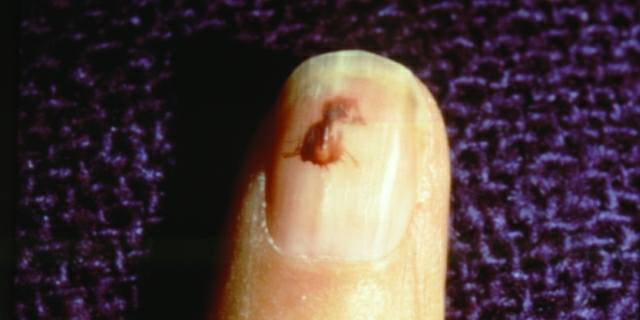
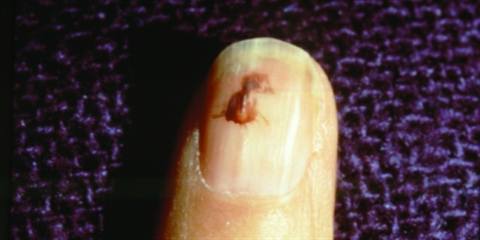
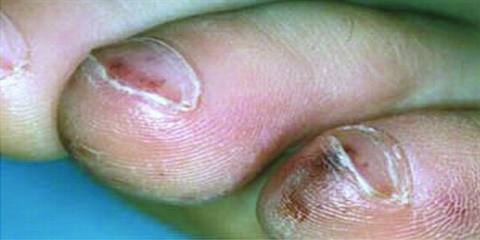
n. (splĭn ‘tər hem’ər-ĭj) small areas of bleeding or hemorrhage underneath the nail bed that take the shape of straight lines; usually caused by hard impact or physical trauma to the nail; usually grows out with the nail after a few months
by Patricia Oropeza
June 1, 2005
5 min to read
What It Is
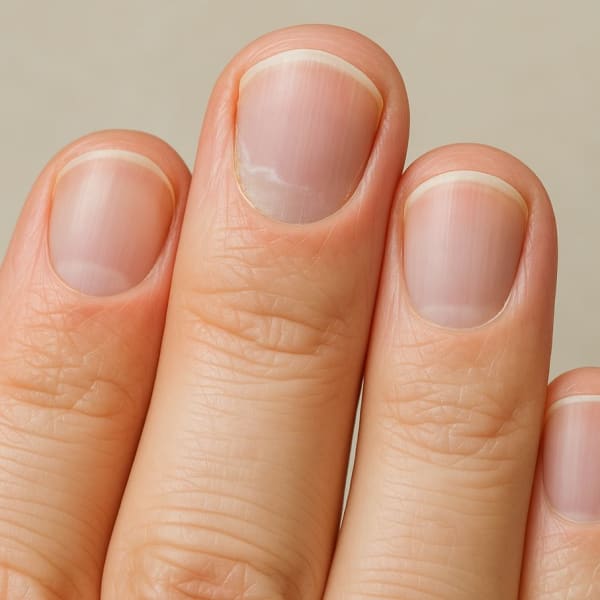
A splinter hemorrhage, also commonly known as a fingernail hemorrhage, actually resembles a splinter underneath the nail. These small areas of bleeding or hemorrhaging under fingernails or toenails often take the shape of straight lines.
Ad Loading...
The nail bed contains many small blood vessels. Since the nail bed’s anatomic structure is arranged in longitudinal grooves and ridges, when there is a small amount of bleeding within one of these grooves, the overlying nail plate traps the blood. The nail bed is linear in its construction so the blood takes on the appearance of a straight line. Eventually small clots form and the bleeding stops.
Symptoms
Thankfully, there is no pain or discomfort associated with splinter hemorrhages, other than the initial trauma that may have caused it, if that is the case. The only way you can tell you have a hemorrhage is by a visible red stain under the nail plate.
If the splinter hemorrhage is the result of another condition such as Raynaud’s disease, for example, then there may be discomfort as a result of that particular condition or disease.
Causes
Ad Loading...
Splinter hemorrhages are often caused by some type of hard impact or other physical trauma to the nail bed and should not be a cause for concern. “There really is no way to prevent them from occurring,” says Nancy Satur, M.D., North Coast Dermatology Associates in Encinitas, Calif.
“In healthy individuals, the most common cause is acute trauma to toenails or fingernails usually associated with tennis, jogging, or hockey,” adds Jessica Luu, D.P.M., of JT Enterprises Corporation. “But less vigorous activities such as playing with a frisbee or golf can cause trauma to the capillaries of the vascular nail bed.”
However, there are some instances where a splinter hemorrhage may be a sign of something more serious.
Onychomycosis (fungal infection), for example, can give rise to splinter hemorrhages. Nail psoriasis may also cause hemorrhaging of the nail bed. In this condition, there is a thinning of the upper layer of the nail bed. Blood vessels are closer to the nail plate , so splinter hemorrhages are easier to develop.
Some medications may also cause splinter hemorrhages. Aspirin, for example, slows the coagulation process of the blood. Medications that are sold over-the-counter for headaches, arthritis, and other minor pains may also cause nail bed hemorrhaging.
Ad Loading...
If splinter hemorrhaging occurs on more than one nail the chances of your client having an underlying disorder or disease are more likely. And if they occur on more than one nail and frequently reappear, it may be a sign of a connective tissue disorder such as lupus, which is serious and requires medical evaluation and treatment.
Clients with Raynaud’s disease may also suffer from splinter hemorrhages. Clients with this condition are oversensitive to cold and if they do develop a hemorrhage the tips of their fingers may also be discolored and look pink, blue, or white.
On rare occasions, people with endocartitis (disease of the heart valves) can develop hemorrhages. Since they suffer from high fever, anemia, and heart murmurs they are usually already under the care of a physician.
They may also be associated with vasculitis (inflammation of the blood vessels) or microscopic clots that damage small capillaries (microemboli), says Dr. Luu.
[PAGEBREAK]
Ad Loading...
How to Treat It
Treatment depends on the underlying cause of the splinter hemorrhage. But the only way to get rid of a splinter hemorrhage is to simply let it grow out. Since it is deposited on the under surface of the nail plate, the splinter hemorrhage will grow out with the nail and the nail bed over a period of time and disappear completely. This usually takes a few months.
“The nail will grow out, but it may grow back abnormal,” adds Dr. Luu.
If the splinter hemorrhage is caused by certain medications, the medication should be discontinued if possible.
If the hemorrhage is the result of a fungal infection or nail psoriasis, then obviously treating those underlying conditions will cause the bleeding to disappear and no longer recur.
Ad Loading...
If the cause is trauma from a sports-related activity, keeping the nails trimmed short can prevent these hemorrhages, says Dr. Luu.
Your client may want to check her shoes to be sure the toenails are not hitting the inside of the shoe if the splinter hemorrhages are occurring on the toenails. This can happen with abnormally shaped toes or when wearing shoes that don’t fit properly. Clients may want to have the shoes modified to accommodate an abnormally shaped toe, suggests Tammy Brown, D.P.M., of JT Enterprises Corporation.
“Local pharmacies often carry a variety of toe pads and specialty shoe providers can often loosen an area of tightness in a shoe to accommodate an abnormal digit,” says Dr. Brown.
Splinter hemorrhages that persist over a period of time should be medically evaluated to rule out the possibility of a blood disorder or other condition a person may not be aware of.
Considerations for Nail Techs
Ad Loading...
If a client comes to you with a splinter hemorrhage on her nail, fear not. While a hemorrhage may look ugly you can still work on the area of the nail that it’s on, says Dr. Satur. However, you should handle the hemorrhaged area with care. Filing, buffing, or handling a nail with a hemorrhage should be performed gently so the underlying nail bed is not traumatized.
Before you begin a service conduct a client consultation, especially if you’re dealing with a new client. Before you begin working on the injured nail ask your client what happened to it. Chances are she’ll tell you she injured it, but if she hasn’t, advise her to have her physician check it out promptly.
And while your client would probably love to camouflage that nasty hemorrhage with polish it may be a good idea to have her get it checked out before you apply anything on the nail.
“If there are systemic causes involved the client should be referred to a physician so her medical issues can be treated or addressed before that client can cover up the nail with nail polish or acrylic nails,” says Dr. Luu.
If a client has a splinter hemorrhage on more than one nail or has recurring hemorrhages you should advise her to see her physician if she hasn’t done so already. It may be a sign of a more serious disease or condition.
Uncured gel polish and microscopic e-file dust contain active acrylates that penetrate the skin, triggering permanent contact dermatitis. Learn the chemistry behind these irritants and how to protect your clients and yourself.
The Good Patch is a leading wearable wellness patch brand, offering wellness and skincare patches that support everyday needs including energy, sleep, relaxation and more.
Orthopedic PT reveals three daily exercises plus ergonomic advice that can help salon professionals avoid the aches and injuries caused by standing, bending and repetitive overhead work.
From acrylic monomers to airborne bio-dust, the air inside a nail salon carries risks most professionals never see coming. Aerovex Systems reveals the source-capture and room-purification strategies that are setting a new standard for salon safety.
Working in beauty doesn’t have to hurt. Learn how Somatic Movement helps hairstylists, lash artists, and other beauty pros release tension, improve posture, and extend their careers.
As a spa or salon professional, your clients expect more than just beauty—they expect safety, hygiene, and peace of mind. Fungal infections like Athlete’s Foot and Nail Fungus are more common than you think, especially in environments where tools and footbaths are reused without proper sanitation. This blog covers how to stop these issues before they start, using proven infection prevention strategies for salons and spas.
A federal initiative aimed at studying chemical exposure in nail salons has ended due to staffing and budget changes. Here’s what the project set out to do—and what its conclusion means for salon professionals.
For many people, a pedicure is a relaxing beauty ritual. But what most don’t realize is that this simple service, if done without proper hygiene and sanitation, can cause serious infections and long-term health issues.
Onycholysis is the separation of the nail plate from the nail bed. While it may look painful, it typically isn’t—at least not at first. But without proper care, this common nail disorder can lead to infections, deformities, and long-term damage.
Mckenzie Kool, Psychologist, MC, RPsych provides us with guidance on what may or not be helpful in speaking with someone who has suffered a significant loss.
Clients come to you to feel their best—not leave with a viral souvenir. Warts and cold sores can spread fast in busy salons, but a few smart habits make all the difference. Let’s talk about what’s really lurking in your salon (and how to kick it to the curb).
As Earth Day approaches, The Green Beauty Community Foundation and the Green Spa Network invite beauty pros to step forward and embrace sustainability through the Green Pledge--a powerful initiative designed by and for beauty industry leaders.
Don’t cancel Valentine’s Day altogether, urges Jill Palmquist. Instead, think of it as a (frilly, flowery, Champagne-bubbly) wake-up call to fall deeply in love with your own life.
Life coach and Culture Ambassador of Sam Villa, Andrew Carruthers, outlines how to tell if your burnout is temporary - or if it's time to make a bigger career change.