Nail techs can significantly reduce muscle tension and soreness and lower stress levels simply by incorporating a few yoga poses and breathing techniques into their daily work routine.
by Staff
November 1, 2002
7 min to read
As a long-time nail client, Lilias Folan empathizes with the physical and mental stresses nail techs endure. She’s watched you spend hours hunched over, holding her hand and other’s as you sculpt, file, and polish. She’s seen you bent over men’s and women’s feet, scrubbing and rubbing. She’s spent countless appointments all of the others in her day, and it puts a lot of pressure on the body.”pouring out her heart, and she knows she’s only one of many.
She sympathizes with your sore back, stiff shoulders, numb and tingling fingers, tension headaches, and generalized fatigue at the end of each day. “A nail tech’s spine is rounded and she’s leaning forward,” she observes. “Add those stresses to
Ad Loading...
As long-time yoga practitioner and instructor, Folan has her own professional recommendation for nail techs: Take a few minutes between each client to practice yoga poses and breathing techniques for improved physical and mental well-being.
Unlike many exercise programs, yoga promotes physical and mental fitness through stretching and strengthening your muscles, lungs, and mind. Even better, yoga instructors agree that nail techs can significantly reduce muscle tension and soreness and lower stress levels simply by incorporating a few yoga poses and breathing techniques into their daily work routine.
“There are a couple of things that we’ve found work extremely well for people who sit for long periods or who are in stressful situations,” says Patricia Rockwood, a yoga instructor and executive editor of instructional materials for the American Yoga Association (AYA). “You’ll notice the benefits on the first day because it doesn’t allow the stress to accumulate.”
Get a New Outlook on Life
More than just an exercise, yoga is a philosophy of life that promotes the union of mind, body, and spirit. More than 100 forms of yoga are practiced throughout the world, but hatha yoga—a system of physical exercises, breathing techniques, and meditation—dominates in the United States.
Ad Loading...
There are as many variations of poses within hatha yoga as there are styles, but Folan says beginners need only understand that all yoga poses are based on squeezing or tightening a muscle, holding the squeeze, and then releasing it.
“Yoga ask you to look inward, to take a moment to see where you are in each pose,” says Folan, who has practiced yoga for 27 years and taught through TV shows, books, audiotapes, videos, workshops, and seminars nationwide (learn more at www.liliasyoga.com). “These [brief] periods of relaxation give your body time to absorb what you’ve done so that you become aware of your body’s relaxed state.”
Forget the human pretzel poses you may associate with yoga. Most people find the basic yoga poses as simple and natural as yawning. “Stretching and yawning—with your arms up, your back arched and your jaw open—is a natural yoga posture that most people have been doing since they were children,” Folan notes.
Along with specific exercises and positions, yoga emphasizes practicing breathing techniques independently as well as during poses. “Breathing techniques are based on the concept that breath is the source of life in the body,” Rockwood explains. “The yoga student gently increases breath control to improve the health and function of both body and mind.”
Take a Deep Breath
Ad Loading...
Breathing is as integral to yoga as it is to life, so it’s really no surprise that mastering yoga breathing techniques helps you navigate your own good emotional health. “People literally can drain your energy if you let them,” Folan says. “When you get clients who talk about difficult things, watch what happens to your breathing. When someone close to you is upset, that emotion often transfers and causes your breathing to become faster and more shallow.”
“When you’re frustrated or angry, there’s tightening of the respiratory muscles,” agrees Rockwood. “Something as simple as inhalation and exhalation of breath does wonders to break up that pattern . . . and to relieve stress almost immediately.”
Before every client, take a minute to catch your breath with the following technique, courtesy of the AYA. (Find more yoga poses and information on books and videos at www.americanyogaassociation.org.)
Seated at the edge of your chair with a straight yet natural posture, close your eyes and inhale slowly through your nose. Concentrate on the sound of the breath. (“This gives your mind a rest, which contributes greatly to the stress coping effect,” Rockwood says.)
Place your hands on your belly and breathe out, trying not to slouch forward. Tighten your belly muscles to get as much air out as possible. Then breathe in from the bottom up, letting your belly muscles relax so the air appears to fill your belly. Continue to breathe in and feel the air filling the center part of your torso. Imagine the muscles between your ribs stretching so that your ribs expand in all directions, not just forward. Breathe in a little more and feel the air filling the very top sections of your lungs.
Ad Loading...
When your lungs fill, slowly start to breathe out, releasing air from the top down. First relax your chest, then let your ribs contract, and finally tighten your belly and push the last of the air out. The complete cycle may take anywhere from 10 to 30 seconds.
Build Strength Inside and Out
Yoga benefits the body by stretching and strengthening muscles and promoting circulation, both of which help to carry fresh oxygen into body tissue while pumping out natural waste products.
A few three-to five-minutes intervals of yoga interspersed throughout the day will do wonders for your sense of well-being. Best of all, the following exercises take a little time, no special equipment or space, and most are such natural moves they won’t even prompt a second glance from those around you.
“These all are fast, easy exercises that immediately give you a release and energy you can feel,” Folan asserts. “And you can do all of them right at your desk.”
Ad Loading...
Stretch Your Time
If these yoga poses make you feel good enough to want more, Folan and Rockwood recommend seeking out a yoga class in your community or buying a video so you can practice at home. “For someone wanting to seriously practice yoga and see benefits on a comprehensive level, then daily practice of at least 20 minutes is essential,” Rockwood explains.
With all of the different styles and levels of yoga available, there’s something for everyone. To find what’s best for you, know your priorities—whether it’s stretching, strengthening or meditation; for example—and ask questions to find the best match.
Nor do most people have to force themselves to find the time. “The effect of practice is self-motivating because you remember how good you felt last time and want to feel that again,” Rockwood says. “And the fact that you can do it anytime, anywhere, is a big factor.”
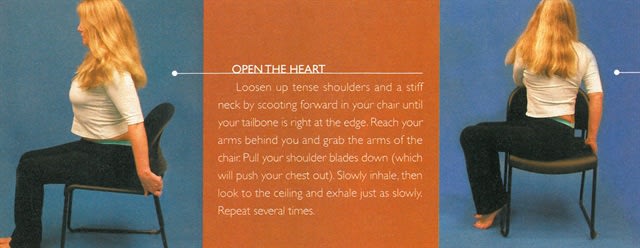
OPEN THE HEART
Ad Loading...
Loosen up tense shoulders and a stiff neck by scooting forward in your chair until your tailbone is right at the edge. Reach your arms behind you and grab the arms of the chair. Pull your shoulder blades down (which will push your chest out). Slowly inhale, then look to the ceiling and exhale just as slowly. Repeat several times.
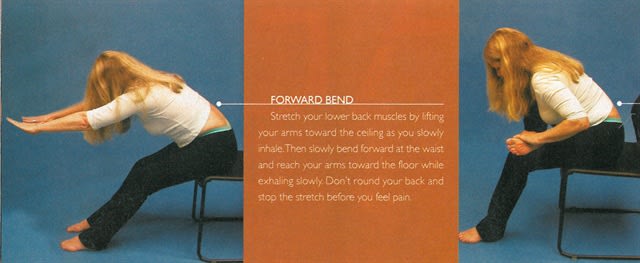
FORWARD BEND
Stretch your lower back muscles by lifting your arms toward the ceiling as you slowly inhale. Then slowly bend forward at the waist and reach your arms toward the floor while exhaling slowly. Don’t round your back and stop the stretch before you feel pain.
SEATED CHAIR TWIST
Stretch your back and neck muscles by sitting with your hips and spine firmly against the back of your chair reach one arm behind you and wrap it firmly around the chair back. Then twist your upper body in the same direction while keeping your hips planted firmly forward. Exhale as you twist then hold the position and take a few slow breaths. Repeat the twist in the opposite direction.
Ad Loading...
ELBOW TWIST
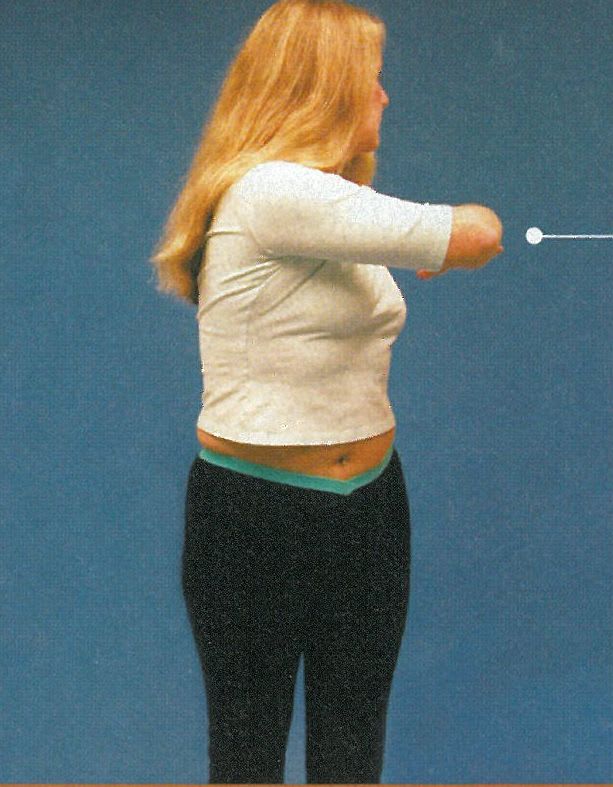
The AYA recommends relieving neck and shoulder tension by standing with feet parallel, a few inches apart. Lift your arms in front of you with elbows bent and place one hand on top of the other. Leading with your elbows, twist slowly to the right then to the left. Keep your arms raised parallel to the floor and your back straight. After a couple of cycles, begin to exhale as you twist to the side and to inhale as you return to the front.
OPEN THE HIPS
Folan recommends loosening up your hips several times throughout the day by sitting up straight, then lifting and bending one leg so that the ankle rests on the opposite knee. Lean forward from the waist until you feel the stretch, then hold for a few seconds and release.
SUN BREATHS
Ad Loading...
Gently stretch your upper body and neck by sitting at the edge of your chair and lifting your arms, palms facing up, perpendicular to your body. Keeping your arms straight, slowly raise them up over your head, inhaling through your nose, until your open palms meet. Slowly tilt your chin up and back and look at your palms. Then lower your arms, palms facing down, as you slowly exhale.
Uncured gel polish and microscopic e-file dust contain active acrylates that penetrate the skin, triggering permanent contact dermatitis. Learn the chemistry behind these irritants and how to protect your clients and yourself.
The Good Patch is a leading wearable wellness patch brand, offering wellness and skincare patches that support everyday needs including energy, sleep, relaxation and more.
Orthopedic PT reveals three daily exercises plus ergonomic advice that can help salon professionals avoid the aches and injuries caused by standing, bending and repetitive overhead work.
From acrylic monomers to airborne bio-dust, the air inside a nail salon carries risks most professionals never see coming. Aerovex Systems reveals the source-capture and room-purification strategies that are setting a new standard for salon safety.
Working in beauty doesn’t have to hurt. Learn how Somatic Movement helps hairstylists, lash artists, and other beauty pros release tension, improve posture, and extend their careers.
As a spa or salon professional, your clients expect more than just beauty—they expect safety, hygiene, and peace of mind. Fungal infections like Athlete’s Foot and Nail Fungus are more common than you think, especially in environments where tools and footbaths are reused without proper sanitation. This blog covers how to stop these issues before they start, using proven infection prevention strategies for salons and spas.
A federal initiative aimed at studying chemical exposure in nail salons has ended due to staffing and budget changes. Here’s what the project set out to do—and what its conclusion means for salon professionals.
For many people, a pedicure is a relaxing beauty ritual. But what most don’t realize is that this simple service, if done without proper hygiene and sanitation, can cause serious infections and long-term health issues.
Onycholysis is the separation of the nail plate from the nail bed. While it may look painful, it typically isn’t—at least not at first. But without proper care, this common nail disorder can lead to infections, deformities, and long-term damage.
Mckenzie Kool, Psychologist, MC, RPsych provides us with guidance on what may or not be helpful in speaking with someone who has suffered a significant loss.
Clients come to you to feel their best—not leave with a viral souvenir. Warts and cold sores can spread fast in busy salons, but a few smart habits make all the difference. Let’s talk about what’s really lurking in your salon (and how to kick it to the curb).
As Earth Day approaches, The Green Beauty Community Foundation and the Green Spa Network invite beauty pros to step forward and embrace sustainability through the Green Pledge--a powerful initiative designed by and for beauty industry leaders.
Don’t cancel Valentine’s Day altogether, urges Jill Palmquist. Instead, think of it as a (frilly, flowery, Champagne-bubbly) wake-up call to fall deeply in love with your own life.
Life coach and Culture Ambassador of Sam Villa, Andrew Carruthers, outlines how to tell if your burnout is temporary - or if it's time to make a bigger career change.