The most important structure of the entire nail unit is the nail matrix, which is where the nail plate is manufactured. A very delicate anatomical structure, the nail matrix is easily injured, damaged, and scarred. Any injury or trauma to tills matrix can show up as a visible change in the nail plate or affect how it grows out.
The nail matrix is comprised of three basic sections, arbitrarily divided into three sections for discussion, but really one complete unit. The proximal section is the third of the matrix that is closest to the joint of the finger (therefore nearest to the center of the body). The second part is between the proximal portion and the distal section, which is farthest away from the joint and the body. We all know the distal part because it is the only visible portion, and it is known as the moon or lunula. It is not necessarily abnormal or indicative of any problem if you can’t see the lunula on all nails.
The proximal area of the matrix manufactures the top one-third of the nail plate; therefore, when there is something wrong there, it shows up on the surface of the nail plate. Common examples of this would be the small pock marks, known as pits, that are seen on the surface of the nail plate of patients with nail psoriasis. This type of psoriasis affects the proximal matrix, and damage in that area is reflected in the portion of the nail plate it manufactures: the top layers. Paronychia, or infection of the skin near the cuticle (known as the proximal nail fold), can also injure the proximal area of the nail matrix; damage from paranychia shows up on the nail plate as Beau’s lines (wavy horizontal lines across the nail).
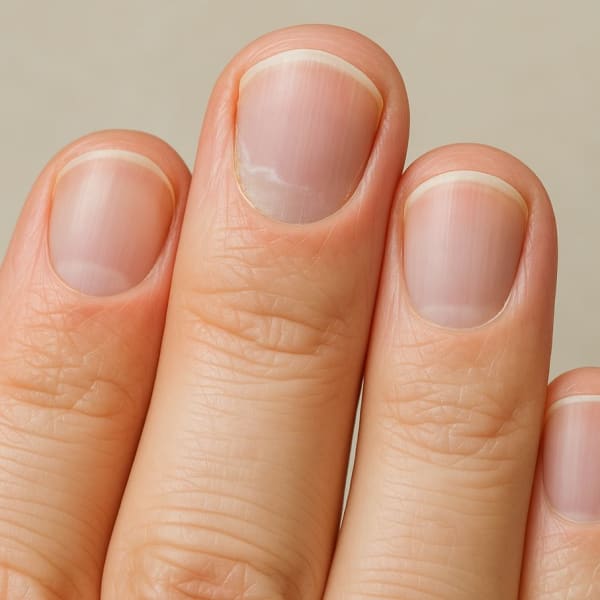
An injury to the middle third of the matrix, which manufactures the middle layers of the nail plate, is visible as white spots, known as leukonychia. The nail plate surface, however, is smooth because the middle matrix does not produce the top of the nail plate. A common cause of leukonychia is over-vigorous pushing hack of the cuticles.
Finally, if the distal portion of the matrix is damaged, it affects the lowest part, or bottom of the nail plate. When this happens, it interferes with the attachment of the nail plate to the skin underneath (the nail bed) and can cause separation of the nail plate from the nail bed (onycholysis). Lichen planus is one disorder that can injure the distal portion of the matrix. Thus if you look carefully at any nail plate changes, you can often determine the exact location of the injury or disease.
Nail damage as a result of matrix damage can be severe. One of my patients pushed back her cuticles so forcefully with a metal instrument that she caused substantial injury to the proximal portion of her nail matrix. This resulted in a permanent scar of the nail matrix, which in turn created a split in the nail plate. The only way to repair this would be to surgically remove the scar. Technically, this is a very difficult procedure; the results must be perfect or else the scar remains. If it does, so would the split nail. It is thus advisable to avoid over-vigorous manipulation of the cuticles. The safest way to treat cuticles without injuring the underlying delicate nail matrix is to soak the fingers in warm water or mild cuticle remover and push the cuticles back gently with a moist towel or an implement wrapped in cotton. Keep in mind that the cuticle protects the proximal nail groove by keeping this space sealed when it is exposed to such things as viruses, fungi, bacteria, and even harsh chemicals, soaps, and detergents. You aren’t supposed to remove the cuticle because it serves a very important function.
A number of other things can affect the nail matrix besides physical injury. Certain medications can cause visible changes. The nail matrix contains pigment cells, which can be over-stimulated by certain medications. When this happens, the nail may become brown or black or show dark lines from the cuticle outwards. Examples of these medications include minocycline, an antibiotic used for acne, and AZT, a drug prescribed to treat AIDS. Fortunately, these side effects happen very infrequently. Gold treatment (sometimes used for patients with severe forms of arthritis) and tetracycline have both caused yellow nails. Cancer drugs may injure the proximal matrix and cause Beau’s lines. Likewise, if the cancer drug damages the middle matrix, white lines from side to side may form.
Although it is not common, some disorders — such as scleroderma or poor circulation — are capable of permanently damaging the nail matrix. When this occurs, a scarred or abnormal nail plate can develop, or the nail can be lost permanently. Finally, a brown or black line in the nail plate that grows from the cuticle outwards can indicate a matrix problem. Although the line may represent a mole or birthmark, it can also in rare cases indicate the beginning of melanoma (cancer of the nail), which is why a client suddenly exhibiting this condition should be referred to a dermatologist.
In summary, we can say that the nail matrix, which is responsible for nail growth, demands our respect. It should be treated gently and should never be abused or mistreated.
Richard K. Scher, M.D., is a dermatologist specializing in nails. He is Professor of Dermatology and head of the Section for Diagnosis and Treatment of Nail Disorders at Columbia University-Presbyterian Medical Center. Dr. Scher is an internationally known expert and pioneer in nail disease treatment and surgery.