The latest studies prove it: The more you sit, the less you’re fit. As a nail tech who sits most of the day, you might have come to see your job as a fitness foe. NAILS looks at the research on sitting and suggests ways you can get out of the chair to stand up for your health.
Maybe you’ve heard the latest health-related buzz-phrase: Sitting is the new smoking. Maybe you’ve dismissed it as hyperbole or the latest in a seemingly continuous inventory of national health scares. But the man credited with the phrase, Dr. James Levine, director of the Mayo Clinic/Arizona State University, is adamant that sitting is killing us. “Sitting is more dangerous than smoking, kills more people than HIV, and is more treacherous than parachuting,” said Levine in a recent Los Angeles Times interview. “We are sitting ourselves to death.”
We all know we shouldn’t smoke, eat too much saturated fat, or drink to excess, but why is something as seemingly innocuous as sitting so gravely dangerous for our health? And what can we possibly do about it — especially when our jobs depend on it?
WHY SITTING ISN’T PRETTY In a number of recent studies, prolonged sitting was found to be the culprit in risks for cancer, heart disease, obesity, Type 2 diabetes, hypertension, muscular problems, depression, and overall mortality rate. And don’t think that logging an hour at the gym or running before or after work will offset the perils of prolonged sitting. A recent Time article reported findings of 43 studies that analyzed activity and cancer rates among people who reported daily prolonged sitting. Regardless of how much they exercised, these individuals had a 24% greater risk of developing colon cancer, a 32% higher risk of endometrial cancer, and a 21% higher risk of lung cancer.
The problem is that our bodies function completely differently when we’re sitting than when we’re standing up and moving around. We don’t burn calories or store fat as efficiently, and our brains even function differently during prolonged sitting. We use a different type of energy when we’re standing as opposed to sitting, and scientists have a name for it: non-exercise activity thermogenesis (NEAT). This energy — the type of energy we use for daily tasks requiring movement like taking stairs, doing laundry, shopping, etc. — is the kind of energy our bodies were designed to expend. According to Time, when we sit most of the day, our bodies only burn about 300 NEAT calories per day as compared to someone like a coffee shop barista who spends most of her shift standing/moving and burns up to 1,300 extra NEAT calories per day.
TAKE A STAND Despite the bad news about sitting all day, the good news is there’s a pretty simple solution: Stand up every hour and move for at least 10 minutes. This may be easier said than done, but awareness is the first step. When you’re booked with back-to-back clients, hours can pass without you even realizing it.
Ad Loading...
“Once I realized how long I was sitting without standing up and moving around, I rearranged my whole system,” says Debbie Escamilla of Hand to Toe Nail Services in Merced, Calif. “Now I make sure that I don’t have everything within my reach that is necessary. For instance, my towel cabbie is across the room from where I do pedicures, so I need to get up at least twice during a 45-minute pedicure.”
It’s also important to schedule enough time to take breaks between clients, and ideally a longer break in the middle of the day. It can be difficult to do this when you have clients who are insistent about getting in on a particular day or time, but in the end, it’s an investment in your health and your career. Marsee Essington of Nails by Marsee in Mount Pleasant, Pa., is aware of this and now makes sure to take a half-hour break to walk around the block. “I have a headset and tennis shoes, and it takes me 15 minutes,” Essington says. “I always feel so much better after I do it. It gives me energy for the rest of the day.”
“I don’t think most of us realized when we started doing nails how it really takes a toll on our bodies,” says Kathy Dent of Salon Glow in Reno, Nev. “It’s really hard to stay fit when we sit all day, usually in a very unhealthy position. The most important thing I do is schedule enough time for each appointment so that I have enough time between clients to get up and walk around a bit. I could probably squeeze in an extra client each day, but it’s more important to take what steps we need to enable us to keep doing this job that we love.”
THERE’S AN APP FOR THAT “A number of my clients have sit-down jobs and are concerned about being sedentary during the day,” says Huntington Beach, Calif.-based personal trainer and fitness consultant Laura Klees. “Besides the usual advice to park farther away from work, take the stairs, and walk during lunch breaks, I suggest that clients set themselves reminders to take frequent breaks for standing and stretching. There are a number of apps available now made just for that purpose.”
Apps and website helpers such as Stand Up, Break Tracker, EVO, and Big Stretch can be utilized on your phone or your computer monitor. You can customize when and how often the reminder messages will appear. Some of the simpler apps, such as Stand Up, are primarily alarms/reminders, while others, like EVO, include more features such as various themes and modes for your screen and an eyes gymnastics exercise.
“The important thing is to break up the long stretches of sitting by setting the reminder app to alert you every 50 minutes or so,” says Klees. “Then you need to stand up — and preferably stretch or walk — for 5-10 minutes. Other fitness apps can help as well. My Fitness Pal is a great app because it helps you set weight loss and exercise goals, has an extensive food library for logging your diet, and can link to fitness devices like Fitbit and BodyMedia.”
Put in perspective, you have incredible power to take control of your health. “When something as simple as standing up every hour can preserve your health and maybe even save your life,” Klees says, “you simply do it.”
CHAIR SCARE
Ad Loading...
If you sit all day at your job, you have double the chance of cardiovascular disease than you would if you stood. Other adverse effects of sitting are immediate and worsen over the course of 24 hours.
Over a lifetime:
In a study conducted by The American Cancer Society, it was found that men who spent six hours or more per day sitting had a death rate 20% higher than those men who sat for three hours or less per day. For women, the death rate for those who sat more than six hours per day was approximately 40% higher than that of women who sat three hours or less.
Within just one day:
Your risk of Type 2 diabetes rises, as insulin effectiveness drops 24%. Your risk for obesity rises as well; the enzymes responsible for breaking down lipids and triglycerides drops by 90%, which causes the levels of good (HDL) cholesterol to fall by 20%.
Ad Loading...
Here’s what happens as soon as you sit down:
Electrical activity in the muscles shuts off. Metabolism drops to only one calorie burned per minute, about 1/3 of what it would be if you were standing and moving around.
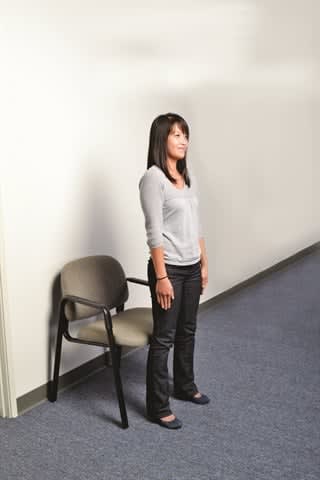
Get Moving! “Standing exercises help break up long periods of sitting and get your blood flowing,” says Klees. She suggests the three following exercises to work your upper body, lower body, and core. Perform 10 repetitions of each exercise, and repeat 2-3 times:
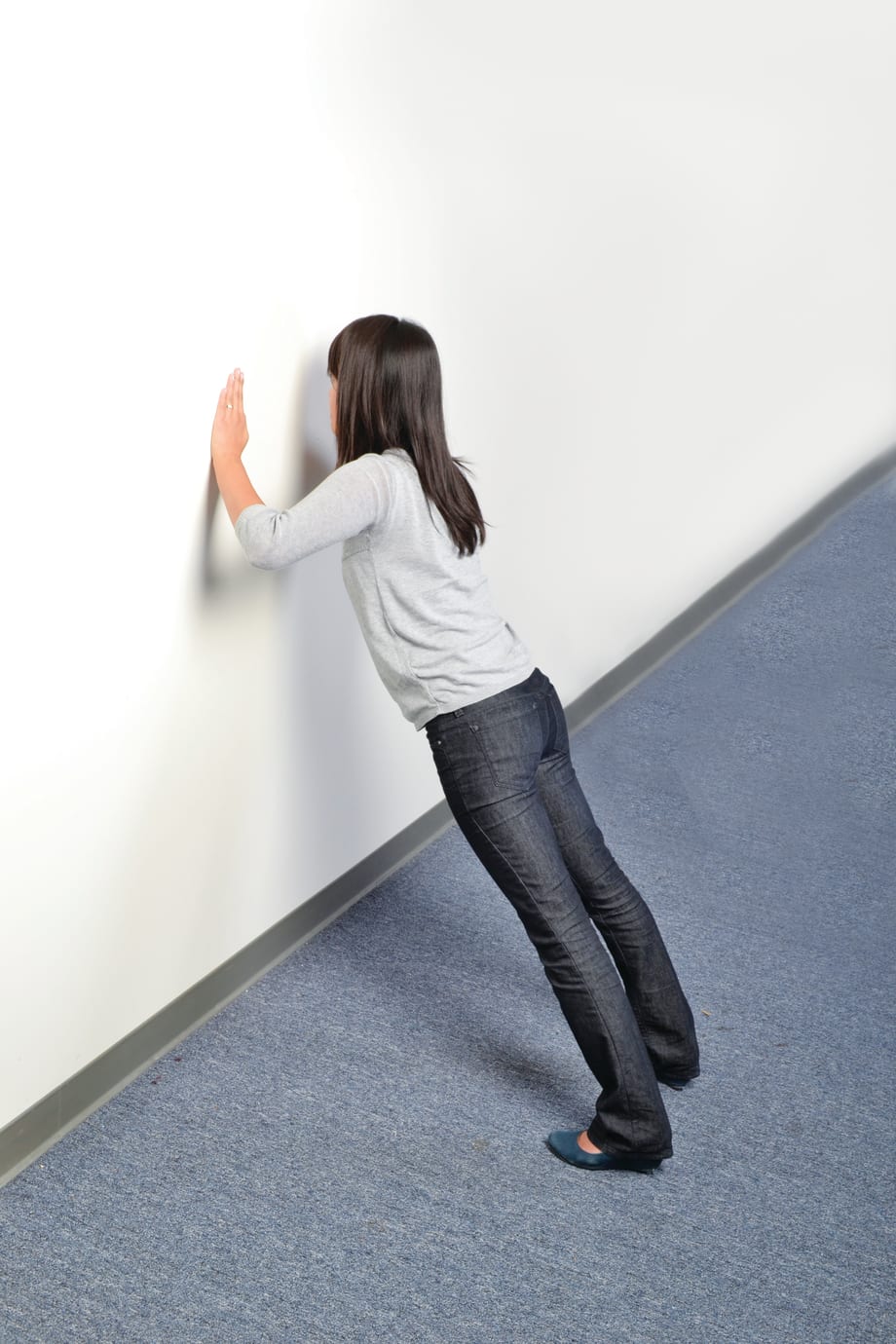
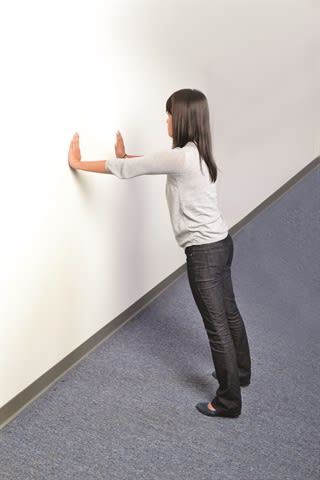
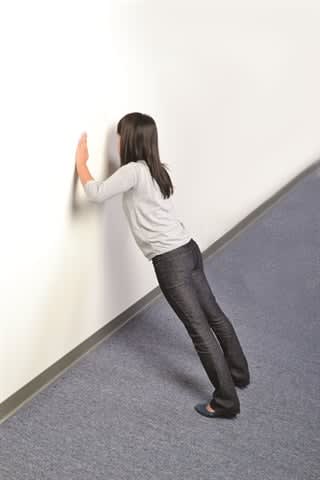
1. Standing pushups: Place your hands flat against a wall just below chest level. Take a step back, and put your feet hip-distance apart. Keeping your abdominals pulled in, slowly bend your elbows toward the wall, then return to the starting position. As you become stronger, you can step farther away from the wall to make the exercise more challenging.
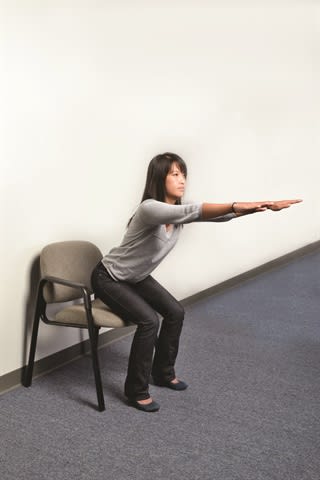
2. Chair squats: Place your chair against a wall. Stand in front of the chair with your feet hip-distance apart. Keeping your back straight and your chin up, lower yourself toward the chair (concentrate on your bottom/glutes moving back toward the wall rather than the knees coming forward). Stop just before sitting down, and raise back to standing.
Ad Loading...
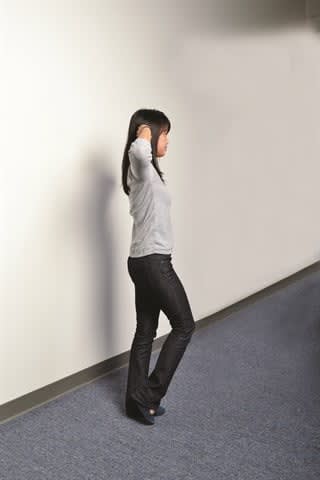
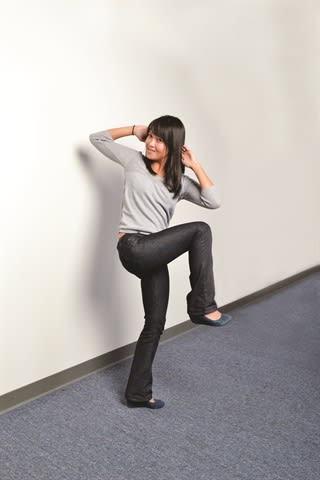
3. Standing bicycle: Stand with your feet hip-distance apart, and place both hands behind your head. While looking forward, raise one knee toward the opposite shoulder while lowering that elbow toward the knee. Repeat on the opposite side.
For Further Reading:
Get Up! Why Your Chair Is Killing You & What You Can Do About It by James A. Levine, M.D., Ph.D.
Uncured gel polish and microscopic e-file dust contain active acrylates that penetrate the skin, triggering permanent contact dermatitis. Learn the chemistry behind these irritants and how to protect your clients and yourself.
The Good Patch is a leading wearable wellness patch brand, offering wellness and skincare patches that support everyday needs including energy, sleep, relaxation and more.
Orthopedic PT reveals three daily exercises plus ergonomic advice that can help salon professionals avoid the aches and injuries caused by standing, bending and repetitive overhead work.
From acrylic monomers to airborne bio-dust, the air inside a nail salon carries risks most professionals never see coming. Aerovex Systems reveals the source-capture and room-purification strategies that are setting a new standard for salon safety.
Working in beauty doesn’t have to hurt. Learn how Somatic Movement helps hairstylists, lash artists, and other beauty pros release tension, improve posture, and extend their careers.
As a spa or salon professional, your clients expect more than just beauty—they expect safety, hygiene, and peace of mind. Fungal infections like Athlete’s Foot and Nail Fungus are more common than you think, especially in environments where tools and footbaths are reused without proper sanitation. This blog covers how to stop these issues before they start, using proven infection prevention strategies for salons and spas.
A federal initiative aimed at studying chemical exposure in nail salons has ended due to staffing and budget changes. Here’s what the project set out to do—and what its conclusion means for salon professionals.
For many people, a pedicure is a relaxing beauty ritual. But what most don’t realize is that this simple service, if done without proper hygiene and sanitation, can cause serious infections and long-term health issues.
Onycholysis is the separation of the nail plate from the nail bed. While it may look painful, it typically isn’t—at least not at first. But without proper care, this common nail disorder can lead to infections, deformities, and long-term damage.
Mckenzie Kool, Psychologist, MC, RPsych provides us with guidance on what may or not be helpful in speaking with someone who has suffered a significant loss.
Clients come to you to feel their best—not leave with a viral souvenir. Warts and cold sores can spread fast in busy salons, but a few smart habits make all the difference. Let’s talk about what’s really lurking in your salon (and how to kick it to the curb).
As Earth Day approaches, The Green Beauty Community Foundation and the Green Spa Network invite beauty pros to step forward and embrace sustainability through the Green Pledge--a powerful initiative designed by and for beauty industry leaders.
Don’t cancel Valentine’s Day altogether, urges Jill Palmquist. Instead, think of it as a (frilly, flowery, Champagne-bubbly) wake-up call to fall deeply in love with your own life.
Life coach and Culture Ambassador of Sam Villa, Andrew Carruthers, outlines how to tell if your burnout is temporary - or if it's time to make a bigger career change.